


Of the many dramatic 3,000m-plus mountains in Taiwan's central mountain range, the gargantuan Tapachien Mountain (
Tapachien Mountain is located in the traditional territory of the Atayal Aboriginal tribe, whose roots can be traced to the first Aboriginal migration from China to Taiwan about 12,000 years ago.
Atayal culture and civilizaton have been severely affected by encroaching modernization, but the tribe of proud, clan-based hunter-gatherers have, nonetheless, continued to inhabit a large area of mountainous central and northern Taiwan and maintained an identity distinct from the far more numerous plains-dwelling Han and Hakka people. In the mountains, those calling themselves Atayal number about 90,000.
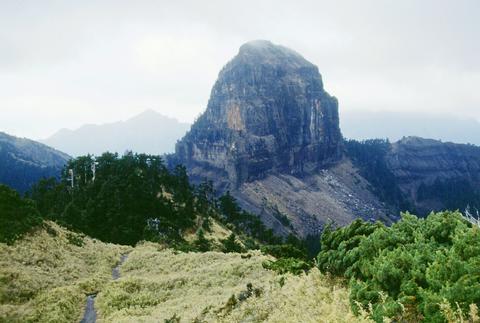
PHOTO: GARY HEATH
Historians are unanimous in tracing the Atayal to southern China, and possibly the Malayan peninsula before that, though no trace of this journey remains in Atayal oral history. However, Atayal oral history and mythology are closely tied to the tribe's land of settlement, and attach particular symbolic significance to several high peaks of the central mountain range, one of the most important of those being Tapachien Mountain.
According to Atayal legend, the place of origin of the tribe is a spot known as Pinsbkan in Nantou County (the word Pinsbkan refers both to the place of creation, and creation itself). Various versions of the cosmogonic myth surrounding Pinsbkan can be found in books and among the Atayal -- not all of whom subscribe to the same set of myths -- but the basic story is that one day a thrush and crow, birds that commonly act as assistants or enablers in ancient mythology, competed to lift a stone to see which of the two was stronger. The thrush lifted the stone highest, then dropped the stone from which the first human couple appeared. There are different versions as to what happened next, but essentially these first male and female humans come together and procreate, forming the Atayal nation.
Tapachien Mountain, known as Papak-Wagu to the Atayal, is an alternative, or additional, site for the above myth. The shape and appearance of the mountain give the impression of being a rock split in two and it is widely believed among the Atayal that the first people originated from such a rock.
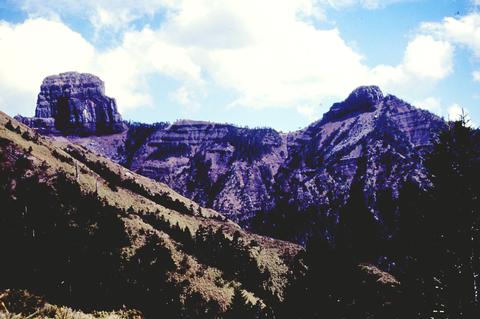
PHOTO COURTESY OF TAIWAN TOURIST BUREAU
The other site connected with the Atayal creation myth is a place known as Bunobon in Taichung County. Pinsbkan, Papak-Wagu and Bunobon are all tall mountains loosely grouped together in a small area and are all connected by ridges, forming a kind of mountain holy trinity in Atayal mythology.
High mountains being a place of creation does have a rationale, as mountains have long been considered to be special places close to heaven where gods reside and dead spirits travel -- Mount Olympus in Greek mythology is an obvious example. For people to have originated from the high mountains may fly in the face of scientific facts as currently known, but must have seemed logical to people who live off the mountains, and used them as a means of communication; they obviously understand them as "good" places.
Tapachien Mountain also plays an important role in Atayal oral history, in which the mountain is featured as a kind of strategic high point from which the tribe spread across the seven counties of northern Taiwan. This part of Atayal history is told in the tale of chief Ikmbuta, a wise and strong leader who one day realized that his people were too numerous and that the tribal lands no longer could support the growing Atayal population. Together with two brave men -- Ikmayan and Ikmyabox -- Ikmbuta left Pinsbkan and headed to Papak-Wagu, or Tapachien Mountain, and from this high point surveyed the world before him. Looking down at the big and little rivers, Ikmbuta was able to chart a mental map of the world he saw and promptly set off with his two companions to find new land to populate, and to mark the expanded Atayal territorial boundary.
Over the years, the Atayal people came to revere Tapachien Mountain in line with its important role in the tribe's cosmogonic myth. The mountain is further considered sacred, being a place where dead souls travel to paradise. If a man had been a brave and successful headhunter, or a woman had been a skilled weaver, for example, then they could complete the journey to paradise via Tapachien Mountain. Finally, Tapachien Mountain is generally respected by the Atayal as the origin of water, and therefore of all nature and life.
A team of Japanese climbers in 1927 were the first to scale the highest peak of Tapachien Mountain. The team reached the top only by temporarily evading their Atayal guides, for whom climbing to the peak was a strict taboo, and making a dash for the summit.
In 1969, metal railings were added to Tapachien's limestone summit, making the climb to the top a popular tourist activity. The railing was taken down, however, after several people died scaling the steep rock face. Today, it is possible to approach the base of Tapachien Mountain, and walk across to Hsiaopachien, the mountain's satellite peak, but making it to the top of the big rock is not a practical proposition -- a case of nature reclaiming a sacred site for an ethnic minority.
And what a rock Tapachien Mountain is. It is a truly majestic jewel of stone in the middle of steep valleys and forested mountains. Although the mountain is the subject of many pictures and postcards, nothing quite prepares you for its arresting and magnetic presence. Reaching the mountain takes a couple of days and includes a grueling hike, but the amazing scenery makes this trek, or pilgrimage, more than worthwhile.
Seen in the early morning, the angular, terraced summit of the 3,492m-tall Tapachien Mountain in black silhouette is a mysterious sight. The more regularly eroded Hsiaopachien Mountain (
It is perhaps not surprising that in the process of constructing myths about their origins and after life, the Atayal turned to the mountains that stand at the center of their world and dominate the topography all around. Even today, it is impossible to go to Tapachien Mountain and be left unaffected by the mystery and grandeur of this majestic peak.

Paul Thomas Anderson’s “One Battle After Another” was crowned best picture at the 98th Academy Awards, handing Hollywood’s top honor to a comic, multi-generational American saga of political resistance. The ceremony Sunday, which also saw Michael B. Jordan win best actor and “Sinners” cinematographer Autumn Durald Arkapaw make Oscar history as the first female director of photography to win the award, was a long-in-coming coronation for Anderson, a San Fernando Valley native who made his first short at age 18 and has been one of America’s most lionized filmmakers for decades. Before Sunday, Anderson had never won an Oscar. But “One Battle

In Kaohsiung’s Indigenous People’s Park (原住民主題公園), the dance group Push Hands is training. All its members are from Taiwan’s indigenous community, but their vibe is closer to that of a modern, urban hip-hop posse. MIXING CULTURES “The name Push Hands comes from the idea of pushing away tradition to expand our culture,” says Ljakuon (洪濬嚴), the 44-year-old founder and main teacher of the dance group. This is what makes Push Hands unique: while retaining their Aboriginal roots, and even reconnecting with them, they are adamant about doing something modern. Ljakuon started the group 20 years ago, initially with the sole intention of doing hip-hop dancing.

You would never believe Yancheng District (鹽埕) used to be a salt field. Today, it is a bustling, artsy, Kowloon-ish “old town” of Kaohsiung — full of neon lights, small shops, scooters and street food. Two hundred years ago, before Japanese occupiers developed a shipping powerhouse around it, Yancheng was a flat triangle where seawater was captured and dried to collect salt. This is what local art galleries are revealing during the first edition of the Yancheng Arts Festival. Shen Yu-rung (沈裕融), the main curator, says: “We chose the connection with salt as a theme. The ocean is still very near, just a

A key feature of Taiwan’s environmental impact assessments (EIA) is that they seldom stop projects, especially once the project has passed its second stage EIA review (the original Suhua Highway proposal, killed after passing the second stage review, seems to be the lone exception). Mingjian Township (名間鄉) in Nantou County has been the site of rising public anger over the proposed construction of a waste incinerator in an important agricultural area. The township is a key producer of tea (over 40 percent of the island’s production), ginger and turmeric. The incinerator project is currently in its second stage EIA. The incinerator


 RSS
RSS