


Lin Tung-fang Beef Noodle (林東芳牛肉麵)
274, Pa-te Road, Sec. 2 (八德路二段274號), tel: 2752-2556.
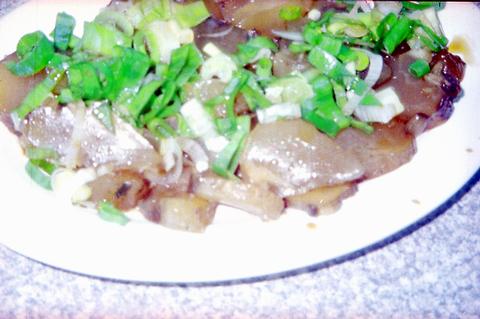
PHOTO: YU SEN-LUN
Open 11am to 3am. Average meal: NT$150, no English menu, credit cards not accepted.
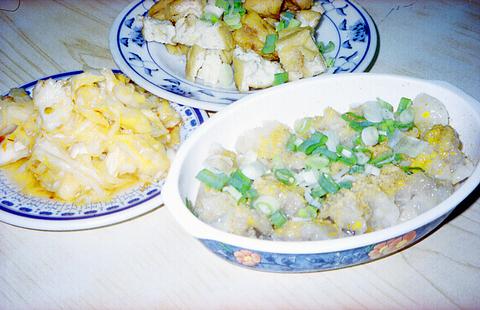
PHOTO: YU SEN-LUN
Walking into this small store, you have to cross an unfinished gutter and muscle your way through a narrow row of customers gulping down noodles to sit on a stool about the size of the typical playing card. Beside you may be a huge barrel of beef soup which the store's staff occasionally comes to ladle into another big bucket. But you will dismiss these minor discomforts, because seeing so many people cram into this street-side store even at 3am informs you that the food here is exceptionally good.
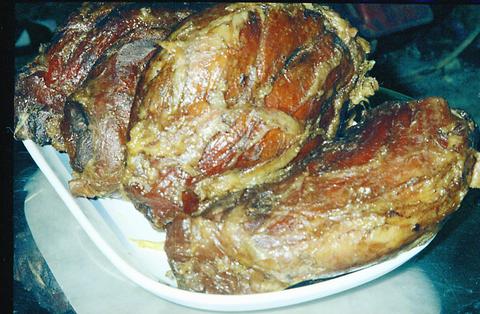
PHOTO: YU SEN-LUN
It's a beef specialty store, so ordering beef noodle soup is an obvious choice. Unlike many beef noodle stores that use beef breast or sirloin in their beef noodles, Lin Ting-fang uses beef parts full of tendon. A main difference in this cut of beef is it contains a lot of gelatin and adds tenderness to the meat.
"Some beef breast meat has a harder taste texture, but tendon meat is never like that. It's always soft," said owner Lin Tung-fang (林東芳), who is the second-generation owner of this 30-year-old store. Lin added that because their beef is first stewed and then sliced, " the sweet taste of the meat is finely preserved."
Adding chili is a must for beef noodles and at Lin Tung-fang, the chili oil is another phenomena. On each table is a tin cup that contains a dark red substance. According to Lin, it is the store's original chili oil derived from beef oil extracted from the beef stew and then stir fried with chili oil and red pepper.
Other recommendations of the store include side dishes like beef stomach, beef gelatin and beef intestine.
A-san Shan-tou Beef Noodle (阿三汕頭牛肉麵)
286, Pa-te Road, Sec. 2, (八德路二段286號), tel: 8772-2935.
Open 11am to 3am. Average meal: NT$150, no English menu, credit cards not accepted.
This is probably the most spacious noodle shop on Pa-te road. It's relatively new, having opened about six months ago, but its flavors are never amateur.
Lin Wen-tu (林文土), owner of the store, confided that his shop is an offshoot of neighboring Lin Tung-fang Beef Noodle. "We were originally the big family of beef noodles. After my grandmother, the original inventor of our beef noodles, passed away last year, some things happened and my uncle decided to have his own store," Lin's nephew explained.
So on this small strip of Pa-te Road a family feud is being played out over the rightful claimant of Lin family beef noodle orthodoxy. According to Lin Wen-tu, his beef soup originates from the grandmother's recipe, whereas Lin Ting-fang's beef soup is a variation. "Old customers who prefer the original taste come to our store," said Lin Wen-tu.
The meat, gelatin and beef stomach taste nearly the same as at Lin Tung-fang, but Lin Wen-tu especially recommends his beef gelatin, which is stewed for five hours and then cooled and refrigerated. This process ensures the gelatin's crispness while retaining its flavor. Another recommended side dish is Hua-kan (花干), a fried bean curd stewed in beef soup.
It is not easy to compare the two Lin family stores. But A-san, the less crowded of the two, has one disconnected attraction. Celebrities including DPP Chairman Frank Hsieh (謝長廷), Wubai (伍佰) and Tsui Hark (徐克) have all signed their names on the wall of the store.
Wang's Noodle House (王家麵館)
273, Pa-te Road, Sec. 2, (八德路二段273號), tel: 2731-9148.
Open 10am to 3am (closed every other Sunday). Average meal: NT$120, no English menu, credit cards not accepted.
For those less into meat but very much into the texture of noodles, Wang's Noodle House will serve your need. This shop has established a name for itself with the distinct taste of its noodles.
Ta-lu noodle (大滷麵) is a must when you visit Wang's. It's a bowl of abundant ingredients: stewed pork slices, carrot slices, mushrooms, day lily, bamboo shoots and egg shreds. With so many elements and thickened with starch, the soup is as rich as gravy. It's hard to believe a bowl only costs NT$70. Despite the price and the soup, the true magic of the house lies in its northern Chinese rich, thick handmade noodles.
Owner Wang Mu-jen hails originally from outlying Matsu Island (馬祖). Thirty years ago a veteran from China taught Wang and his wife how to make hand-pulled noodles. They then opened a small noodle stall to serve the soldiers on the island. Ten years later the Wangs brought their shop to Taiwan proper.
Apart from their famed ta-lu noodles, the Wang's restaurant is also known for its cha-chian noodles (炸醬麵) and red chili dumplings (紅油抄手). Cha-chian noodles are dry with a rich, homemade pork sauce. Red chili dumplings are seasoned with chili oil, peanut powder, chopped green onion, and a bit of sugar. For a vegetable dish, try the cabbage pickled in a mixture of vinegar, sugar, rice wine and chili. It helps wash down the slight greasiness of a big bowl of noodles.

The Portuguese never established a presence on Taiwan, but they must have traded with the indigenous people because later traders reported that the locals referred to parts of deer using Portuguese words. What goods might the Portuguese have offered their indigenous trade partners? Among them must have been slaves, for the Portuguese dealt slaves across Asia. Though we often speak of “Portuguese” ships, imagining them as picturesque vessels manned by pointy-bearded Iberians, in Asia Portuguese shipping between local destinations was crewed by Asian seamen, with a handful of white or Eurasian officers. “Even the great carracks of 1,000-2,000 tons which plied
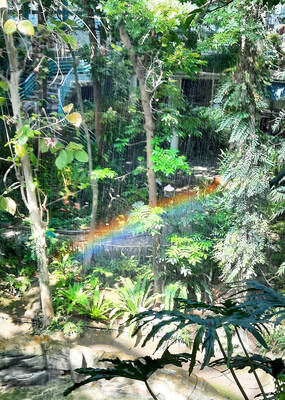
It’s only half the size of its more famous counterpart in Taipei, but the Botanical Garden of the National Museum of Nature Science (NMNS, 國立自然科學博物館植物園) is surely one of urban Taiwan’s most inviting green spaces. Covering 4.5 hectares immediately northeast of the government-run museum in Taichung’s North District (北區), the garden features more than 700 plant species, many of which are labeled in Chinese but not in English. Since its establishment in 1999, the site’s managers have done their best to replicate a number of native ecosystems, dividing the site into eight areas. The name of the Coral Atoll Zone might

On Monday morning, in quick succession, the Chinese Communist Party (CCP) and the Chinese Nationalist Party (KMT) released statements announcing “that the Central Committee of the Communist Party of China and General Secretary Xi Jinping (習近平) have invited KMT Chairwoman Cheng Li-wun (鄭麗文) to lead a delegation on a visit to the mainland” as the KMT’s press release worded it. The KMT’s press release added “Chairwoman Cheng expressed her gratitude for the invitation and has gladly accepted it.” Beijing’s official Xinhua news release described Song Tao (宋濤), head of the Taiwan Work Office of the CCP Central Committee, as
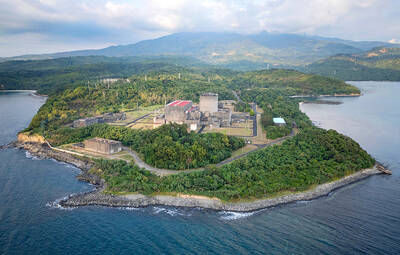
Nuclear power is getting a second look in Southeast Asia as countries prepare to meet surging energy demand as they vie for artificial intelligence-focused data centers. Several Southeast Asian nations are reviving mothballed nuclear plans and setting ambitious targets and nearly half of the region could, if they pursue those goals, have nuclear energy in the 2030s. Even countries without current plans have signaled their interest. Southeast Asia has never produced a single watt of nuclear energy, despite long-held atomic ambitions. But that may soon change as pressure mounts to reduce emissions that contribute to climate change, while meeting growing power needs. The


 RSS
RSS