


The publication this month of Treason by the Book by the Yale scholar and author Jonathan Spence brings into the limelight Taipei's extensive collection of Qing dynasty archives from imperial China. Spence consulted the collection when he was in Taipei in January 1999, and many of its items now form crucial links in the extraordinary story he has to tell.
The book gives a detailed account of an investigation by the Chinese civil service nearly 300 years ago into a perceived uprising against the recently established northern Manchu emperors. But in reality there was no rebellion. What set alarms in the capital ringing was the misguided work of a 49-year old eccentric, Zeng Jing (
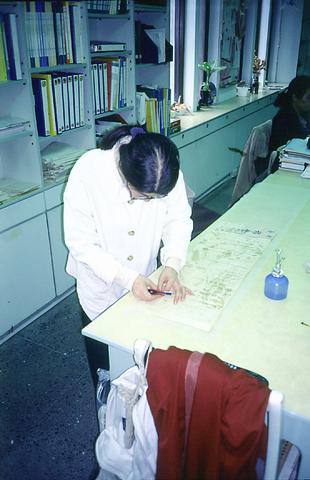
PHOTO: BRADLEY WINTERTON
This solitary act of half-crazed rebellion, which got no further than the writing of a treasonous letter, led to a nation-wide investigation, and a campaign of self-justification emanating from the hand of the emperor himself, and reaching in printed form every known scholar in the whole of China.
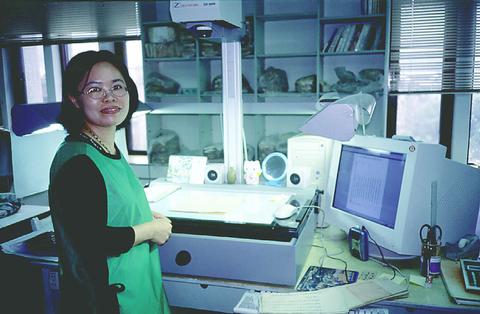
PHOTO: BRADLEY WINTERTON
There are around 700,000 documents from the Qing archives in Taipei, 300,000 at the Academia Sinica's Institute of History and Philology and 400,000 at the National Palace Museum.
The Academia Sinica's holdings were shipped to Taiwan in 1949 in 100 crates, after which they remained in storage until work began in earnest on sorting, cataloguing and publishing them in the 1980s.
The original hoard, a priceless collection for scholars, and of inestimable value by any standards for the history of China, was purchased by a scholar named Lo Cheng-yu in 1929 from a paper mill in China, where the documents were destined to be pulped.
Today, anyone can access much of the Academia Sinica's unique collection on its Web site. The transition from near-destruction to universal ordering and instant accessibility in 70 years is almost beyond belief.
"The documents are first of all treated, then mounted, and finally scanned into the computer records," said Professor Liu Cheng-yun (劉錚雲), Research Fellow at the Institute. "We now have over a million computer pages." Spence thanks Liu in his book for undertaking a computer scan of the archives that came up with many documents relating to 18th century China's extraordinarily efficient distribution system for civil service documents.
"Spence was originally invited to Taipei to mark the 10th anniversary of the fund-granting Chiang Ching-kuo Foundation," said Professor Chen Jo-shui (陳弱水), the Institute's vice-director. "He gave a lecture here on his work on Zeng Jing, and only then discovered that there was additional material in Taipei relating to the case.
"He's one of the few scholars in the US to specialize in early Qing," Chen added. "He's an exceptional type of man. For instance, in the 1980s he rented a small apartment in downtown New Haven, with no telephone, so he could work undisturbed. I would say that, as a Westerner contributing to Chinese scholarship, he is a modern equivalent to Arthur Waley [1889 - 1966]. He has been able to use his training and ability to shed light on many aspects of Chinese history. He asks good questions, and good questions invite good answers."
The material at the National Palace Museum's Department of Rare Books and Historical Documents includes the important "palace memorials," secret reports sent by senior officials for the emperor's eyes only, together with copies of these that were first systematically made under the emperor Yongzheng (雍正) who is at the center of Spence's book. There are also a considerable number of books dating back to the Song dynasty.
Publication of the documents is ongoing, and compilations on specific themes have already appeared, said the Department's Librarian, Sung Chao-ling. The materials are all catalogued, and are accessible to the public, and the scholarly community in particular.
Spence's wonderful book, written by a man the publishers call "the leading historian of China writing in English," is a work of scholarly investigation about another investigation. It tells how, in 1728, the foolhardy Zeng persuaded a former pupil to hand a letter cataloguing the shortcomings of the Manchus to governor-general Yue Zhongqi of Sichuan and Shaanxi Provinces in Xi'an. This reckless action was immediately reported to Beijing, and quickly led to a witch-hunt that covered every nook and cranny of China.
Zeng had written to General Yue that if only he joined the cause, hosts would surely rise on all sides and rally to the call. What he meant was that heaven would inevitably support such a just crusade. What the authorities thought he meant was that thousands were already recruited, trained in military skills, and were only waiting for an illustrious name to lead them to rise up and overthrow the Manchu dynasty.
Many things are extraordinary about the story. The enormous efficiency with which letters were delivered to and from the imperial court across large distances (1,400km in five days, for instance) is one. The detailed attention which emperor Yongzheng gave to every important letter is another, writing his comments on them in vermilion ink between the black columns of text, and then writing questions and instructions at the end, often squeezing his "difficult running script" (as Spence describes it) into the limited space available.
Fascinating, too, is the habit of senior officials to have other officials present at important meetings -- sometimes visible and other times hidden behind a partition -- to avoid any suspicion of collusion in conspiracy.
But most extraordinary of all is the emperor Yongzheng's reaction to the supposed conspiracy itself.
His first inclination, he writes, was to laugh out loud at its absurdity. But then, when Zeng's actual letter is sent to him (General Yue had been too afraid to include it, with its accusations of imperial drunkenness and sexual abandon, first time round) the emperor unleashes a torrent of self-defense of himself and his dynasty that eventually totals 83 pages.
Nor is this all. Yongzheng is determined to present an image of himself as steeped in the Chinese classics, enlightened and benign, despite his Manchu background. He conducts a long, secret correspondence with Zeng, by now a prisoner in Beijing, during which he unveils many details of how China is governed so as to convince Zeng -- a retired school teacher -- of his conscientiousness, industry and compassion.
Then, despite a document submitted to him signed by the 148 most senior government officials in Beijing calling for Zeng to be immediately put to death by the unspeakably horrific method of slicing, the emperor proceeds instead to give him gifts of money and clothing, and finally orders his immediate release.
He then has all his thoughts on the affair printed together with long extracts from Zeng's outrageously insulting original letter, plus his subsequent retractions, and orders the resulting 509-page book distributed to officials throughout the empire. Instructions are appended to print further copies locally, and for these to be sent to every school and private scholar in the land.
This is the famous Awakening from Delusion, a book that emperor Yongzheng's successor, Qianlong (乾隆), banned, ordering all the huge number of copies by then in existence to be destroyed.
Spence's marvelous book inevitably puts the reader into an investigative state of mind, and implicitly invites him to pursue his own private line of inquiry. A close perusal of its notes, sources and bibliography reveals that Spence's interest in the case was first aroused by a PhD thesis at Princeton University by one Thomas S. Fisher, completed in 1974. This material has subsequently been expanded by Spence through a close study of the very substantial surviving documentation that the case gave rise to.
Spence is a master of digesting complex scholarly material and then regurgitating it as a compulsively readable popular narrative. This act of imaginative, but meticulously fact-based, re-creation puts Treason by the Book on a par with other best-selling works that have brought off similar feats of historical reconstruction such as Maurice Collis's Foreign Mud, Emmanuel Le Roy Ladurie's Montaillou and Dava Sobel's Longitude.
Spence's decision to use the present tense throughout, never an easy option to sustain, pays off. Eighteenth century China springs to life, and though some of the by-ways explored in the third quarter of the book are perhaps presented in too much detail, throughout most of the narrative the momentum never flags. Locations shift back and forth as in a movie, character sketches are made using minute shreds of evidence, and the final conclusion is as much of a shock as in the most suspense-filled novel.
Many of the letters that form the basis of the narrative are given in full, translated into modern, almost colloquial, language. But Spence, who clearly has the best instincts of the popularizer, cuts the longest of them short just at the moment when tedium might have threatened.
Spence thanks many people, but they are almost all librarians, curators and fellow scholars, with a poet and an archaeologist thrown in for good measure.
Taipei is an important source for much of Spence's material, as he makes clear when he thanks the Academia Sinica, "home of so many major scholars," and the National Palace Museum where he was given the "unforgettable opportunity" of holding and reading Zeng's handwritten letter to the emperor thanking him for his gift of 1,000 taels of silver.
Additional information on Academica Sinica's archive can be accessed at http://saturn.ihp.sinica.edu.tw/~mct/newpage1.htm. 'Treason by the Book' is published by Allen Lane, Penguin Press, 289 pages.

Taiwan’s English education system is being pulled apart by three opposing forces. Bilingual Nation 2030 pulls students toward English and global communication. Artificial Intelligence (AI) readiness pulls them toward digital judgment, verification and AI-mediated work. But Taiwan’s old exam culture pulls them back toward memorization, grammar drills, timed reading and correct answers. If the education system keeps using old exams to define success, it risks producing graduates who are neither genuinely bilingual nor genuinely AI-ready, but trained for tasks machines can already perform. The first force is Bilingual Nation 2030. Launched in 2018, the policy aimed to “help Taiwan’s workforce connect

“Taiwan’s Opposition Leader Comes to US With a Message Straight Out of Beijing” read a May 31 headline in the Wall Street Journal. Top US administration officials and members of Congress almost certainly read the WSJ, and if there was a bullet point takeaway that people in Washington should absorb ahead of Chinese Nationalist Party (KMT) Chair Cheng Li-wun’s (鄭麗文) arrival in DC on June 9, that headline is it. The last few columns have discussed this very topic, and the timing is not coincidental. While those top officials likely do not read the Taipei Times, judging by the number

With weighty, anxiety-inducing geopolitical topics dominating the headlines, checking in on the wild and weird state of local politics can take some of the edge off. This November’s elections will determine who will be in charge of fixing potholes in your neighborhood, not the potholes in Taiwan’s complicated geopolitical space. Recently, after an online interview with a Taipei-based journalist, I commented that Taipei journalists never go further than the MRT can take them. He laughed and agreed. Naturally, the Taipei mayoral race is eating up much of the press attention. TAIPEI CITY Democratic Progressive Party (DPP) candidate Puma Shen (沈伯洋) has
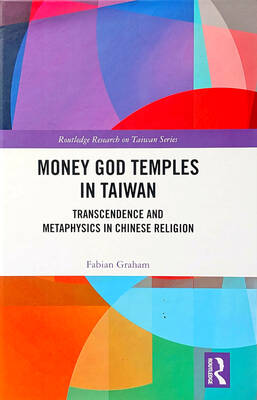
As someone who normally steers clear of books with “transcendence” or “metaphysics” in their subtitles, this reviewer — a casual observer of local belief systems since the 1990s — found Fabian Graham’s Money God Temples in Taiwan a challenging read. Those who’ve only dipped their toes into temple culture will likely need to parse several sections with special care if they’re to keep up with the author, a British ethnographic researcher whose previous books have investigated religious practices among ethnic Chinese in Southeast Asia. This scholarly volume examines a facet of Taiwan’s religious landscape that didn’t exist a century ago, and


 RSS
RSS