


The WHO years ago cautioned that a mysterious “disease X” could spark an international contagion. The new coronavirus, with its ability to quickly morph from mild to deadly, is emerging as a contender.
From recent reports about the stealthy ways the COVID-19 virus spreads and maims, a picture is emerging of an enigmatic pathogen whose effects are mainly mild, but which occasionally — and unpredictably — turns deadly in the second week.
In less than three months, it has infected about 77,000 people, mostly in China, and killed more than 2,200.
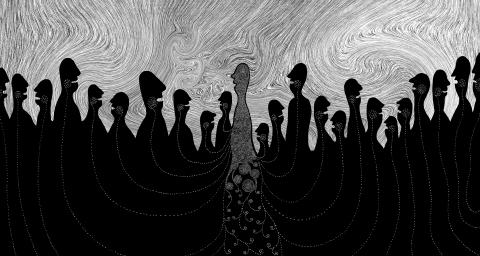
Illustration: Mountain People
“Whether it will be contained or not, this outbreak is rapidly becoming the first true pandemic challenge that fits the disease X category,” Marion Koopmans, head of viroscience at Erasmus University Medical Center in Rotterdam, and a member of the WHO’s emergency committee, wrote on Wednesday last week in the journal Cell.
The disease has now spread to more than two dozen countries and territories. Some of those infected caught the virus in their local community and have no known link to China, the US Centers for Disease Control and Prevention said.
“We are not seeing community spread here in the United States yet, but it’s very possible — even likely — that it may eventually happen,” CDC National Center for Immunization and Respiratory Diseases Director Nancy Messonnier told reporters on Friday last week.
Unlike SARS, its viral cousin, the COVID-19 replicates at high concentrations in the nose and throat akin to the common cold, and appears capable of spreading from those who show no, or mild, symptoms. That makes it impossible to control using the fever-checking measures that helped stop SARS 17 years ago.
A cluster of cases within a family living in Anyang, China, is presumed to have begun when a 20-year-old woman carried the virus from Wuhan, the outbreak’s epicenter, on Jan. 10 and spread it while experiencing no illness, researchers said on Friday last week in the Journal of the American Medical Association.
Five relatives subsequently developed fever and respiratory symptoms.
COVID-19 is less deadly than SARS, which had a case fatality rate of 9.5 percent, but appears more contagious. Both viruses attack the respiratory and gastrointestinal tracts, via which they can potentially spread.
While more than 80 percent of patients are reported to have a mild version of the disease and will recover, about one in seven develops pneumonia, difficulty breathing and other severe symptoms. About 5 percent of patients have critical illness, including respiratory failure, septic shock and multiorgan failure.
“Unlike SARS, COVID-19 infection has a broader spectrum of severity ranging from asymptomatic to mildly symptomatic to severe illness that requires mechanical ventilation,” doctors in Singapore said in a paper in the same medical journal on Thursday last week. “Clinical progression of the illness appears similar to SARS: Patients developed pneumonia around the end of the first week to the beginning of the second week of illness.”
Older adults, especially those with chronic conditions, such as hypertension and diabetes, have been found to have a higher risk of severe illness.
Still, “the experience to date in Singapore is that patients without significant co-morbid conditions can also develop severe illness,” they said.
Li Wenliang (李文亮), the 34-year-old Chinese ophthalmologist who was one of the first to warn about the coronavirus in Wuhan, died earlier this month after receiving antibodies, antivirals, antibiotics and oxygen, and having his blood pumped through an artificial lung.
The doctor, who was in good health prior to his infection, appeared to have a relatively mild case until his lungs became inflamed, leading to his death two days later, said Wang Linfa (王林發), who heads the emerging infectious disease program at Duke-National University of Singapore Medical School.
A similar pattern of inflammation noted among COVID-19 patients was observed in those who succumbed to the 1918 Spanish flu pandemic, said Gregory Poland, the Mary Lowell Leary emeritus professor of medicine, infectious diseases, and molecular pharmacology and experimental therapeutics at the Mayo Clinic in Rochester, Minnesota.
“Whenever you have an infection, you have a battle going on,” Poland said in a telephone interview on Thursday last week. “And that battle is a battle between the damage that the virus is doing, and the damage the body can do when it tries to fight it off.”
Doctors studying a 50-year-old man who died in China last month found COVID-19 gave him mild chills and dry cough at the start, enabling him to continue working.
However, on his ninth day of illness, he was hospitalized with fatigue and shortness of breath, and treated with a barrage of germ-fighting and immune system-modulating treatments.
He died five days later with lung damage reminiscent of SARS and MERS, another coronavirus-related outbreak, doctors at the Fifth Medical Center of PLA General Hospital in Beijing said in a study in the Lancet medical journal published on Tuesday last week.
Blood tests showed an over-activation of a type of infection-fighting cell that accounted for part of the “severe immune injury” he sustained, the authors said.
Controversially, he had been given 80 milligrams twice daily of methylprednisolone, an immune-suppressing corticosteroid drug that is in common use in China for severe cases, though has been linked to “prolonged viral shedding” in earlier studies of MERS, SARS and influenza, according to the WHO.
The patient’s doctors recommended corticosteroids be considered alongside ventilator support for severely ill patients to prevent a deadly complication known as acute respiratory distress syndrome.
He was given at least double what would typically be recommended for patients with the syndrome and other respiratory indications, said Reed Siemieniuk, a general internist and a health research methodologist at McMaster University in Hamilton, Ontario.
Based on what was observed with MERS, the drug might delay viral clearance in COVID-19 patients, he said.
“Corticosteroids could cause more harm than good because of that risk,” Siemieniuk said in an interview. “I wouldn’t want to let a patient die without trying steroids, but I would wait until patients were extremely ill.”
Chinese state-owned companies COSCO Shipping Corporation and China Merchants have a 30 percent stake in Kaohsiung Port’s Kao Ming Container Terminal (Terminal No. 6) and COSCO leases Berths 65 and 66. It is extremely dangerous to allow Chinese companies or state-owned companies to operate critical infrastructure. Deterrence theorists are familiar with the concepts of deterrence “by punishment” and “by denial.” Deterrence by punishment threatens an aggressor with prohibitive costs (like retaliation or sanctions) that outweigh the benefits of their action, while deterrence by denial aims to make an attack so difficult that it becomes pointless. Elbridge Colby, currently serving as the Under
The Ministry of the Interior on Thursday last week said it ordered Internet service providers to block access to Chinese social media platform Xiaohongshu (小紅書, also known as RedNote in English) for a year, citing security risks and more than 1,700 alleged fraud cases on the platform since last year. The order took effect immediately, abruptly affecting more than 3 million users in Taiwan, and sparked discussions among politicians, online influencers and the public. The platform is often described as China’s version of Instagram or Pinterest, combining visual social media with e-commerce, and its users are predominantly young urban women,
Most Hong Kongers ignored the elections for its Legislative Council (LegCo) in 2021 and did so once again on Sunday. Unlike in 2021, moderate democrats who pledged their allegiance to Beijing were absent from the ballots this year. The electoral system overhaul is apparent revenge by Beijing for the democracy movement. On Sunday, the Hong Kong “patriots-only” election of the LegCo had a record-low turnout in the five geographical constituencies, with only 1.3 million people casting their ballots on the only seats that most Hong Kongers are eligible to vote for. Blank and invalid votes were up 50 percent from the previous
Japanese Prime Minister Sanae Takaichi lit a fuse the moment she declared that trouble for Taiwan means trouble for Japan. Beijing roared, Tokyo braced and like a plot twist nobody expected that early in the story, US President Donald Trump suddenly picked up the phone to talk to her. For a man who normally prefers to keep Asia guessing, the move itself was striking. What followed was even more intriguing. No one outside the room knows the exact phrasing, the tone or the diplomatic eyebrow raises exchanged, but the broad takeaway circulating among people familiar with the call was this: Trump did


 RSS
RSS