


Since 2018, large anti-government protests — what some term the Arab Spring 2.0 — have reverberated across the Middle East. Protesters decry corruption, sectarianism and economic stagnation.
Like the Arab uprisings a decade ago, these protests have successfully unseated key leaders — prime ministers have resigned in Lebanon, Iraq and Jordan, and long-term dictators were toppled in Sudan and Algeria.
In 2011, protests died down after leaders were forced out, but this time they have continued, highlighting the region’s crisis of governance and citizenship, which cannot adequately be addressed by rotating the head on a dysfunctional body politic.
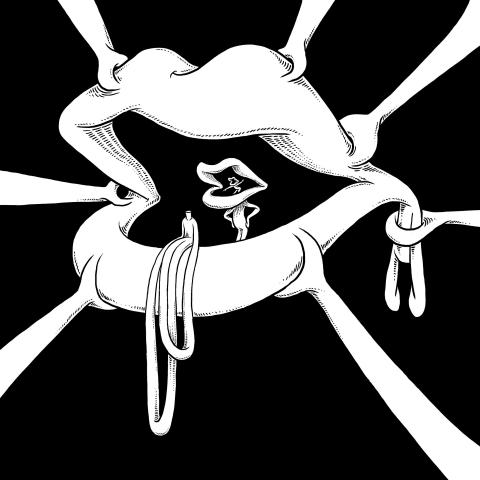
Illustration: Mountain People
Government forces and associated militias in Iraq and Lebanon have attempted to quash protests through violence and intimidation, but protesters have remained undeterred.
As a result, the authorities in these countries have turned to the example of the region’s more authoritarian governments, such as Egypt and Saudi Arabia. Both have managed to quell active dissent more successfully — at least for the time being — through aggressive media suppression and information manipulation, in addition to violent repression and arrests.
For these countries’ leaders, the permissive media and information environment was responsible for the protests that rocked the Arab world in 2011.
In Egypt, for example, Egyptian President Abdel-Fattah al-Sisi has been waging war on any fact or analysis that runs remotely counter to his regime’s interests, and he is successfully controlling the media through comprehensive constitutional and legislative changes.
The Egyptian government has facilitated arrests with sweeping media laws that criminalize the dissemination of “false news” (meaning coverage that contradicts official government statements).
There is also draft legislation under discussion that would criminalize the spread of rumors, which would make a Cabinet-supervised body responsible for parsing what people whisper among themselves.
A raid in November last year on the offices of the online newspaper Mada Masr, Egypt’s last remaining major independent media outlet, is but one example of the country’s comprehensive assault on the media.
Security officials arrested three journalists, claiming that Mada Masr had spread false information and had links to the Muslim Brotherhood (which the government considers a terrorist organization).
In truth, the government conducted the raid to discredit Mada Masr after it published an unflattering article about al-Sisi’s son, Mahmoud.
In this case, the detained journalists were released, but many have not been so lucky. Indeed, only China and Turkey lock up more journalists than Egypt and Saudi Arabia, where the number of jailed journalists and dissidents has risen steadily since 2011.
Since coming to power in 2017, Saudi Arabian Crown Prince Mohammed bin Salman has overseen a ruthless campaign against dissenters, epitomized by the 2018 murder of dissident Saudi Arabian journalist Jamal Khashoggi, a permanent resident of the US, at the kingdom’s consulate in Istanbul, Turkey.
The prince has not stopped at journalists; anyone perceived as a political opponent is fair game. In November last year, police arrested eight writers and entrepreneurs, most of whom were not active dissidents.
Two of them, the writers Abdulmajeed al-Buluwi and Badr al-Rashed, had even publicly supported the prince’s economic-reform agenda in an effort to atone for past criticism.
As in Egypt, Saudi Arabian authorities have claimed that those arrested were working to destabilize the government on behalf of a foreign power. This was the gist of social media campaigns run by the prince’s media adviser, Saud al-Qahtani, to discredit journalists and dissidents.
Countries such as Saudi Arabia, Egypt and Turkey have not faced major consequences, nor have they weathered international backlash for their repression and manipulation of the media.
This has not only emboldened their repressive regimes; it has convinced other governments currently facing protests to use similar methods.
In Iraq, the government has blamed the media for promoting the popular frustration driving large-scale demonstrations against widespread corruption, high unemployment, poor public services and Iranian interference.
Also in November, the Iraqi media regulator blocked transmissions from Dijlah TV, a Jordan-based Iraqi broadcaster, and temporarily shut down its Baghdad offices, along with those of 11 other media outlets, over alleged breaches of licensing rules.
It also issued warnings to five other organizations to “adapt their discourse” about the protests to broadcasting rules.
Journalists have also been detained by security services and targeted by associated militias.
Last year, unidentified armed assailants invaded the Baghdad offices of four broadcasters, ransacking studios and offices, stealing equipment and assaulting employees.
The Iraqi government has cut Internet service numerous times during the protests, at significant cost to the Iraqi economy.
In Lebanon, often viewed as an oasis of media openness in the region, the government has increasingly been intimidating and arresting its critics in an effort to subdue the demonstrations that began in October last year.
Protesters’ complaints about the government’s failings — including its capture by an elite political class — can easily be twisted into charges of fomenting sectarianism, which is illegal under the constitution.
Defamation is another charge used to discredit protesters and journalists.
Supporters of the country’s ruling parties have marshaled their forces to intimidate protesters and pressure service providers to shut down the social media accounts of protest leaders and prominent journalists.
Those accounts are crucial because mainstream Lebanese media, controlled by political parties, have barely covered the protests.
Politically controlled news outlets have also spread disinformation and claimed that foreign powers backed the protests in an attempt to weaken Lebanon.
Yet both the Lebanese and Iraqi governments have been markedly less successful than their authoritarian neighbors at using information-suppression tactics to keep citizens in line.
Demonstrators seem intent on keeping up the fight until their governments genuinely respond to their demands, and media suppression has served only to highlight alternative media and communication channels.
Autocratic regimes have long understood that discrediting or suppressing the press is easier and more effective than using violence to maintain power, even if that control comes at the expense of the openness and economic dynamism that these countries desperately need.
However, the experiences of Iraq and Lebanon suggest that this approach has its limits.
Although both countries face deep structural challenges, and journalists, writers and intellectuals remain at risk, their political systems’ dependence on power-sharing arrangements has prevented dissenting voices from being entirely silenced.
Lydia Khalil is a research fellow in the West Asia program at the Sydney-based Lowy Institute.
Copyright: Project Syndicate
Chinese state-owned companies COSCO Shipping Corporation and China Merchants have a 30 percent stake in Kaohsiung Port’s Kao Ming Container Terminal (Terminal No. 6) and COSCO leases Berths 65 and 66. It is extremely dangerous to allow Chinese companies or state-owned companies to operate critical infrastructure. Deterrence theorists are familiar with the concepts of deterrence “by punishment” and “by denial.” Deterrence by punishment threatens an aggressor with prohibitive costs (like retaliation or sanctions) that outweigh the benefits of their action, while deterrence by denial aims to make an attack so difficult that it becomes pointless. Elbridge Colby, currently serving as the Under
The Ministry of the Interior on Thursday last week said it ordered Internet service providers to block access to Chinese social media platform Xiaohongshu (小紅書, also known as RedNote in English) for a year, citing security risks and more than 1,700 alleged fraud cases on the platform since last year. The order took effect immediately, abruptly affecting more than 3 million users in Taiwan, and sparked discussions among politicians, online influencers and the public. The platform is often described as China’s version of Instagram or Pinterest, combining visual social media with e-commerce, and its users are predominantly young urban women,
Most Hong Kongers ignored the elections for its Legislative Council (LegCo) in 2021 and did so once again on Sunday. Unlike in 2021, moderate democrats who pledged their allegiance to Beijing were absent from the ballots this year. The electoral system overhaul is apparent revenge by Beijing for the democracy movement. On Sunday, the Hong Kong “patriots-only” election of the LegCo had a record-low turnout in the five geographical constituencies, with only 1.3 million people casting their ballots on the only seats that most Hong Kongers are eligible to vote for. Blank and invalid votes were up 50 percent from the previous
Japanese Prime Minister Sanae Takaichi lit a fuse the moment she declared that trouble for Taiwan means trouble for Japan. Beijing roared, Tokyo braced and like a plot twist nobody expected that early in the story, US President Donald Trump suddenly picked up the phone to talk to her. For a man who normally prefers to keep Asia guessing, the move itself was striking. What followed was even more intriguing. No one outside the room knows the exact phrasing, the tone or the diplomatic eyebrow raises exchanged, but the broad takeaway circulating among people familiar with the call was this: Trump did


 RSS
RSS