


No matter how bad the coronavirus epidemic gets, the crisis will not change how China is governed under Chinese President Xi Jinping (習近平).
Since coming to power in 2012, Xi has strengthened the Chinese Communist Party’s (CCP) hold on power and developed a comprehensive national agenda from which all else — including domestic crisis management — must follow.
The coronavirus crisis represents the single biggest challenge for Xi since he became CCP general secretary in 2012.
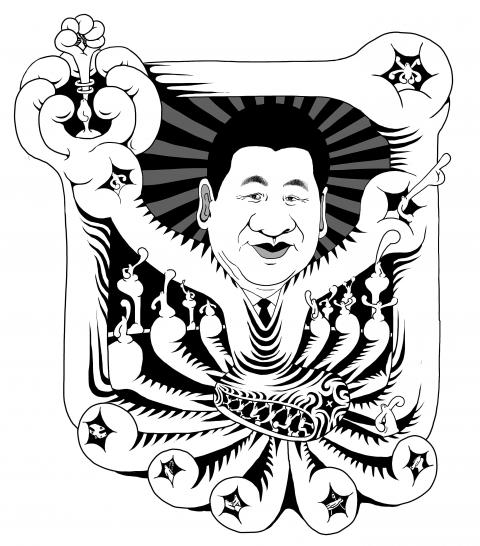
Illustration: Mountain People
Individuals and families across China are living in fear. Multiple provinces are under virtual lockdown. The virus has brought significant parts of the economy to a grinding halt, as firms instruct their employees to work from home.
Politically, the blame game bounces between local authorities in Wuhan, the epicenter of the outbreak, and the central government in Beijing, with both sides mindful of the eternal principle of Chinese politics: When disaster strikes, someone must be seen to pay the price.
The wider world should show sympathy and express solidarity with the long-suffering Chinese people. These are ugly times, and the racism implicit (and sometimes explicit) in many responses to Chinese people around the world makes me question just how far we have really come as a human family.
Too many people beyond China’s shores seem to have forgotten another eternal principle: “No man is an island, Entire of itself.”
Xi wields near-absolute political power over China’s Marxist-Leninist state. Arguably, only an authoritarian regime could have pursued the draconian methods that China has in trying to control the virus since last month. Only time will tell how effective these measures ultimately prove to be.
However, what is certain is that the crisis, once resolved, will not change how China is governed in the future.
To understand why, one must consider the underlying worldview that guides Xi as he seeks to realize his dream of making China the global great power of the future.
When people have asked me what Xi wants, I have explained his approach in terms of 10 priorities. This may best be seen as 10 sets of concentric circles emanating from the party center, or, in the tradition of the psychologist Abraham Maslow, Xi’s “Hierarchy of Needs”
The first priority is to keep the CCP in power. Xi has never seen the party as a transition mechanism to some sort of democracy or semi-democracy.
Rather, he sees China’s unique form of authoritarian capitalism as essential for its future great-power status, and as a model that could potentially be applicable to other parts of the world.
Second, Xi believes that he must always maintain national unity, because that is central to the CCP’s internal legitimacy.
This is why there have been sustained crackdowns in Tibet and Xinjiang under his rule, as well as a consistent hardening of policy toward Taiwan.
The third task is to expand the economy. Xi understands that the economy’s size, strength and technological sophistication are central to all dimensions of national power, including military capacity.
Moreover, without long-term growth, per capita income will not rise, and China will fall into the middle-income trap.
Sustained growth is thus also central to the CCP’s legitimacy, as is the national effort to become a technological superpower, with global dominance in 5G, semiconductors, supercomputing, and artificial intelligence (AI).
The fourth goal is to incorporate environmental sustainability into China’s growth matrix. In the past, such concerns were ignored, but now they, too, are central to the party’s legitimacy. The Chinese people will not tolerate high levels of air, soil and water pollution.
Still, sustainability, including action to combat climate change, will always compete with priority three (economic growth), both in domestic industry and in the transnational infrastructure projects envisioned in Xi’s signature Belt and Road Initiative (BRI).
Priority number five is to expand and modernize the Chinese military. Xi is overseeing the People’s Liberation Army’s (PLA) biggest reform — in terms of military organization, weapons platforms and personnel — since 1949.
The PLA is being transformed from an army-based institution for continental defense into a force for projecting power beyond China’s borders, through expanded naval, air force, cyber, space and AI capabilities.
Xi’s stated mission is to build a world-class military “to fight and win wars.”
The sixth objective is to secure benign and (when possible) compliant relationships with China’s 14 neighboring states and six maritime neighbors.
Russia has been key to this project, having gone from being an historic adversary that occupied much of China’s strategic attention to a virtual ally.
On the maritime front, China has made clear that it will not yield on its territorial claims in the East and South China seas.
Seventh, on China’s eastern maritime periphery, Xi believes that he must push the US back to the “second island chain” that runs from the Japanese archipelago through Guam to the eastern Philippines.
China also wants to weaken (or sever, if possible) the US’ longstanding security alliances in the region, particularly those with South Korea, Japan and the Philippines.
The ultimate objective here is to enhance China’s capacity to secure reunification with Taiwan — by force, if necessary.
Eighth, to secure China’s western continental periphery, Xi wants to turn the Eurasian landmass into a new market for Chinese goods, services, technology and critical infrastructure investment.
Through the BRI, he also wants Central Asia and the Middle East, as well as central, eastern and western Europe, to become increasingly sensitized to and supportive of China’s core foreign-policy interests.
Similarly, China sees large-scale market potential, not dissimilar to that of Eurasia, across the rest of the developing world, in Africa, Asia and Latin America.
Hence, Xi’s ninth priority is manifested in the “Maritime Silk Road,” which is becoming as significant as the BRI.
More broadly, China has also been successfully converting this global economic strategy into reliable G77 voting support in critical multilateral forums.
Finally, Xi wants to reshape the global order so that it is more accommodating of Chinese interests and values.
China’s leaders see the post-1945 liberal international order as reflecting the worldview of the victorious white colonial powers that created it.
Xi considers the world of 2020 to be radically different from that of the post-war era. China has therefore developed a two-pronged strategy.
While increasing its power, personnel and financial influence within the existing global-governance institutions, China’s leaders are also building new, China-centric institutions like the BRI and the Asian Infrastructure Investment Bank.
Not everyone in the CCP’s senior echelon shares Xi’s worldview. There is much internal dissension and debate about whether China is overextending itself in departing from Deng Xiaoping’s (鄧小平) longstanding strategy of “hide your strength, bide your time, never take the lead.”
Time will tell how these debates shake out, particularly in the run-up to the party’s 20th National Congress in 2022, which is to make the crucial decision about whether to extend Xi’s leadership term beyond previous term limits — through the 2020s and possibly beyond.
In this context, Xi’s management of the coronavirus crisis at home, and of politically totemic projects such as 5G expansion abroad, assumes a critical new significance.
Kevin Rudd, a former prime minister of Australia, is president of the Asia Society Policy Institute in New York.
Copyright: Project Syndicate
Chinese state-owned companies COSCO Shipping Corporation and China Merchants have a 30 percent stake in Kaohsiung Port’s Kao Ming Container Terminal (Terminal No. 6) and COSCO leases Berths 65 and 66. It is extremely dangerous to allow Chinese companies or state-owned companies to operate critical infrastructure. Deterrence theorists are familiar with the concepts of deterrence “by punishment” and “by denial.” Deterrence by punishment threatens an aggressor with prohibitive costs (like retaliation or sanctions) that outweigh the benefits of their action, while deterrence by denial aims to make an attack so difficult that it becomes pointless. Elbridge Colby, currently serving as the Under
The Ministry of the Interior on Thursday last week said it ordered Internet service providers to block access to Chinese social media platform Xiaohongshu (小紅書, also known as RedNote in English) for a year, citing security risks and more than 1,700 alleged fraud cases on the platform since last year. The order took effect immediately, abruptly affecting more than 3 million users in Taiwan, and sparked discussions among politicians, online influencers and the public. The platform is often described as China’s version of Instagram or Pinterest, combining visual social media with e-commerce, and its users are predominantly young urban women,
Most Hong Kongers ignored the elections for its Legislative Council (LegCo) in 2021 and did so once again on Sunday. Unlike in 2021, moderate democrats who pledged their allegiance to Beijing were absent from the ballots this year. The electoral system overhaul is apparent revenge by Beijing for the democracy movement. On Sunday, the Hong Kong “patriots-only” election of the LegCo had a record-low turnout in the five geographical constituencies, with only 1.3 million people casting their ballots on the only seats that most Hong Kongers are eligible to vote for. Blank and invalid votes were up 50 percent from the previous
Japanese Prime Minister Sanae Takaichi lit a fuse the moment she declared that trouble for Taiwan means trouble for Japan. Beijing roared, Tokyo braced and like a plot twist nobody expected that early in the story, US President Donald Trump suddenly picked up the phone to talk to her. For a man who normally prefers to keep Asia guessing, the move itself was striking. What followed was even more intriguing. No one outside the room knows the exact phrasing, the tone or the diplomatic eyebrow raises exchanged, but the broad takeaway circulating among people familiar with the call was this: Trump did


 RSS
RSS