


It is called Italy Plaza, a vast traffic circle in the Chilean capital, Santiago. To the north and east live the country’s ultra-wealthy. One way of describing those out of touch with the rest of the country’s grim reality is to say they have “never been below Italy Plaza.”
The spot is ground zero for furious street demonstrations, which have turned Chile from Latin America’s richest and stablest nation into a test case of profound social unrest. The area, which demonstrators have renamed Dignity Plaza, is coated in layers of graffiti, with most shops looted and shuttered.
The case of Chile — US$2 billion in property damage, 26 dead — has shocked the investor world, because it was supposed to be a regional model.
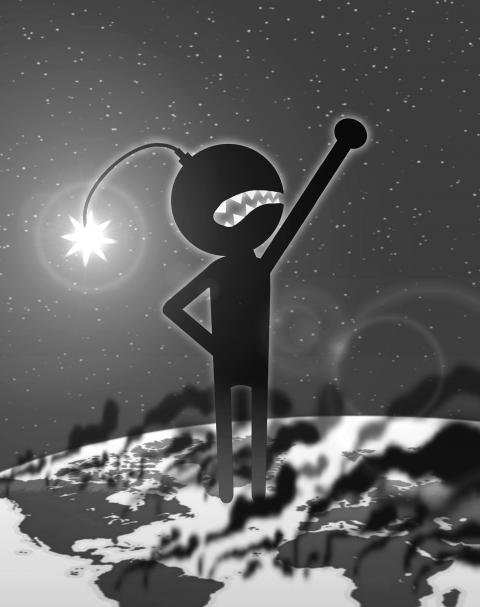
Illustration: Yusha
However, the virus of discontent was already spreading elsewhere, with streets in Colombia, Ecuador and Bolivia turning into scenes of pot-banging fire-setting fury.
Numerous factors are at play. Among the most significant are economic inequality, ethnic tensions and police brutality. While the most violent protests have for now dissipated, these forces continue to gnaw away at social cohesion and could once again spark unrest unexpectedly and suddenly. Institutions and the rule of law are fragile, and economies are expected to have another tough year.
Here are snapshots of three issues in three countries:
CHILE’S INEQUALITY
Every Friday, after David Vargas completes his shift as a technician at a credit-card company in the upscale Santiago neighborhood of Nueva Las Condes, he heads to nearby Italy Plaza to join the protests.
Vargas, 38, embodies Chile’s socioeconomic divide. He comes from a poor family and works among the well-to-do. While he once watched the gap shrink, lately he has seen it stagnate. He was struck when he saw the difference in how the authorities treated his work neighborhood from the one where he lives.
The area around his company “was packed with soldiers,” he said. “They were guarding everything when absolutely nothing had happened. But if you went downtown or to other parts of Santiago, it was pure chaos. They just guarded from Italy Plaza to the rich neighborhoods.”
Vargas’ father, a former factory worker, collects a monthly disability pension of just 80,000 pesos (US$103). His mother cleaned houses.
“I’m protesting mostly because of the pensions and to show solidarity, because right now I have privileges that many don’t have,” Vargas said. “I know what it is to live in a poor neighborhood, I know what it is to wait for eight hours at public hospitals for service, I know what it means that the elderly receive extremely low pensions and don’t have enough to live or to buy food.”
A few blocks away is where it all began. In early October last year at a subway station, students plotted ticket evasions sparked by a fare increase of 30 pesos. They coordinated on social networks and dangled their feet over the tracks to force trains to stop. Things got nasty, fast. Police special forces clashed with the protesters and groups set dozens of stations on fire.
Stunned, the Chilean government declared a state of emergency and a curfew, sending the army to the streets. Protests morphed into the biggest social unrest since at least former Chilean president Augusto Pinochet’s dictatorship in the 1970s and 1980s.
They were now against every injustice imaginable: low pensions, school debts, health services, public education, police brutality, women’s rights, even replacing the Pinochet-era constitution, which Chilean President Sebastian Pinera has agreed to in an attempt to calm the situation.
The message was clear. The neglected middle class in South America’s richest country was very mad. It was a taste of the frustration of similar populations across the region in the past few years.
Paulina Astroza, professor of political science at Chile’s Universidad de Concepcion, said Chile’s economic model worked when commodity prices were soaring, but has failed since.
“The issue is distrust of the political class, of the church, even of union and labor leaders,” she said. “There has to be a change in the model for more wealth redistribution or the grotesque inequality and the discontent will continue. If we want to avoid other unrest movements in one, two or even five years, we have to see a redistribution of power.”
COLOMBIA’S POLICE BRUTALITY
Dilan Cruz was not much for politics. An 18-year-old with a broad smile and a big group of friends, Cruz joined Colombia’s anti-government demonstrations in late November last year to protest for more funding for education.
“He believed he could get ahead if he could get a chance to study,” said Alexa Beltran, a close friend.
He was about to graduate high school and planned to study business administration, she said.
Cruz was killed by riot-control police at one of the demonstrations. His death was a flash point and an example of aggressive police tactics that have inflamed protests in countries across the Andes.
Dozens of demonstrators have been killed and thousands injured by state forces from Bogota to Santiago. The violence has been most prominent in Chile, where thousands have been hurt, including more than 200 who sustained eye injuries from the use of pellet shotguns by authorities, according to human rights groups.
“There are similarities in the way the police units are behaving,” said Silvia Otero Bahamon, a professor at Universidad del Rosario in Bogota who studies inequality and political violence.
Dictatorship, war and high levels of violence in the past have led to heavily militarized police forces. Abuses are common.
Colombians, who lived through decades of armed conflict, have become so accustomed to them that few of the more than 40 killings of demonstrators by anti-riot police in the past two decades have been investigated, Otero Bahamon said.
“Repression of protest by police is common in Colombia,” she said. “That’s why what’s happened with Dilan Cruz has been surprising.”
Cruz’s death sparked fresh protests and anger. Marchers carried signs bearing his likeness and broke out into spontaneous chants of “Dilan didn’t die, he was murdered.”
Protest leaders are demanding that the government dismantle the national police’s Mobile Anti-Disturbance Squadron, known by its Spanish acronym, ESMAD.
Colombian President Ivan Duque has ruled out such a move. Cruz’s death is under investigation by the attorney general’s office.
Sometimes provoked, but other times not, ESMAD agents have been seen clubbing protesters, kicking a woman in the face and casually tossing tear gas into peaceful demonstrations.
Cruz came from a broken home; his father died years ago and his mother was in jail. He lived with his older sister in a hardscrabble neighborhood, taking day jobs selling fast food.
He had joined a few peaceful protests in the past, but none of them compared with the demonstrations that shook Colombia starting on Nov. 21, when hundreds of thousands took to the streets in a broad-based rejection of government policies.
Two days after the protests began, Cruz was on the street. He picked up a tear gas canister, threw it at anti-riot police and ran, video footage from cellphones and street cameras shows. An officer shot a projectile, hitting Cruz in the head.
Cruz collapsed in front of an Internet cafe on a normally busy commercial street. Two days later, he died in a hospital. His sister Denis attended his graduation ceremony in his place.
In a video she posted, she said: “No more violence. Dialogue and love will always be our best weapons.”
ECUADOR’S INDIGENOUS TENSIONS
When Ecuadoran President Lenin Moreno announced the end of gasoline and diesel subsidies in October last year to comply with an IMF program, the reaction was so violent that he fled the capital, Quito, and moved the government to the coastal business center of Guayaquil. At the heart of the protests were indigenous tribal groups, among the most affected.
Round-the-clock roadblocks, achieved by felling trees, burning tires and rolling boulders, paralyzed large areas. Some ransacked flower plantations and farms. Others caused US$140 million in damage by sabotaging oil production.
Looting and street riots culminated in the arson of the Ecuadoran Office of the Comptroller General and several deaths, leading Moreno to repeal his decree. The indigenous umbrella group CONAIE called off the demonstrations. The government is back in Quito, but tension remains high.
Jaime Vargas is a 40-year-old indigenous leader who wears a necklace ending in a jaguar’s tooth he said he pulled from a live cat himself, along with a brightly feathered crown typical in swathes of the Amazon, where he is from.
“People have been carrying a heavy load. Of the violence, there are justifications,” he said.
Indigenous Ecuadorans, who make up about 10 to 20 percent of the country’s 17 million inhabitants by various estimates, mirror the marginalized poor across South America.
Their cultures are as diverse as their homelands, ranging from sweltering rain forests to icy, windswept mountains capped with receding glaciers.
Some came into contact with Western civilization only when the oil industry showed up in the 1960s and 1970s, while most descend from people who fought both invading Incas and Spanish conquistadors hundreds of years ago.
Many have moved to urban areas for education and jobs, only to find both elusive. They live in marginal areas, exposed to crime, drugs and prostitution.
CONAIE leaders, wearing traditional ponchos and felt hats, and carrying hardwood spears, have toppled several elected governments in Ecuador in the past. Moreno has responded cautiously while trying to move the economy to more of a market orientation.
Luisa Lozano, the 43-year-old head of CONAIE’s women’s organization — who has already beaten back charges for her role in previous anti-government protests, including blocking highways — wears a wide-brimmed black-and-white hat she said is a symbol of the sun worshiped as a deity before the Spaniards arrived.
“The more repression, the greater the adrenaline to resist,” she said in reference to the October protests and clashes over fuel prices. “The more blood, the stronger the people’s reaction. When it comes down to it, people will react, because we know everything we’ve achieved has come through struggle after struggle.”

Weeks into the craze, nobody quite knows what to make of the OpenClaw mania sweeping China, marked by viral photos of retirees lining up for installation events and users gathering in red claw hats. The queues and cosplay inspired by the “raising a lobster” trend make for irresistible China clickbait. However, the West is fixating on the least important part of the story. As a consumer craze, OpenClaw — the AI agent designed to do tasks on a user’s behalf — would likely burn out. Without some developer background, it is too glitchy and technically awkward for true mainstream adoption,
On Monday, a group of bipartisan US senators arrived in Taiwan to support the nation’s special defense bill to counter Chinese threats. At the same time, Beijing announced that Chinese President Xi Jinping (習近平) had invited Chinese Nationalist Party (KMT) Chairwoman Cheng Li-wun (鄭麗文) to visit China, a move to make the KMT a pawn in its proxy warfare against Taiwan and the US. Since her inauguration as KMT chair last year, Cheng, widely seen as a pro-China figure, has made no secret of her desire to interact with the Chinese Communist Party (CCP) and meet with Xi, naming it a
Taiwan People’s Party (TPP) Chairman Huang Kuo-chang (黃國昌) took the stage at a protest rally on Sunday in front of the Presidential Office Building in Taipei in support of former TPP chairman Ko Wen-je (柯文哲), who has been sentenced to 17 years in jail for corruption and embezzlement. Huang told the crowd that Chinese Nationalist Party (KMT) Chairwoman Cheng Li-wun (鄭麗文) had sent a message of support the previous day, saying she would be traveling from the south to Taipei: If the protest continued into the evening, she had said, she would show up. The rally was due to end
A delegation of Chinese Nationalist Party (KMT) officials led by Chairwoman Cheng Li-wun (鄭麗文) is to travel to China tomorrow for a six-day visit to Jiangsu, Shanghai and Beijing, which might end with a meeting between Cheng and Chinese President Xi Jinping (習近平). The trip was announced by Xinhua news agency on Monday last week, which cited China’s Taiwan Affairs Office (TAO) Director Song Tao (宋濤) as saying that Cheng has repeatedly expressed willingness to visit China, and that the Chinese Communist Party (CCP) Central Committee and Xi have extended an invitation. Although some people have been speculating about a potential Xi-Cheng


 RSS
RSS