


There is always so much bad news. Some of it, like the helicopter crash last week that killed General Shen Yi-ming (沈一鳴) and his colleagues, is genuinely heartbreaking. So much of the rest of it is just the nature of the news cycle — supercharged by social media.
Yet, there are so many good things happening in the world — especially as regards Taiwan.
First, the obvious. Taiwan is holding its seventh consecutive free Presidential election and ninth consecutive national election for the LY. For goodness sake! Think about that. There is no culturally-Chinese polity in the world with such a thorough-going commitment to liberal democratic governance — while in China proper, it is fully absent.
Second, Taiwan relations with its most critical friend — the US — are closer than any time since 1979. I’m studiously avoiding Taiwan politics on the eve of its elections. But it would be wrong to ignore how good things have been lately: Five major arms packages in three years, multiple expanded Presidential transits through the US, increased “diplomatic” coordination across a range of issues, and a Congress more supportive of Taiwan than at any time since it passed the Taiwan Relations Act.
In fairness to the previous Taiwan government, it’s also appropriate to recognize that President Ma Ying-jeou (馬英九) was dealing with different signals coming from Beijing. For that matter, it was dealing with different signals coming from Washington. Donald Trump has brought to Washington a sense that anything is possible. This is sometimes unsettling. For US-Taiwan relations, it’s been a boon.
Third, there is a truce in the US-China trade war. I’m not being clever here. I know some readers like the trade war. It’s no secret that government intervention in markets creates winners. And it has created some in Taiwan.
The trade war, however, has hurt Americans — businesses, consumers, farmers, and workers. Moreover, where we were headed — a broader breakdown in economic relations between the two biggest economies in the world — is not in America’s interest.
So, yes, I’m glad to see a pause.
I’m even more pleased to see the outline of a way forward on the toughest economic issues at stake in the US-China relationship. Those issues — among them, disciplines around government subsidies, regulation of state-owned enterprises, rules governing digital trade — are not irresolvable. And as far as Taiwanese are concerned, even if there are some who benefit from US-China trade tensions today, more will prosper from their resolution.
Fourth, Taiwan is one of the freest economies in the world — according to the Heritage Foundation Index of Economic Freedom. It’s not a partisan thing. Taiwan’s score has been trending higher since 2009. This points to a consensus that whatever the ups and downs, when all is said and done, Taiwan values markets over state planning, free flow of goods and services over protectionism. This is generally the same in Washington — despite growing calls from both sides of the political spectrum for more government control over the economy.
The US and Taiwan would benefit from reinforcing principles of economic freedom in a comprehensive (and truly free) trade agreement (FTA). With USMCA, the US-Japan Trade Agreement and phase one of the US-China trade talks done, the decks at USTR are clear. The good news is that a big push for a US-Taiwan FTA is coming in 2020. See the letter sent a couple weeks ago by 161 Congressmen.
Fifth, the US is not Taiwan’s only friend in the world — far from it. In the second half of 2019 alone, Taipei saw parliamentarian delegations from France, Germany, Italy, the Netherlands, the UK, and the EU. Japan sent a delegation of more than 200 — including more than 30 Diet members — to celebrate 10/10. And in Europe, in addition to the EU Parliament’s Taiwan Friendship Group, there is a new inter-parliamentary Formosa Club to promote ties with Taiwan.
Look, I can understand Beijing discounting this sort of legislative diplomacy. But those who live with the power of real legislatures have no excuse. Activities like this are often leading indicators of where governments are headed. And governments in these countries are, indeed, becoming more active on Taiwan. Witness the growing chorus of support for Taiwan’s inclusion in international organizations — most notably the World Health Assembly. Not to mention that several nations’ navies — including France, the UK, and Canada — joined the US this year in physically demonstrating their legal right to operate in the Taiwan Straits.
There are so many things to worry about. The US military and its allies aren’t on guard in the Pacific 24-hours-a-day for nothing. But, at least once a year, we should take stock and as American lyricist Johnny Mercer once preached, “Bring gloom down to a minimum.” And save at least some of it for the personal tragedies — like those of General Shen and his compatriots — where it is truly warranted.
Walter Lohman is director of the Heritage Foundation’s Asian Studies Center.

KMT Chairwoman Cheng Li-wun’s (鄭麗文) recent visit to Beijing and her upcoming visit to Washington will serve as a high-level test of her diplomatic mettle. In Beijing, Cheng was received with symbolic gestures, a warm reception, and high-level access. In Washington, she will receive far less pomp and far sharper questions about the KMT’s vision for the future of Taiwan. Her challenge will be to persuade Washington that the KMT’s engagement with China can coexist with strong deterrence. Cheng’s April 7-12 visit to mainland China coincided with an intense period of conflict in Iran. Despite the strategic significance of Cheng’s trip,
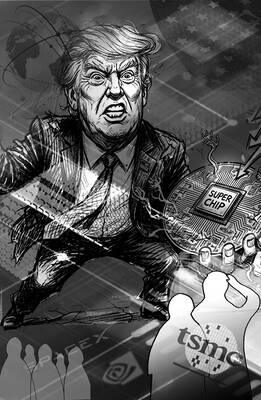
The White House’s decision to take a 9.9 percent stake in Intel Corp is looking like very shrewd business indeed. Since the government bought in at US$20.47 a share last August, the US chipmaker’s surging stock price has delivered the US a US$43 billion return. One of the reasons the investment has so far proved so sound is that the White House has made sure of it. According to The Wall Street Journal, Howard personally pushed deals on Intel’s behalf with some of the most lucrative clients imaginable. They include Nvidia Corp, the company at the heart of the AI

The closure of the Strait of Hormuz has sent the vast Asian chemicals industry into a tailspin. Deprived of the likes of Qatari natural gas and Saudi Arabian oil, the region’s fertilizer and plastics plants are slowing production or even shutting down. Everywhere except China, that is. In petrochemicals, China is unique. As well as a traditional industry that uses oil and gas as feedstock, it has parallel output that relies on its abundant domestic coal. Unsurprisingly, India and other regional powers want to copy and paste the Chinese method. This would not be easy — or climate friendly. The
Indonesian President Prabowo Subianto says he knows how to fix the problems facing Indonesia. Yet his economic mismanagement and authoritarian tendencies are steering the nation toward a familiar mix of currency instability and political chaos. The world’s fourth-most populous nation risks reversing the hard-won democratic and business reforms that came after the Asian Financial Crisis in 1997. At that time, the rupiah collapsed and the political upheaval that followed forced former president Haji Mohamed Suharto from power. Prabowo’s administration is ignoring similar warning signs. That disconnect was apparent in a national address on Wednesday, when Prabowo projected the swagger that has


 RSS
RSS