


As the big day dawned last weekend, Berliners held a huge street party, with more than 100,000 revelers gathering in the cold to “ooh” and “aah” over an epic display of fireworks. Elsewhere, celebrants of the 30th anniversary of the fall of the Berlin Wall followed their own time-honored traditions. TV producers ran that grainy archive of burly Germans smashing sledgehammers into brickwork, while posh newspapers rolled out their grandest pen-suckers to pronounce on “The Future of the Continent.”
Thus, a historic event that changed the world is stripped of some of its most troubling questions and tidied away into a neat little period piece, a “Now That’s What I Call Perestroika!” compilation album.
Let us try to change that today, for I come not to bury communism, but to praise it — or rather, one aspect of it that gets next to no recognition. On its own terms, “really existing socialism” was a miserable failure: brutally repressive to its own peoples and ultimately unable to compete with capitalist economies. Yet it achieved something else that its own politburos and planners never intended — an achievement that represents one of our era’s greatest paradoxes.
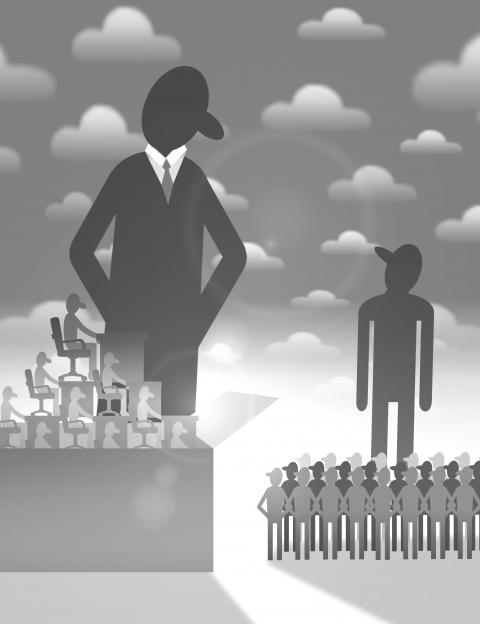
Illustration: Yusha
Communism did not topple capitalism, but kept it honest — and so saved it from itself.
The very presence of a powerful rival ideology frightened capitalists into sharing their returns with workers and the rest of the society, in higher wages, more welfare spending and greater public investment. By sending tanks into Prague in 1968, then-Soviet leader Leonid Brezhnev might have crushed the dream of “socialism with a human face,” but he and other Soviet general-secretaries forced capitalism to become less inhumane.
Conversely, the collapse of communism between 1989 and 1991 has left capitalism unchallenged and untempered — and increasingly unviable.
The challenge of our time, whether in the UK’s general election or next year’s US presidential contest, is to build a political movement that can restrain a system spinning madly out of control.
You are not meant to think of it this way. From the very outset, November 1989 was framed as the moment when capitalism could stop battling for survival and finally renew itself. The Guardian’s own leading article, published even as the Trabants lined up by the mile to get into the West, summed up liberal hopes: “The wealth is at last available not only to tackle long-neglected evils at home, but to pay for a genuine fight against poverty, injustices and ecological disaster in the rest of the world.”
I trust I am not giving away too much of the plot by observing it has not panned out like that. Indeed, for most of the past three decades, the political classes — whether former British prime ministers Tony Blair or David Cameron, or former US presidents George W. Bush or Barack Obama — have accepted vast gulfs between rich and poor as just one of those sad facts of life. With tiny shrugs, they put it down to globalization or the shifting job market and deploy the work of top economists such as Harvard University’s Lawrence Katz and David Autor, who argue that income inequality has been a natural byproduct of technological innovation.
Yet history supplies very different testimony. It shows how the existential threat to capitalism posed by socialist movements, whether revolutionary communist or reformist social democrat, rebalanced power toward workers. The starkest example is the eight-hour working day.
Demanded for more than a century by socialists such as Robert Owen, it had been the rallying cry of the annual May Day demonstrations organized since 1890 — yet it took the Bolshevik revolution of October 1917 and the concurrent unrest of workers across Europe to make it law within months in France, Germany and Portugal.
The manner in which socialism reformed capitalism is made explicit in a paper from the International Labour Organization that notes how the surge in inequality across the West in the 19th century was reversed “as the threat of the spread of communism inspired welfarist redistributive reforms, giving capitalism a more human face.”
In 1929, the richest 0.1 percent of Americans owned almost 25 percent of all the nation’s household wealth; by the 1970s, that had dropped below 10 percent.
For perhaps a couple of decades after World War II, the future looked distinctly red-tinted. In 1951, Canadian news magazine Maclean’s asked: “What hideous magic is possessed by the discredited conspiracy called communism that it continues to control more than a quarter of the voting power in France and Italy?”
A few years later, Harold Macmillan’s Conservative ministers were fretting about how the Soviets were outstripping both Americans and the British on education spending, and churning out many more scientists and technologists.
Whether it was the space race or huge European trade unions with links to Moscow, a specter was haunting the West: the specter of egalitarianism.
In a new study of 16 industrial countries during the Cold War, Brazilian economists Andre Albuquerque Sant’Anna and Leonardo Weller argue that the “more national elites were under the threat of communist revolution, the more the state-introduced policies that reduced top income shares” — whether that be taxing and spending more, or allowing uncomfortably powerful trade unions. Those “reds under the bed” helped ensure you would have social democracy at home.
Communism was not the sole shackle on capitalism, but it is one that typically gets painted out of history.
Yet as the late Marxist historian Eric Hobsbawm observed in his memoir Interesting Times, even in the 1980s, when the Soviet bloc was ailing and feeble, it could still “frighten the rich and the rulers of the world into taking some notice of the needs of the poor.”
Almost all such counterweights to extreme capitalism have disappeared today, from strong trade unions to alternative national models. The resulting debauchery is all around us, from the companies that shovel money toward their shareholders while sending their workers to food banks, to the billionaires now preparing to run for US president, to the major capitals, such as London, that ask barely any questions of passing kleptocrats, but instead sell them anything they want.
Countervailing forces made capitalism not only more bearable for those living under it, but also more likely to survive. Without them, the system loses both consent and even the will to carry on. The banking crash, Brexit, the impending climate catastrophe — all should serve as distress signals for keen-eared capitalists, yet the answer to each is to serve up more of the same: more finance, more slash-and-burn and more tokenism around carrier bags.
A system so manifestly unwilling to change course will hit the rocks. One paradox of the 20th century was that communism failed, yet helped capitalism to success. The challenge for this century will be whether we can build a new political movement to scare the capitalists silly, so as to force them to come to their senses.
The Comedy Club on Fuxing N Road in Taipei was vandalized with paint bombs mixed with feces on May 29, allegedly because one of its performers had satirized Chinese President Xi Jinping (習近平). The incident has triggered concerns about the growing threat from China’s cross-border repression within Taiwan. On the day of the attack, a comedian surnamed Huang (黃), who is known for mocking Xi, was the headline performer. The Comedy Club founder said the assault was obviously politically motivated. China, which Freedom House said “conducts the most sophisticated, extensive and far-reaching campaign of transnational repression in the world,” has
China’s Taiwan Affairs Office spokesperson Zhu Fenglian (朱鳳蓮) at a press conference last week repeated the same, tired line, claiming that Taiwan’s future should be “decided jointly by the more than 1.4 billion Chinese people, including Taiwan compatriots.” The statement is absurd. Virtually every word is incorrect, with some parts mistaken to an astonishing degree. First, the People’s Republic of China (PRC) has never included Taiwan. When the Republic of China’s (ROC) original five-colored flag was established in 1912, Taiwan was still under Japanese rule. When the PRC was founded in 1949, Taiwan was under the control of president Chiang
Following the outbreak of conflict in Iran, TikTok was flooded with videos targeting Taiwanese users. Many featured artificial intelligence (AI)-generated anchors posing as Taiwanese broadcasters with localized traditional Chinese subtitles. The videos warned of imminent social collapse due to liquefied natural gas shortages, blamed the Democratic Progressive Party and its alleged failed energy policies for a fabricated crisis, and used recycled footage from unrelated events to create the impression Taiwan stood on the edge of systemic breakdown. By saturating the information environment with falsehoods or selectively edited material designed to trigger emotional responses, malign actors can exploit cognitive vulnerabilities and
Taiwan’s leading position in the global semiconductor industry is not, as some claim, based on misconceptions, a result of “stealing.” It was built upon formal, transparent and costly technology transfer agreements between the Taiwanese government and US enterprises half a century ago. According to the oral history of Hu Ding-hua (胡定華), a pioneer in Taiwan’s semiconductor industry, the origin of Taiwan’s integrated circuit (IC) technology dates back to the “IC pilot factory” in the 1970s. The implementation of this project fully complied with international commercial standards and legal procedures. First, the project completed formal contract signing and payment. In 1975,


 RSS
RSS