


The transnational state is a relatively new conception in global affairs (although it originated in the early 20th century), which posits that heightened interconnectivity is reducing the significance of economic, political and social borders, and increasing communication between individuals, states and other groups. In a word, transnationalism refers to the manifold links, relationships and correspondent cultural filaments that couple people and institutions across the borders of nation-states.
Some might confuse “globalization” with transnationalism, but the global view tends to be more centered on economics, while that which is “trans“ is just that — going across and through, changing.
The transnational is more aligned with identity, individuality and from there, how such uniqueness is positioned in truly communal settings (some also speak of historical elements in the transnational, that is, how fluctuations within the history of one country are impacted by developments in others).
At one high level, Kwame Anthony Appiah has spoken of a responsibility to learn from differences. This is a point we should all take to heart. I have said it before: As a foreigner living in Taiwan I have been thrust into a new world of difference, and as a certain “other” in this country, I am yet more obligated to make a difference of my own in my interaction and collaboration with Taiwanese. I will do my best, and may we all.
And I have said this before too: Much of this discussion centers on language and learning and using new languages (“borders, both visible and invisible,” as one analyst has written). Though often uncomfortable, such efforts are essential to construct and illumine new borders and spaces, better suited for understanding other peoples.
Wikipedia refers to the possibilities of transnational companies, crime, feminism, governance, psychology and a variety of other constructs. We can see the wide-open possibilities this conception offers in terms of identity and makeup.
In practice, transnationalism refers to increased versatility and incorporation of processes that connect and define individuals, governments and groups of all kinds — businesses, non-governmental organizations, supranational organizations, educational groups, “emergent organizations,” workers’ cooperatives, community assemblies and even criminal organizations — such that they can mobilize effectively beyond state boundaries.
Individuals, groups, institutions and states are interacting with each other in a new global amplitude, where cultural and political characteristics are combined with evolving, oblique engagements.
It is also said that transnationalism is a part of the process of capitalist globalization, which indicates a darker, perhaps exploitative side of this issue, which I have rejected.
Taiwan can most assuredly see itself in all of these lights, with many transnational/transitional actors having an impact. Probably one key actor (though not that as such) is the social movements that have rocked Taiwan in the past few years, with their efforts to redefine politics and culture. Such movements are in effect challenging the role of the state in national affairs and bringing citizens into the conversation.
A look at Taiwan in this light is truly enlightening: From the early democracy demonstrations to the Wild Lily Movement, the Wild Strawberry advocates, through the recent successes in LGBT rights, to the Sunflower protests... It has been a very active scene in Taiwan for many, many years.
To be perfectly frank, these movements might not be “transnational” in the true sense, although to be sure many people of other nationalities have assumed roles in them, indicating a blending of borders that is very much transnational.
Most importantly, this indicate a new view onto what national/world affairs actually are and can be, and how such movements transgress the limits and norms of ordinary politics and (now seemingly hidebound) states.
Such movements are in essence actors who are having an influence on how the state functions and makes decisions in a borderless environment. Taiwanese social movements have to be sure done all of this.
In a related action, the International Federation for Human Rights in May announced that it will hold its forum in Taipei this fall, a major development in human rights activism in Taiwan.
Such a move is truly “transnational” in scope, with many countries and other organizations participating in a movement that truly does attempt to eliminate boundaries among people.
This is by no means the first such international assembly that has occurred in Taiwan. There are many conferences and meetings every year, and an event like the 2017 Taipei Universiade was a major accomplishment, indicating a transnational focus in the nation.
These events and summits are yielding collective action locally, nationally and internationally, and in turn forging links across national borders amid a new global civil society.
In these ways these transnational constructs are interconnected networks, with such systems promoting relationships and addressing common issues, despite geographical “limitations” (we can hardly call them that any more). Such is the “shrinking” of the global space in today’s world.
Some have argued that diasporas, of which there are many historical examples, are a precursor to modern transnationalism. I have written about the Taiwanese diaspora worldwide since World War II and how this has had a significant effect internationally.
The migration of Taiwanese to other countries in modern times has yielded a new Taiwanese transnational identity — a mutual identity — which creates itself across borders and back again.
With Taiwan having shaped the modern world in significant ways, giving so much back, I wrote last year, that this might one day comprise an epic historicity that will match others of the past (“Taiwanese settling far and wide: a global view,” Feb. 5, 2018, page 6).
Education is probably one other key area that is having a transnational impact, and here again Taiwan is in the driver’s seat. The nation is no doubt internationalizing its educational methodologies and systems dramatically, and up to 10 percent of all students in Taiwan (more than 100,000) are now from other countries.
I have experienced this just this semester, when eight Indonesian students attended my English conversation class at National Taiwan University of Science and Technology (the most popular Taiwan school for foreign students, I have read). Such interaction is a truly wonderful thing for Taiwan.
Davina Tham touched on these issues in her article “Taiwanese, in Transition” (June 20, page 13). She wrote of Taiwanese students who have studied abroad, mostly in the West, but it could be anywhere, and how these “parachute kids” have wrestled with identity issues across two nationalities, families, languages and cultures. When they seek to return home to Taiwan, they are pulled in various transnational directions.
“There are no easy labels,” Tham wrote, “but sometimes, it comes down to a conviction that is felt, rather than reasoned out.”
Taiwan, a transnational state in the true sense, with all that can bring to a nation. Reciprocity, sharing, collaboration, exchange, a fluidity and communicative cloverleaf that will take Taiwan into the 21st century in the most rewarding and fruitful ways.
David Pendery is an associate professor at National Taipei University of Business.
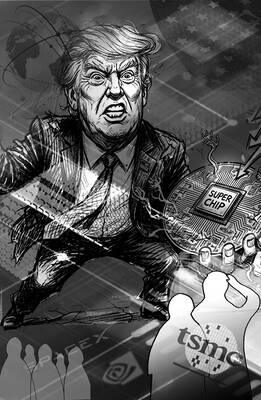
The White House’s decision to take a 9.9 percent stake in Intel Corp is looking like very shrewd business indeed. Since the government bought in at US$20.47 a share last August, the US chipmaker’s surging stock price has delivered the US a US$43 billion return. One of the reasons the investment has so far proved so sound is that the White House has made sure of it. According to The Wall Street Journal, Howard personally pushed deals on Intel’s behalf with some of the most lucrative clients imaginable. They include Nvidia Corp, the company at the heart of the AI
A single photograph can cut through a lot of noise, but it can also be used to misrepresent the truth. At the very least, it can concentrate the mind on something that requires further investigation. On Monday last week, Ma Ying-jeou Foundation CEO Tai Hsia-ling (戴遐齡) and former National Security Council secretary-general King Pu-tsung (金溥聰) held a news conference in which they showed a photograph of former foundation CEO Hsiao Hsu-tsen (蕭旭岑), now Chinese Nationalist Party (KMT) deputy chairman. In the image Hsiao is seated next to Xiamen Taiwan Businessmen Association chairman Han Ying-huan (韓螢煥). The two men were holding
The Ministry of the Interior, working with the navy and coast guard, is organizing Taiwan’s first joint exercise simulating escort tankers carrying liquefied natural gas (LNG) and oil through a Chinese blockade. The drills simulate fuel transport along three maritime corridors leading toward Japan, the Philippines and the US. Deputy Minister of the Interior Sawyer Mars (馬士元) said that a blockade of the Taiwan Strait would amount to “almost a 100 percent blockade of the regional energy supply.” Minister of National Defense Wellington Koo said planning to counter a blockade is standard practice in Taipei. While the exercise is limited in
In a Taiwanese university classroom, a lecturer asks in English: “Can anyone give me an example from Taiwan?” Students look down. No one answers. After class, one student writes on the course platform in Mandarin: “I understood the concept, but I didn’t know how to answer in English.” That moment highlights a key issue in Taiwan’s English-medium instruction (EMI) reform: It is not just about more English-taught courses, but whether students can learn, participate and belong. EMI expansion is part of the Bilingual 2030 policy and the Ministry of Education’s BEST Program, aiming to improve English ability, support EMI teaching


 RSS
RSS