


It is hard to escape Genghis Khan in Mongolia.
The 13th-century conqueror has donated his name to the capital’s airport, a hotel, a central avenue, a garden, a club, even a brewery. Yet none evoke the spirit of autocratic power and greatness better than the shining 40m-high equestrian statue of the warrior built by Mongolian President Battulga Khaltmaa on the steppes.
Now, less than two years after Battulga’s election, some fear his widespread popularity and campaign to root out corruption might be moving the president’s authority closer to that of his hero at the expense of democracy, and shifting Mongolia closer to China and Russia.
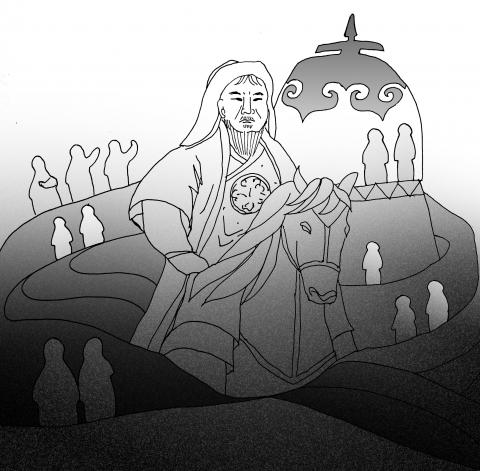
Illustration: Tania Chou
With support from parliament, Battulga passed a law that effectively gave him far-reaching powers to dismiss judges and senior members of the nation’s legal system via his role as chairman of the National Security Council.
He wasted no time in removing a Supreme Court judge and the top highest prosecutor. The deputy general director of Mongolia’s Independent Authority Against Corruption might be next.
Dressed in a trim navy suit and red tie, Battulga urged lawmakers to grant the three-member security council authority to remove those who “are part of a conspiracy system that shields the illegal activities” of “political-economic interest groups.”
Anti-corruption group Transparency International and human rights organizations, including Amnesty International, say the move is an erosion of the nation’s democratic values.
“There won’t be enough checks and balances,” said Badamragchaa Purevdorj, justice program manager at the Open Society Forum in Ulan Bator.
However, voters have become angered by successive governments’ failure to deal with issues such as air pollution and widening income disparity, and Battulga’s tough-guy image and populist campaign to attack corruption have given him widespread popularity.
At stake is Mongolia’s international image in a delicate game it has been playing to balance the influences of Russia, China and the US. While Western democracies see Mongolia as an oasis of democracy, sandwiched between Russia and China, the country relies largely on its neighbors to buy its resources and provide investment. Last month, China bought 86 percent of Mongolia’s exports.
A trade agreement introduced this month in the US Congress — the Mongolia Third Neighbor Trade Act — would remove duties on exports such as cashmere, which Mongolia is pushing to diversify its trade away from minerals.
US Senator Ben Cardin, who cosponsored the bill, called Mongolia “a stable democracy in a sea of authoritarianism” that contributes to US national security goals in Asia.
In a statement on Thursday last week, he said the act would bring employment to the country and help empower women, who comprise most of the nation’s garment industry.
However, Battulga also wants closer cooperation with the eight-member Shanghai Cooperation Organization, an Asian-centered security and economic group that includes China and Russia. In a meeting with Russian President Vladimir Putin in Vladivostok in September last year, he said that relations with Russia were a priority for Mongolia.
Battulga’s advantage is that his political support at home cuts across parties. While the heads of some of the world’s leading democratic nations might be having trouble winning support from polarized parliaments, he has no such problems. His popular support and promise to battle graft have given him a strong position in a parliament that has been embattled by months of protests over corruption.
Thousands of Mongolians gathered in the capital in minus-20?C temperatures in January to protest against political elites that are popularly called manan, Mongolian for fog, a word created by meshing the acronyms for the two main political parties.
Battulga, a vocal critic of oligarchs and elites he accuses of pulling the strings in government, appeals to many voters because of his image as a tough-guy outsider, independent of a tainted political system.
He is a self-made millionaire and a martial arts champion, who competed in Russian sambo wrestling. As the former head of the Mongolian Judo Association, he led the country’s judo team to take the nation’s first Olympic gold medal during the 2008 Beijing Games. Despite his wealth and fame, Battulga has won over the public as a man of the people.
“I respect him because he’s one of us, one of the ordinary citizens,” said Narantsetseg Batkhuu, 53, a Democratic Party supporter who was protesting near the Government Palace at another demonstration on Wednesday last week.
The president’s Democratic Party has only nine seats in the 76-seat legislature, the State Great Hural, after suffering a huge defeat in the last election. However, the motion to extend the National Security Council’s powers was supported by many first-time lawmakers elected in 2016, and the bill passed with 85 percent in favor.
“The new MPs are not corrupted,” said Ganbaatar Jambal, a member of the majority Mongolian People’s Party, who voted for the bill.
He said the president did not directly push the policy on politicians, but “their ideas crossed.”
Notably, the other two members of the security council are Mongolian Prime Minister Khurelsukh Ukhnaa and the influential Speaker of Parliament Zandanshatar Gombojav, both from the majority Mongolian People’s Party.
In Mongolia, the prime minister holds executive power, with the president having right of veto and judicial appointment powers, as well as being head of the nation’s armed forces.
However, presidents over the past decade have increased their influence, raising concern the office is beginning to rival that of the prime minister.
“They are one team now,” said Naranjargal Khashkhuu, president of Globe International, a non-governmental organization that promotes freedom of expression. “It’s very frustrating. It’s also a test of Mongolia’s democracy.”
Naranjargal criticized elected officials for hastily passing a law before accepting any input from voters.
She said that the amendment is unconstitutional and hopes that a case will eventually come before the Constitutional Court to strike it down.
A spokesman for the President’s Office, Tuvshinzaya Gantulga, said that concerns about sweeping powers were overstated.
“The only change is when the National Security Council issues a recommendation on the temporary suspension of judges,” until deliberated on and fulfilled by a judicial council, he said.
In making his case for the rule change, Battulga cited accusations of torture to convict suspects in the of assassination of a former politician in 1998 and concern about the purchase of 49 percent stake in the Erdenet copper mine.
The president’s proposed legislation passed just 48 hours after introducing it and took effect immediately. Enforcement normally begins only after laws are published in a state periodical.
That has rattled some lawmakers, including some in his party who were among the few who voted against the motion.
“The Democratic Party is against the expanding of the power of the president,” said Sukhbaatar Tsedenjav, the party’s secretary for foreign relations and cooperation. “We are for improving and strengthening the parliamentary system.”
Sukhbaatar said the law’s passage was a symptom of Mongolians’ loss of faith in democracy.
“There are more and more voices inside Mongolia preferring authoritarian rule, like in Russia, like China,” he said.
That is not surprising. Mongolia’s short-lived mining boom in 2010 to 2013 ended when commodity prices fell, and disputes between the government and foreign mining firms curtailed investment, forcing the country to be bailed out by the IMF in 2017.
A shift in power could further complicate investments in the country, especially for mining firms as new and old deals come under increased scrutiny.
The largest foreign-investment project, Rio Tinto Group’s Oyu Tolgoi copper and gold mine, is already embroiled in a corruption investigation involving the former minister of finance responsible for signing the deal in 2009.
Rio Tinto and its local unit, Turquoise Hill Resources, did not respond to requests for comment.
In last year’s financial report, the company said it was complying with the Mongolian Anti-Corruption Authority’s requests regarding possible abuses by former government officials, but that it had not received any notice from authorities that its operations or employees were the subject of any investigation.
Mongolia’s GDP per capita is US$3,771 a year and many Mongolians feel that even that wealth is unfairly distributed. With an economy skewed toward its huge coal and ore deposits that enriched oligarchs in the capital, the rural population has been pouring into Ulan Bator, looking for jobs and services like healthcare that are scant in rural areas.
From 2010 to 2016, more than 245,000 people arrived in the city, bringing the population to 1.5 million, or about half the national total, government data showed.
They created sprawling districts of traditional ger tents on the outskirts, where about 60 percent of the city’s people live.
Despite the president’s man-of-the-people image, his assets include a hotel, a tourism company and a meat producer. His conglomerate Genco Holdings is named after Don Vito Corleone’s olive oil import company in the US mafia novel The Godfather.
The image of wealth, independence and strength are melded in his biggest entrepreneurial project before he became president, the Genghis Khan Statue Complex — a kind of 13th-century Mongolian theme park, complete with traditional ger camps, craftsmen, archers, horses and a museum, all crowned by the giant statue of Khan.
Standing as tall as the Christ statue in Rio de Janeiro and wrapped in 250 tonnes of stainless steel, visitors can climb through the belly of the horse to a viewing gallery on the horse’s mane and look out across the steppes.
For many Mongolians, the president represents a new broom that will sweep the country clean and improve the lives of ordinary people. Others hope his alliance with parliament will help end the deadlock that has held back the economy and reform.
“I’m trusting them,” Ganbaatar said about the three members of the security council. “If it continues forever for these three, that’s bad. The good solution is after solving all the problems, we have to remake what was.”
In the US’ National Security Strategy (NSS) report released last month, US President Donald Trump offered his interpretation of the Monroe Doctrine. The “Trump Corollary,” presented on page 15, is a distinctly aggressive rebranding of the more than 200-year-old foreign policy position. Beyond reasserting the sovereignty of the western hemisphere against foreign intervention, the document centers on energy and strategic assets, and attempts to redraw the map of the geopolitical landscape more broadly. It is clear that Trump no longer sees the western hemisphere as a peaceful backyard, but rather as the frontier of a new Cold War. In particular,
When it became clear that the world was entering a new era with a radical change in the US’ global stance in US President Donald Trump’s second term, many in Taiwan were concerned about what this meant for the nation’s defense against China. Instability and disruption are dangerous. Chaos introduces unknowns. There was a sense that the Chinese Nationalist Party (KMT) might have a point with its tendency not to trust the US. The world order is certainly changing, but concerns about the implications for Taiwan of this disruption left many blind to how the same forces might also weaken
As the new year dawns, Taiwan faces a range of external uncertainties that could impact the safety and prosperity of its people and reverberate in its politics. Here are a few key questions that could spill over into Taiwan in the year ahead. WILL THE AI BUBBLE POP? The global AI boom supported Taiwan’s significant economic expansion in 2025. Taiwan’s economy grew over 7 percent and set records for exports, imports, and trade surplus. There is a brewing debate among investors about whether the AI boom will carry forward into 2026. Skeptics warn that AI-led global equity markets are overvalued and overleveraged
As the Chinese People’s Liberation Army (PLA) races toward its 2027 modernization goals, most analysts fixate on ship counts, missile ranges and artificial intelligence. Those metrics matter — but they obscure a deeper vulnerability. The true future of the PLA, and by extension Taiwan’s security, might hinge less on hardware than on whether the Chinese Communist Party (CCP) can preserve ideological loyalty inside its own armed forces. Iran’s 1979 revolution demonstrated how even a technologically advanced military can collapse when the social environment surrounding it shifts. That lesson has renewed relevance as fresh unrest shakes Iran today — and it should


 RSS
RSS