


I have written about Taiwan in opinion pieces in the Taipei Times, and usually enunciated political/social arguments about Taiwanese independence, the two main political parties, identity in Taiwan, threats to Taiwan from abroad, the nation in world affairs, Taiwan’s history, its military, etc. In this piece I would like to step back a bit and compose a more reflective piece (though politics in Taiwan is never far behind). In some senses, this is an “identity” piece, and also a work about Taiwan’s role, character and attributes in world affairs.
Here I am viewing Taiwan from a high level, and from this perspective I am bestowing on Taiwan what I think is a meaningful characterization, which authentically captures the nation’s essence. This is that I see this land, in John Winthrop’s words, as a “city on a hill” in Asia, a beacon of freedom and democracy that speaks to its neighbors and all other nations around the world that “we shall be made a story and a by-word through the world.”
Here and below I will take from Winthrop’s “A Model of Christian Charity” speech to the New England Puritan immigrants he traveled with across the Atlantic in 1630.
The word “city” originates from the Latin for “citizen,” and certainly such a designation is important in Taiwan, with its autonomous and sovereign citizens, ensconced in a free republic. In turn, the picture of the city being “on a hill” denotes a viewpoint and frame of reference (that of Taiwan’s citizens, their attitudes and opinions, their suffrage, their franchise), a prospect and panorama of the autonomous nation.
I warrant that Taiwan can now be viewed as this city on a hill in Asia, and indeed, “the eyes of all people are upon” Taiwan.
I should probably say here, the eyes are not least China’s, which sees Taiwan as this beacon, this light shining in a sometimes benighted part of the world, inspiring people and nations everywhere with its somewhat modest (democracy, plain and simple), but oh so multifaceted polity. Here, in a word, we find that “every man might have need of others, and from hence they might be all knit more nearly together.”
Taiwan has exhibited such binding and attachment to people and countries all over the world, most apparently and creditably in its aid, funding and cooperative work in areas of agriculture; medicine and public health; education; transportation, logistics and construction; “people to people” communications; women’s rights; environmental protection; humanitarian assistance and disaster relief; and technical development. In some respects Taiwan has even treated China this way, such as with the aid to the victims of the 2008 Sichuan earthquake, which benefited many people. Additionally, the Taiwan Fellowship provides for research into this area of the world, connection with opinion leaders worldwide, academic relations and internationalization of education, and cultural and public diplomacy. All of these efforts in part focus on China, and its relationship with Taiwan.
In another important way, Taiwan’s multidimensionality is seen in the many people and cultures that live or are educated here. To be sure, foreigners from everywhere are choosing to make Taiwan their home (this writer is a prime example of this), and the multiculturalism that Taiwan evinces, the variety of languages and cultures that are enthusiastically advocated and embraced, are a joy to everyone who makes their domicile here.
These are only some elements of the whole story, and the more important facet is (again) a good bit more “political.” On one hand, as Winthrop said, Taiwan is something of a “community of peril” (in Taiwan we would say “in peril”). Here again the nation must “knit” itself with others, “uphold a familiar commerce together” and disseminate “commission and community ... our community as members of the same body, so shall we keep the unity of the spirit in the bond of peace.”
Here, Taiwan’s own allies are of utmost importance, as are its relationships with the US, Japan, the EU and Australia — and many other smaller nations around the world. Political and military arrangements are vital, as are those “people to people” connections mentioned above, and also economic agreements, which provide sustenance, enable growth, and provide the means for aid and support. In this light, the forthcoming [Comprehensive and Progressive Agreement for] Trans-Pacific Partnership is significant, as is cooperation with the APEC nations. These are areas Taiwan must focus on.
Although military cooperation is imperative, Taiwan has, in light of this, much more importantly endeavored in peaceful international collaboration for years, and has never made a single hostile or aggressive move toward any other nation. Some say Winthrop’s words are reminiscent of the Sermon on the Mount, with a focus on benevolence and agreement. In these ways Taiwan seeks to “see much more ... wisdom power goodness and truth,” and to bring these qualities to its friends and neighbors (and even to its enemies, few though they are).
In terms of any “threats” that Taiwan might face in these respects, China is of course at the fore here, and answers have been frustratingly difficult to fashion. At this point, one hopes that we really are family across the Taiwan Strait.
Another angle may be a focus on “pleasures, and profits,” which it is hoped do not distract the nation from its greater good and goals. I think Taiwan has been somewhat guilty in this regard, with a focus on a somewhat mercantile approach to economic growth.
To be sure, the concept of the “city on a hill” is central to American culture and identity. Could the same be true for Taiwan? Why not? Because the truth is that Taiwan is such a hillside city in Asia, an empire of liberty, an exceptional example of a nation with a unique and deep-running historical memory, a “first new nation” (the phrase is from Seymour Martin Lipset) based on liberty, egalitarianism, republicanism, and democracy (and, we should probably add, laissez-faire economics, although this introduces difficulties). Taiwan, be it known — and almost everyone around the world does know this — is an inspiration to freedom-loving people in Asia and the world.
David Pendery is an associate professor at National Taipei University of Business.

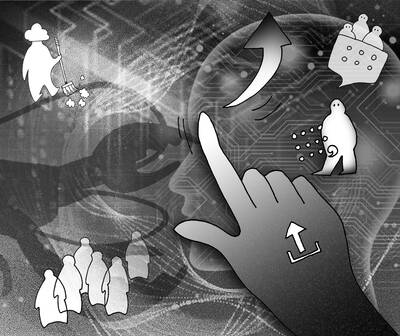
Weeks into the craze, nobody quite knows what to make of the OpenClaw mania sweeping China, marked by viral photos of retirees lining up for installation events and users gathering in red claw hats. The queues and cosplay inspired by the “raising a lobster” trend make for irresistible China clickbait. However, the West is fixating on the least important part of the story. As a consumer craze, OpenClaw — the AI agent designed to do tasks on a user’s behalf — would likely burn out. Without some developer background, it is too glitchy and technically awkward for true mainstream adoption,
On Monday, a group of bipartisan US senators arrived in Taiwan to support the nation’s special defense bill to counter Chinese threats. At the same time, Beijing announced that Chinese President Xi Jinping (習近平) had invited Chinese Nationalist Party (KMT) Chairwoman Cheng Li-wun (鄭麗文) to visit China, a move to make the KMT a pawn in its proxy warfare against Taiwan and the US. Since her inauguration as KMT chair last year, Cheng, widely seen as a pro-China figure, has made no secret of her desire to interact with the Chinese Communist Party (CCP) and meet with Xi, naming it a
A delegation of Chinese Nationalist Party (KMT) officials led by Chairwoman Cheng Li-wun (鄭麗文) is to travel to China tomorrow for a six-day visit to Jiangsu, Shanghai and Beijing, which might end with a meeting between Cheng and Chinese President Xi Jinping (習近平). The trip was announced by Xinhua news agency on Monday last week, which cited China’s Taiwan Affairs Office (TAO) Director Song Tao (宋濤) as saying that Cheng has repeatedly expressed willingness to visit China, and that the Chinese Communist Party (CCP) Central Committee and Xi have extended an invitation. Although some people have been speculating about a potential Xi-Cheng
The ongoing Iran conflict is putting Taiwan’s energy fragility on full display — the island of 23 million people, home to the world’s most advanced semiconductor manufacturing, is highly dependent on imported oil and gas, especially that from the Middle East. In 2025, 69.6 percent of Taiwan’s crude oil and 38.7 percent of liquified natural gas were sourced from the Middle East. In the same year, 62 percent of crude oil and 34 percent of LNG to Taiwan went through the Strait of Hormuz. Taiwan’s state-run oil company CPC Corp’s benchmark crude oil price (70 percent Dubai, 30 percent Brent)


 RSS
RSS