


As a vibrant democracy, Taiwan is full of various or even contentious views on every issue. In this social atmosphere, news media could hardly provide objective reports, but rather reports tinged with bias based on their audience. It is no secret that each outlet has a political leaning, be it to the pan-blue, pan-green or red camp.
Controversy stirred up by a TVBS report is a brilliant case in point. A report suggested that Bonnie Glaser, a China expert at the Center for Strategic and International Studies (CSIS) in Washington, supported the appointment of Vincent Chao (趙怡翔) as head of the political division at the Taipei Economic and Cultural Representative Office in Washington because the center received US$500,000 from the government for a research project.
Glaser fired back on Twitter, condemning TVBS for “distorting the facts to try to smear my credibility,” and claiming “it’s fake news.”
She noted that CSIS does research on the entire world, including Taiwan.
“The report falsely claims that CSIS is close to the DPP [Democratic Progressive Party]. It fails to mention the work CSIS did when Ma Ying-jeou (馬英九) was president. We hosted Ma for several video conferences,” she said.
TVBS responded by insisting that the report regarding “CSIS receiving US$500,000 is based on the public information from the CSIS Web site. So TVBS firmly asserts that this report was not cooked up, fabricated or has any mistakes.”
TVBS was right to claim that with the data obtained from the Web site, there was no fabrication or distortion in the report. However, the report was highly tendentious.
Two cases were cited to insinuate the closeness between the CSIS and the DPP. The first was President Tsai Ing-wen’s (蔡英文) visit to the center in 2015 and the second was a visit last year by then-Kaohsiung mayor Chen Chu (陳菊), who is now secretary-general to the president. Coincidentally, Glaser hosted both meetings.
Moreover, the only expert opinion, an important, symbolic guidance in the context of a news report, was from Lai Yueh-tchienn (賴岳謙), a pan-blue camp academic who endorses the “one country, two systems” framework and is a regular guest on China Central Television’s (CCTV) political program.
Lai was quoted as saying: “She [Glaser] took Taiwan’s funding and then made comments on our diplomat. That’s very inappropriate.”
With this explicit accusation and without a counter argument to balance it, it is clear that TVBS intentionally used the academic’s view to reinforce its undisclosed argument.
Most importantly, the title of the report that was shown on TV and mobile devices was: “Bonnie Glaser supports Vincent Chao: Tsai government donated think tank US$500,000.”
These words explicitly and clearly expressed the report’s main ideas and the connection it tried to make.
This is just one of the controversies sparked by a TVBS reports in recent months.
On Nov. 9 last year, American Institute in Taiwan (AIT) Chairman James Moriarty gave an interview to TVBS, warning that external forces were attempting to manipulate public opinion ahead of that month’s local elections.
In a normal situation, this kind of exclusive interview would be aired repeatedly throughout the day and sometimes the following day.
However, according to local media, TVBS broadcast the interview only once that day and never again. A video of the interview was removed from its Web site six days later. Surprisingly, it was the same day the spokesman of China’s Taiwan Affairs Office claimed that “China never meddles in Taiwan’s elections.”
Ironically, the spokesman’s news clip is still on the TVBS Web site.
As a countermeasure, the AIT posted the interview video on Facebook.
“The reason the interview was pulled from the programming lineup can only be answered by TVBS,” an AIT spokeswoman said.
In a public statement, TVBS claimed that “based on the principle of journalistic neutrality, when dealing with highly controversial news, TVBS’ internal editorial strategy is to remove them from the Web site to prevent further controversy and political manipulation from outside forces.”
It also said that “outside forces should not stir up this fake issue to press the media and interfere with the freedom of the press.”
Minister of National Defense Yen De-fa (嚴德發) has confirmed that the Chinese Strategic Support Force, a branch of China’s People’s Liberation Army (PLA) — a Chinese “troll factory” — has launched a campaign of false news against Taiwan, aiming to help pro-China groups in next year’s presidential election.
National security sources said that the unit has more than 300,000 “cyberwarriors” and the support of the Fifty-Cent Army — more than 2 million Internet commentators hired by Chinese authorities.
Specifically, China used Taiwan’s local elections on Nov. 24 last year to train cyberwarriors and the Fifty-Cent Army by spreading disinformation through YouTube and Twitter, as well as Chinese microblogging sites, the national security sources said.
China remains the biggest security threat to Taiwan since 1949. Besides military intimidation, this highly authoritarian government is exploiting Taiwan’s openness, a weakness that exists in all democratic, free nations.
China believes that meddling in Taiwan’s elections and destabilizing society are a more efficient approach to achieving its goal of unification.
TVBS enjoys freedom of the press and its reports could certainly take a position on any issue under a democratic government named Taiwan or the Republic of China.
However, it should bear in mind that it would be impossible to do so under the government of the People’s Republic of China.
Tu Ho-ting has a master’s degree in diplomacy from National Chengchi University. He is a journalist and international political analyst based in Taiwan.
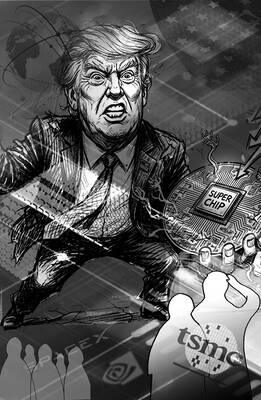
The White House’s decision to take a 9.9 percent stake in Intel Corp is looking like very shrewd business indeed. Since the government bought in at US$20.47 a share last August, the US chipmaker’s surging stock price has delivered the US a US$43 billion return. One of the reasons the investment has so far proved so sound is that the White House has made sure of it. According to The Wall Street Journal, Howard personally pushed deals on Intel’s behalf with some of the most lucrative clients imaginable. They include Nvidia Corp, the company at the heart of the AI
A single photograph can cut through a lot of noise, but it can also be used to misrepresent the truth. At the very least, it can concentrate the mind on something that requires further investigation. On Monday last week, Ma Ying-jeou Foundation CEO Tai Hsia-ling (戴遐齡) and former National Security Council secretary-general King Pu-tsung (金溥聰) held a news conference in which they showed a photograph of former foundation CEO Hsiao Hsu-tsen (蕭旭岑), now Chinese Nationalist Party (KMT) deputy chairman. In the image Hsiao is seated next to Xiamen Taiwan Businessmen Association chairman Han Ying-huan (韓螢煥). The two men were holding
I first met Professor Ray Jiing (井迎瑞) as a film and documentary student at Shih Hsin University’s (SHU) Department of Radio Television and Film in 1988. The following year, he went on to become the director of the Chinese Taipei Film Archive — forerunner of the Taiwan Film and Audiovisual Institute (TFAI). Over his eight-year tenure, Jiing rescued and restored over 200 classic Taiwanese films. In 1997, he established the Graduate Institute of Studies in Documentary and Film Archiving at Tainan National University of the Arts (TNNUA), and I joined the program in his third cohort of students. Beyond a
A recent report concerning a student who is suing his teacher posed the question in its headline: Does failing a student in two subjects constitute bullying? The college student in Chiayi County apparently sought NT$2 million (US$63,603) in state compensation, but a court dismissed the case. The first reaction of many might have been to ask: What has happened to students nowadays? Some say that teachers have lost their authority, while others say students are overindulged. Some even start reminiscing over the days when “whatever the teacher says goes.” However, the real issue might be overlooked if emotional reactions like that are the


 RSS
RSS