


The flecks of white speckled across the parched brown landscape of the Murray-Darling basin appear dramatically out of place — some kind of wintertime miracle in the southeastern Australian bush.
On closer inspection it is not snow, but something equally alien to this harsh environment: fluffy wads of cotton.
The major river system of the world’s driest inhabited continent somehow sustains this thirsty cash crop — the WWF estimates that 2,700 liters of water can be used to produce a single cotton T-shirt.
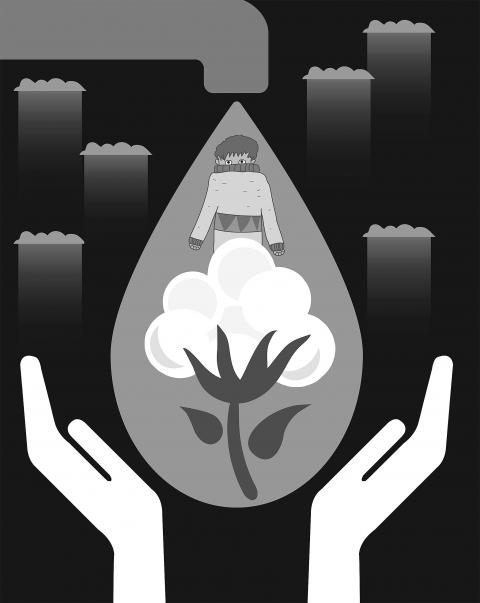
Illustration: Lance Liu
Australian conditions have pushed local farmers to become the most efficient in the game, using high-tech innovations to improve water productivity by more than 40 percent in a decade.
Yet critics note that saved water is simply reinvested in producing ever-more cotton, rather than released back into a once-mighty river network crippled by increasingly erratic rainfall since the turn of the millennium.
Both sides have turned to science to support their position — indeed both to the Commonwealth Scientific and Industrial Research Organisation (CSIRO), Australia’s national science agency, which simultaneously serves as both savior and prophet of doom for the cotton industry.
The agency has developed varieties specially adapted to Australia’s climate, disease threats and nutrient availability, CSIRO business development director for agriculture and food Lionel Henderson said.
“When I first got involved in [the] cotton industry during the early ‘80s, two bales to an acre [0.4 hectares] was standard — now five to an acre is the target,” he said. “The breeding program has helped [the] industry expand, particularly into southern New South Wales and northern Victoria — there is generally going to be water available in one of the different rivers, so by broadening the base you minimize the impact [of low rainfall in a particular region].”
The challenging nature of Australia’s conditions has led to CSIRO-bred varieties being used in similar dry climates around the world.
CSIRO has worked with companies including Monsanto Co to roll out genetically modified varieties over the past two decades, with genetically modified cotton today making up more than 99 percent of the crop.
“Monsanto develop the traits, we then work with Monsanto to incorporate those traits into varieties we are breeding,” Henderson said.
He says the main rivals to Australian growers are not foreign cotton producers, but manufacturers of other fibers. In terms of water use, cotton’s rivals are certainly more efficient, from natural fibers including hemp to synthetics such as polyester, which represents less than 0.1 percent of cotton’s water footprint, according to a 1999 AUTEX Research Journal study by Eija Kalliala and Pertti Nousiainen.
An Australian Conservation Foundation campaigner, Jonathan La Nauze, is more interested in another area of CSIRO work — the agency’s climate change research, which forecasts a dramatic rise in extreme weather events such as droughts and heatwaves, and a sharp drop in winter and spring rainfall across southern Australia.
“We’re already the driest part of the world and water use is a key concern — cotton uses a hell of a lot of it,” La Nauze said. “Growers are aggressively trying to increase [the] amount they can take rather than accept the current amount as the upper limit. We saw the Darling River stop flowing for months this year — extraordinary and avoidable.”
“The impacts on native fish and water birds have been severe, and significant opportunities to improve downstream communities have been missed — and that’s before factoring in the CSIRO’s global warming scenarios of a reduction of water availability in the northern basin,” he said.
La Nauze welcomes Cotton Australia’s measures to improve water efficiency, but says it is not much help to the environment if the saved water does not get shared around.
“The dividend should be a long-term sustainable river system — if you kill that system, you won’t have an industry,” he said.
Cotton Australia chief executive Adam Kay said asking growers to pass the dividends of improved efficiencies on to the environment is “a ridiculous thing to say” given it is farmers making the investments in the first place.
“We’ve got to help the public understand about this perception that cotton is somehow thirsty — it is a normal plant like soybeans or corn, uses about the same amount of water,” Kay said. “The issue is people with the best access to water choose to grow cotton as it offers the best return — that water would still be used to grow other crops if cotton wasn’t there.”
However, even Cotton Australia’s own promotional material acknowledges that the crop’s irrigation requirement of 8 million liters a hectare is the second-most water intensive in Australia, behind rice (12 million liters per hectare), but ahead of alternatives such as nurseries or cut flowers (5 million liters per hectare).
Analysis of Australian Bureau of Statistics data reveals both the dramatic ebbs and flows of cotton production in response to water supply, and the continuing intensity of water use, despite the progress made.
During the water-scarce season of 2014-2015, cotton sales represented 1.7 percent of Australia’s agricultural commodity value, but used 12.2 percent of its water. In the more favorable conditions of 2013-2014, cotton generated 3.9 percent of agricultural profits, but in the process devoured 24 percent of the water diverted to agriculture.
Kay said the industry has left no stone unturned in its quest for water savings and improved yield. Innovations include electromagnetic meters and soil moisture probes to monitor the need for irrigation, the laser-leveling of fields to ensure water drains evenly, weather forecasting software to know how much crop can be sustained before planting, thermal imaging to identify leaks, lining channels with non-porous materials to minimize seepage, autonomous spray rigs and tailwater recycling programs.
“We are on the cusp of incredible things with IoT [Internet of Things] technologies and digital agriculture,” Kay said. “We are using individual pieces [of data gathering] right now — it is commonplace to use drones to monitor crops and look for weed outbreaks, but the time is coming to link data from drones to data from the cotton picker to data in soil tests field and the canopy sensors — once you link it all up, you can drive incredible decisionmaking.”
The reliance on new technology has thrown up new challenges for farmers: Kay notes that regional Internet coverage is inadequate and also that growers need to develop new tech-savvy skill sets.
He says Cotton Australia’s investment of US$20 million a year into research and development can also help deal with the biggest new challenge of all: climate change.
“We have research and development projects going on looking at impacts — tents out in the field to see what higher [carbon dioxide] does to the crop, work on water use efficiency for potential scarcity in the future and managing increased temperature,” he said.
Cotton Australia is encouraging farmers to become accredited with the global Better Cotton Initiative, a framework founded by the WWF that requires members to meet stringent sustainability criteria — not to mention marketing rules.
They must promote their cotton using a selection of approved phrases, including: “The Better Cotton Initiative exists to make global cotton production better for the people who produce it, better for the environment it grows in and better for the sector’s future.”
After Chinese Nationalist Party (KMT) Chairwoman Cheng Li-wun (鄭麗文) met Chinese President Xi Jinping (習近平) in Beijing, most headlines referred to her as the leader of the opposition in Taiwan. Is she really, though? Being the chairwoman of the KMT does not automatically translate into being the leader of the opposition in the sense that most foreign readers would understand it. “Leader of the opposition” is a very British term. It applies to the Westminster system of parliamentary democracy, and to some extent, to other democracies. If you look at the UK right now, Conservative Party head Kemi Badenoch is
From the Iran war and nuclear weapons to tariffs and artificial intelligence, the agenda for this week’s Beijing summit between US President Donald Trump and Chinese President Xi Jinping (習近平) is packed. Xi would almost certainly bring up Taiwan, if only to demonstrate his inflexibility on the matter. However, no one needs to meet with Xi face-to-face to understand his stance. A visit to the National Museum of China in Beijing — in particular, the “Road to Rejuvenation” exhibition, which chronicles the rise and rule of the Chinese Communist Party — might be even more revealing. Xi took the members
A Pale View of Hills, a movie released last year, follows the story of a Japanese woman from Nagasaki who moved to Britain in the 1950s with her British husband and daughter from a previous marriage. The daughter was born at a time when memories of the US atomic bombing of Nagasaki during World War II and anxiety over the effects of nuclear radiation still haunted the community. It is a reflection on the legacy of the local and national trauma of the bombing that ended the period of Japanese militarism. A central theme of the movie is the need, at
The Chinese Nationalist Party (KMT) and the Taiwan People’s Party (TPP) on Friday used their legislative majority to push their version of a special defense budget bill to fund the purchase of US military equipment, with the combined spending capped at NT$780 billion (US$24.78 billion). The bill, which fell short of the Executive Yuan’s NT$1.25 trillion request, was passed by a 59-0 margin with 48 abstentions in the 113-seat legislature. KMT Chairwoman Cheng Li-wun (鄭麗文), who reportedly met with TPP Chairman Huang Kuo-chang (黃國昌) for a private meeting before holding a joint post-vote news conference, was said to have mobilized her


 RSS
RSS