


In the week of Groundhog Day, it seemed entirely appropriate: Greek farmers, many on tractors, have once again been blockading roads and border posts amid mounting signs that the country long at the epicenter of Europe’s debt woes is — once again — teetering toward crisis.
Protesting farmers have been a regular feature of the social unrest that has sporadically gripped Greece. It is now more than seven years since the Greek financial crisis erupted and the debt drama has often had a deja vu quality about it.
Eclipsed last year by the UK’s vote to exit the EU, and US President Donald Trump’s equally unlikely electoral victory, audience interest in the nation’s epic struggle to keep bankruptcy at bay has inevitably waned.
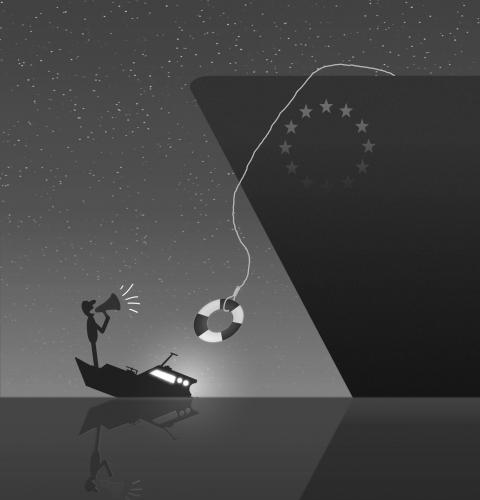
Illustration: Yusha
Yet out of the spotlight, away from the headlines, a perfect storm is brewing.
Bailout negotiations between Athens and its creditors have stalled. The possibility of Grexit, or euro exit, has re-emerged and bond yields have spiked. The yield on two-year Greek government bonds has soared from 6 percent to 10 percent in less than two weeks as spooked investors have dumped their holdings, and the shrill rhetoric last seen at the height of the crisis in 2015 has returned.
Analysts sensing dangerous deadlock are sounding the alarm — an alarm that the embattled Greek Prime Minister Alexis Tsipras was expected to raise in talks with German Chancellor Angela Merkel and other European leaders in Malta on Friday.
“I am very worried we are heading toward a rupture with the EU,” prominent political commentator Pantelis Kapsis said. “There are lots of signs that at the back of their minds people in Syriza [the ruling leftist party] are entertaining various ideas of going it alone. What is sure is that we are entering a very difficult period which quite possibly could lead us to a point of no return.”
Once again, time is of the essence. Shored up by a third EU-led bailout, Athens was told this week that further rescue funds would not be forthcoming until it concluded a compliance review of terms attached to the 86 billion euros (US$92.8 billion) aid package.
In July, Greece faces debt repayments of 10.5 billion euros — once again raising the specter of default because the country just does not have the money.
The impasse has turned into a standoff as creditors demand additional austerity once the current bailout expires.
Without further reduction of pensions — already cut 12 times since the crisis began — and the tax-free threshold of personal incomes, the IMF argues the debt-stricken country will never be able to achieve its agreed fiscal goal of a primary surplus of 3.5 percent of GDP from 2018.
In a fiery parliamentary debate late Wednesday, Tsipras dug in, insisting his two-party coalition — in power with a wafer-thin majority of two — would not cave in to demands that his government has repeatedly called absurd.
“The IMF’s demands go beyond any democratic and constitutional logic and value,” he said.
Exiled from international capital markets, completion of the review is essential to Greece being included in the European Central Bank’s bond-buying program on March 9, key to the country regaining market access.
If the deadline is missed, few believe Athens will be able to keep itself afloat without a fourth bailout once the latest loans end.
In a Europe preoccupied with other matters — and in fear of an anti-establishment ascendant far right — the prospect of that happening is slim.
“What we are witnessing is a disaster for the real economy because everything is on hold,” head of the Alco polling institute Costas Panagopoulos said.
“Once again we are talking about economic catastrophe, once again we are talking about Grexit,” he said. “The next few weeks are critical. If an agreement isn’t reached, if there is more uncertainty, we don’t know how Greeks will react.”
On Thursday amid widespread rumors of his own resignation, Greek Minister of Finance Euclid Tsakalotos attempted to deflect the spiraling tensions.
In a written statement, the Marxist economics professor said while a third of the bailout review had been “totally completed” and a third “totally agreed,” the rest remained subject to “political negotiation” — raising little hope of the talks concluding any time soon.
What happens next is not only dependent on what happens in Athens. To a great degree, events in Europe and Washington will also play a role.
Ahead of Germany’s general election in September, German Minister of Finance Wolfgang Schaeuble has also raised the stakes with growing criticism of Greece — a tactic that has proved popular with voters who might otherwise support Germany’s far right Alternative for Germany (AfD) party.
Earlier this week, Bild, the mass-selling newspaper, stoked passions further by suggesting the German government was warming to the idea of Greece leaving the euro — a notion Schaeuble has openly supported in the past.
“Grexit is not our agenda, it is the agenda of those who want the break-up of Europe,” said Sia Anagnostopoulou, a leading Syriza MP and former alternate European affairs minister.
“It is what Mr Schaeuble wants,” she added, echoing the commonly held view that Athens is hostage to Germany.
Complicating matters further is the direction the IMF will take now that Trump is in power. In his former role as billionaire businessman, Trump tweeted that the Greeks were “wasting their time” in the eurozone.
Last week, the IMF delivered its gloomiest assessment yet of Greece’s debt burden, arguing that it was not only unsustainable, but eventually likely to become “explosive.”
The IMF’s board is to formally discuss the issue today, but has already hinted that without a commitment of debt relief from the EU, it will be unable to contribute further loans.
Germany, the biggest contributor to the nearly 300 billion euros of emergency funds assigned to Greece, insists further aid depends exclusively on IMF participation.
Analysts are undecided whether the government is deliberately stalling in the hope of getting a better deal as repayment season approaches and fears of a disorderly default mount, or whether it is playing with fire.
Syriza, like every governing party before it, has been hollowed out by the eviscerating effects of having to apply policies that it came to power vowing to oppose. On Tuesday, its parliamentary spokesman took Greeks by storm proposing that Grexit be discussed “without taboo” in the 300-member House.
The once unassailable popularity of Tsipras, meanwhile, has been pummeled by the implementation of some of the harshest measures to date and few believe he has the political capital to enforce another round of austerity.
“It is not a can, but a bomb being kicked down the road,” one western diplomat said. “In a world where liberal values are under threat, we could be looking at a very dangerous scenario where the cradle of democracy also collapses.”
Bereft of growth and battered by cuts and tax increases, Greeks have become poorer and ever more cognizant of their own insolvency in a state where sovereignty exists in little more than name. One in three now live below the poverty line and unemployment hovers around 23 percent.
The latest impasse has not only seen emigration levels rise and non-repayment of household and business loans soar, but also nostalgia for the drachma grow.
That is what worries Panagopoulos, the pollster, most. What was once a minority view is changing fast with the majority of Greeks in a recent Alco survey saying it was “wrong” to have joined the euro.
“We have become a society that has no hope, not even a slice or piece of hope for the future,” he said. “The only reason people want to stay in the euro is because they fear the consequences if we were to leave, but if things don’t get better, that will change too.”
Chinese Nationalist Party (KMT) Chairwoman Cheng Li-wun (鄭麗文) on Tuesday returned from her visit to the US, where she had met with several US senators and representatives, think tanks, and overseas Taiwanese and Chinese communities, espousing her vision of promoting cross-strait dialogue as a way to evade war. On Monday last week, she sat down with US academic Orville Schell and Asia Society Policy Institute distinguished fellow Daniel Russel. Russel is a seasoned diplomat who has served in positions related to East Asian and Indo-Pacific affairs. At the conclusion of the discussion, Russel employed his considerable diplomatic experience and knowledge
I arrived in Taiwan when I was 18, fresh out of high school and trying to navigate university life. Everything felt unfamiliar. My broken Mandarin quickly revealed what I already knew: I was not from here. When I told people I was from Indonesia, many told me that I did not look Indonesian. This caught me off guard, not because it was cruel, but because of how casually it was said. Sometimes it came with curiosity, sometimes surprise, occasionally admiration for my “fair skin.” More often than not, the people asking meant no harm. It is understandable. I look ethnically
Nearly three decades after the 1997 handover, Hong Kong has become a paradox: a place where financial dynamism coexists with political repression — a reality Taiwan cannot afford to ignore. Despite a sharp contraction of civic freedoms since 2020, Hong Kong remains a major global financial center. It has recently overtaken Switzerland as the world’s largest offshore wealth hub, supported by steady inflows of capital from China and across Asia. The territory continues to serve as a key intermediary linking Chinese firms, multinational investors and global markets. Institutional continuity has played a role. The Hong Kong dollar’s peg to the
In the aftermath of China’s expulsion of the New York Times correspondent Vivian Wang (王月眉), Chinese Ministry of Foreign Affairs spokesman Lin Jian (林劍) has publicly and explicitly articulated Beijing’s core thinking on the Taiwan issue. Chinese authorities accused the newspaper of promoting what they called “Taiwan independence fallacies,” and said that its description of Taiwan as a country amounts to a challenge to the “one China” principle. The significance of the incident goes beyond the reporting dispute and has given the international community a window into the Chinese Communist Party’s (CCP) attitude toward Taiwan. Lin, in a statement, said


 RSS
RSS