

The Central Election Commission (CEC) is to decide this week whether the 14th presidential election will be held in tandem with the ninth legislative election in January next year. Although synchronizing the two elections has received a high level of public support, Chinese Nationalist Party (KMT) Chairman Eric Chu (朱立倫) has said that he has serious reservations about a merger.
A recent poll conducted by the CEC showed that 68.4 percent of respondents were in favor of the two elections being held on the same day, while 13 percent opposed the idea. Public opinions expressed at three public hearings and through an online poll also revealed similar results.
In the wake of unprecedented KMT losses in the nine-in-one elections in November last year, arguably attributable to the government being out of touch, Chu has vowed to lead the party to stand on the right side of public opinion, even if it means redirecting current government policy.
However, Chu’s stance on the election timetable demonstrated that he was driven more by political opportunism than anything else when it comes to issues that might stack the deck against the KMT.
Under the Constitution, the legislature will open the first of two sessions each year on Feb. 1, meaning that if the two elections were to be combined, the presidential election would be held in January at the latest, about four months earlier than the conventional presidential inauguration date of May 20.
With the exception of the presidential election in 2012 — which was held in January together with the eighth legislative election — since the first president was elected via a popular vote in 1996, presidential elections have taken place in March.
Chu recently opposed a combined election, saying that bringing forward the presidential election would create a four-month-long “constitutional vacuum” because President Ma Ying-jeou’s (馬英九) administration would virtually assume a caretaker role as early as January.
Pressed to explain why his new position was different from four years ago — when he strongly argued for holding the two elections together — Chu gave another reason, saying four months would be too long for a country to simultaneously have a newly elected president and an incumbent president. He said he was not much concerned about the “overlapping” issue in 2012 because, with Ma running for re-election, the “rarity in the world” had only a 50 percent chance of happening.
To emphasize whether a president-elect might do something drastic during a transition period is as much a matter of concern for smooth transition as what an outgoing president might do: Chu just used a play on words by refraining from describing the four-month transition period as a “constitutional vacuum,” and using “overlapping” instead.
Chu’s concerns reflect nothing but his lack of confidence in the democratic practices that the nation and the public have developed over the decades. Fours years ago, when Ma stood a good chance of being re-elected, it was the KMT, Chu included, that dismissed the Democratic Progressive Party’s (DPP) criticism that combining the two elections was an attempt to gerrymander the legislative election, and urged the DPP to trust Taiwan’s democracy.
Taiwan is not yet a mature democracy: There is no legislation in place to regulate the handover of power during a transitional period, absentee voting is not allowed, the right of recall is hamstrung by unreasonably high thresholds and referendums exist in name only.
Unless improvements are made to rectify such defects, it will not be the last time a party in power changes the rules to serve its own interests should the CEC decide to separate the presidential election from the legislative poll.
Taiwan’s domestic political situation is following recognizable political rhythms, while the international environment surrounding Taiwan is undergoing a major transformation. Within Taiwan, there are ongoing battles between the legislative and executive branches over the budget, and between cities and the central government over resources. Tensions between political parties dominate headlines and consume much of the attention of party leaders. Jockeying is underway for local elections this November and national elections in 2028. And the longstanding philosophical debate inside Taiwan over how best to protect Taiwan and promote the good life remains unresolved. Amidst all of this, Taiwan continues to function well. It
In an article published on Tuesday in The Atlantic, titled “Will Taiwan Just Give Up?”, journalist Simon Shuster emphasizes the unpredictability of the US as an ally under US President Donald Trump and cites diminishing faith in the US as a contributor to what he sees as waning determination to resist China. As the title suggests, Shuster views a deal between Taiwan and China as an increasingly inevitable alternative to a costly war — one that Taiwan, lacking reliable allies and military capabilities, would eventually be destined to lose. He focuses on Chinese Nationalist Party (KMT) Chairwoman Cheng Li-wun (鄭麗文) — her
With candidate registration for this year’s local elections closed on Sept. 4 and the elections less than 80 days away, Democratic Progressive Party (DPP) Legislator and Taipei mayoral candidate Puma Shen’s (沈伯洋) rapidly growing popularity has become the focus of political talk shows and online discussions over the past week, heating up the mayoral election race in Taipei. Local media headlines and political pundits have picked up his supporters’ slogan “ocean current” (洋流) — a play on the last character of Shen’s name, which literally means “ocean” (洋), and the character (流), which can mean “current,” “flow” or “trend” — to
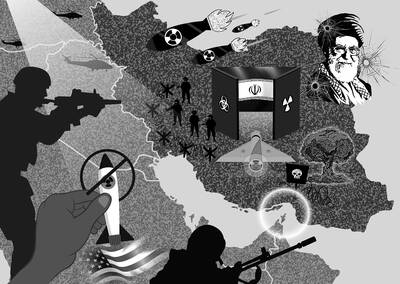
When was the last time you heard a meaningful proposal to prevent Iran from developing a nuclear arsenal? There has been nothing on the subject since the June Memorandum of Understanding between the US and Iran; the promised 60 days of talks to settle questions around Tehran’s uranium-enrichment program never began and have long since expired. When the war was launched, on Feb. 28, a resolution of the nuclear dispute was prominent among the dizzying array of US and Israeli aims to explain the attack. But as should be clear by now, the attempt was entirely reliant on achieving regime change. That


 RSS
RSS