


The National Development Conference started the new year with five opening salvos, including plans to strengthen regional balance, establish a national brand and recruit talent from overseas. Policymakers and planners have clearly been very busy, but prolificacy a literary masterpiece does not make, and national economic policymaking is not a writing competition.
It is difficult to remember all the grandiose initiatives the government has come up with over the past few years. We have had the proposed Golden Decade national prospects, the Six Key Emerging Industries initiative, the Ten Major Service Industries plan, the Three Industries, Four Reforms concept, the Economic Power-Up plan, the Cheng Ho plan and the Long-Term Plan proposal, to name but a few.
If you want to make the economic situation in Taiwan look positive, all you need do is take China out of the equation, and you are halfway there.
In 2013, when the government was trying to push the cross-strait service trade agreement and the proposed free economic pilot zones proposals through the legislature, both were blocked by what later became known as the Sunflower movement, which was essentially a pro-localization movement. Despite this, Taiwan’s economic growth last year outpaced that of South Korea, Hong Kong and Singapore, putting Taiwan in pole position among the four Asian Tigers and demonstrating the importance of placing one’s faith in the nation.
Therefore, if the government really wants to improve the economy and win back the hearts of Taiwanese, it should turn its attention to the following items, without any further delay.
First, United Microelectronics Corp should put any plans to invest US$6.2 billion in a joint venture to build a 12-inch wafer fab in China’s Fujian Province on the back burner and divert that money into investment in the Southern Taiwan Science Park — which would be in line with the “improving regional balance” part of the five initiatives and boost the nation’s high-tech industry.
The Chinese are desperate to get their hands, through UMC, on talent and technologies from Taiwan’s semiconductor industry so that they can complete their huge initiative to promote the development of China’s integrated chip industry. They have in their sights the Taiwanese semiconductor industry.
If Taiwan’s government has faith in the nation, it will do its utmost to ensure that UMC’s investment money is diverted to Taiwan to further bolster the domestic semiconductor industry.
Second, Beijing suddenly took a lot more interest last year in the annual Cross-Strait CEO Summit in Taipei after the drubbing the Chinese Nationalist Party (KMT) received in the November nine-in-one elections, trying to attract major Taiwanese companies, such as Taiwan Semiconductor Manufacturing Co (TSMC), to participate in China’s national development transformation plan. Meanwhile, the pro-China media in Taiwan have been putting out stories like “TSMC plans to set up a 12-inch wafer fab in China” to create a sense of immediacy.
Given all this, the government should be doing all it can — including the environmental impact assessment report — to help TSMC complete its 18-inch wafer fab investment project, and to dig deep and fork out the US$12 billion investment for next year, to consolidate Taiwan’s semiconductor industry.
Third, Hon Hai Precision, or Foxconn, is planning to invest 35 billion yuan (US$5.6 billion) in Hainan, China, to manufacture LCD screens for Apple Inc’s iPhone7. President Ma Ying-jeou (馬英九) should step in and advise Hon Hai chairman Terry Gou (郭台銘) to divert these funds to Taiwan in line with the government’s goal of encouraging Taiwanese companies to return home.
Ahead of the nine-in-one elections, Hon Hai also announced that it would, within the next two years, invest NT$90 billion (US$2.87 billion) in the Southern Taiwan Science Park to build a 6G low temperature polysilicon plant and another NT$200 billion in Taichung to get into the territory of the Internet of Things. The Ministry of Economic Affairs should do all it can to help it complete this plan in the short term.
In the past few years, South Korea has fallen hook, line and sinker for the “free-trade agreement” trap. It has pursued such pacts with Europe, the US and China, which on the surface appear to be good for specific industries, but have actually been detrimental to a larger number of other industries.
At the beginning of the new year, the government adjusted downward its economic growth forecast for this year from 3.9 percent to 3.4 percent.
The government should forget about the cross-strait service trade and trade in goods agreements, as well as the Regional Comprehensive Economic Partnership. Instead, it should concentrate its time and efforts on the three items mentioned above and manage and promote the domestic investment environment. If it does, it will win back the trust of the public, and Taiwan’s economy will surely soar once more.
Huang Tien-lin is a former national policy adviser.
Translated by Paul Cooper
Minister of Labor Hung Sun-han (洪申翰) on April 9 said that the first group of Indian workers could arrive as early as this year as part of a memorandum of understanding (MOU) between the Taipei Economic and Cultural Center in India and the India Taipei Association. Signed in February 2024, the MOU stipulates that Taipei would decide the number of migrant workers and which industries would employ them, while New Delhi would manage recruitment and training. Employment would be governed by the laws of both countries. Months after its signing, the two sides agreed that 1,000 migrant workers from India would
On March 31, the South Korean Ministry of Foreign Affairs released declassified diplomatic records from 1995 that drew wide domestic media attention. One revelation stood out: North Korea had once raised the possibility of diplomatic relations with Taiwan. In a meeting with visiting Chinese officials in May 1995, as then-Chinese president Jiang Zemin (江澤民) prepared for a visit to South Korea, North Korean officials objected to Beijing’s growing ties with Seoul and raised Taiwan directly. According to the newly released records, North Korean officials asked why Pyongyang should refrain from developing relations with Taiwan while China and South Korea were expanding high-level
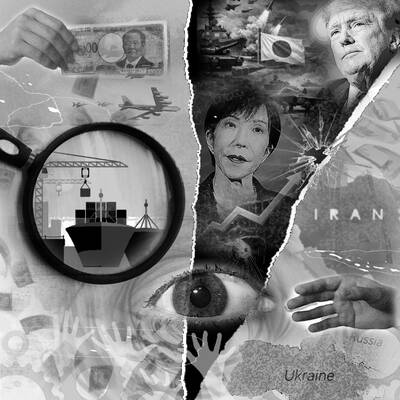
Japan’s imminent easing of arms export rules has sparked strong interest from Warsaw to Manila, Reuters reporting found, as US President Donald Trump wavers on security commitments to allies, and the wars in Iran and Ukraine strain US weapons supplies. Japanese Prime Minister Sanae Takaichi’s ruling party approved the changes this week as she tries to invigorate the pacifist country’s military industrial base. Her government would formally adopt the new rules as soon as this month, three Japanese government officials told Reuters. Despite largely isolating itself from global arms markets since World War II, Japan spends enough on its own
When 17,000 troops from the US, the Philippines, Australia, Japan, Canada, France and New Zealand spread across the Philippine archipelago for the Balikatan military exercise, running from tomorrow through May 8, the official language would be about interoperability, readiness and regional peace. However, the strategic subtext is becoming harder to ignore: The exercises are increasingly about the military geography around Taiwan. Balikatan has always carried political weight. This year, however, the exercise looks different in ways that matter not only to Manila and Washington, but also to Taipei. What began in 2023 as a shift toward a more serious deterrence posture


 RSS
RSS