


The madness season began earlier this year.
Not the unofficial electioneering for the Nov. 29 elections that began months ago, but the madness of a political implosion that comes seemingly out of nowhere to haunt the halls of power for months on end.
A year ago Taiwan was slogging through the final weeks of the heat and humidity of August, blissfully unaware of what the following month would bring. On Sept. 6 the “September strife” erupted — triggered by President Ma Ying-jeou’s (馬英九) bid to oust Legislative Speaker Wang Jin-pyng (王金平) from his post by revoking his Chinese Nationalist Party (KMT) membership.
That scandal began when the Special Investigation Division of the Supreme Prosecutors’ Office announced an investigation into Wang on allegations of unduly using his influence. The division’s press conference, held just hours after Wang had left for Malaysia to attend a wedding, triggered weeks of accusations, counterclaims, probes, more probes and lawsuits, much of which focused on the questions of who said what to whom and when.
Wang denied the allegations and said that Ma had been “misled.”
Now it is one week into what could be called the “August angst”: centered on the abrupt resignation/dismissal of former Mainland Affairs Council (MAC) deputy minister Chang Hsien-yao (張顯耀), followed by reports of an investigation into alleged misdeeds, including leaking information to China.
Once again there are questions about who said what and when — along with denials of allegations and warnings that Ma has been deceived. Chang has denied leaking information to Beijing or spying for it. He has said he fears that the president had been “hijacked” by a “small group of people.”
There has been a flurry of statements from the Executive Yuan, the MAC, council Minister Wang Yu-chi (王郁琦) and Chang amid rumors that Chang was replaced because of a conflict with Wang Yu-chi or because he somehow ran afoul of National Security Council Secretary-General King Pu-tsung (金溥聰), Ma’s longtime strong right hand.
King’s possible role in the saga is turning into a major issue, with Chang refusing to say directly if King is part of the “small group of people” he fears are influencing Ma. However, given the way King has been expanding his purview since taking up his post at the end of March, with controversial visits to the National Security Bureau, the National Police Agency, the Bureau of Investigation and other intelligence bodies, it would surprise no one to learn that he has been getting involved in the MAC as well.
The Executive Yuan’s move against Chang suffered a setback on Thursday, when the High Court Prosecutors’ Office rebuffed a request to investigate him, citing a lack of evidence that could put the case under the office’s jurisdiction. It seems the government suffered an own-goal, for the High Court prosecutors pointed out that since Ma’s government does not recognize China as a separate nation, Beijing could not be considered a “foreign government” for the purposes of a treason case.
The Taipei District Prosecutors’ Office yesterday decided it would investigate Chang for alleged violations of the National Security Information Protection Act (國家安全機密保護法). The public will now have to wait and see how this drama plays out and whether prosecutors decide there is evidence to indict Chang.
Irrespective of the outcome, Chang’s sacking has been an unholy mess that leaves few in authority looking good.
It is worth noting that the Chang saga began on Aug. 14, when Wang Yu-chi told him that he would have to resign. That is just one day after the Taipei District Prosecutors’ Office announced that Wang Jin-pyng had been cleared of allegations of influence peddling raised in September last year.
Obviously, it was time for a new scandal.
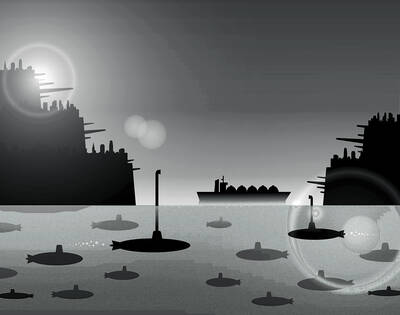
In the event of a war with China, Taiwan has some surprisingly tough defenses that could make it as difficult to tackle as a porcupine: A shoreline dotted with swamps, rocks and concrete barriers; conscription for all adult men; highways and airports that are built to double as hardened combat facilities. This porcupine has a soft underbelly, though, and the war in Iran is exposing it: energy. About 39,000 ships dock at Taiwan’s ports each year, more than the 30,000 that transit the Strait of Hormuz. About one-fifth of their inbound tonnage is coal, oil, refined fuels and liquefied natural gas (LNG),
To counter the CCP’s escalating threats, Taiwan must build a national consensus and demonstrate the capability and the will to fight. The Chinese Communist Party (CCP) often leans on a seductive mantra to soften its threats, such as “Chinese do not kill Chinese.” The slogan is designed to frame territorial conquest (annexation) as a domestic family matter. A look at the historical ledger reveals a different truth. For the CCP, being labeled “family” has never been a guarantee of safety; it has been the primary prerequisite for state-sanctioned slaughter. From the forced starvation of 150,000 civilians at the Siege of Changchun
The two major opposition parties, the Chinese Nationalist Party (KMT) and the Taiwan People’s Party (TPP), jointly announced on Tuesday last week that former TPP lawmaker Chang Chi-kai (張啟楷) would be their joint candidate for Chiayi mayor, following polling conducted earlier this month. It is the first case of blue-white (KMT-TPP) cooperation in selecting a joint candidate under an agreement signed by their chairpersons last month. KMT and TPP supporters have blamed their 2024 presidential election loss on failing to decide on a joint candidate, which ended in a dramatic breakdown with participants pointing fingers, calling polls unfair, sobbing and walking
In the opening remarks of her meeting with Chinese President Xi Jinping (習近平) in the Great Hall of the People in Beijing on Friday, Chinese Nationalist Party (KMT) Chairwoman Cheng Li-wun (鄭麗文) framed her visit as a historic occasion. In his own remarks, Xi had also emphasized the history of the relationship between the KMT and the Chinese Communist Party (CCP). Where they differed was that Cheng’s account, while flawed by its omissions, at least partially corresponded to reality. The meeting was certainly historic, albeit not in the way that Cheng and Xi were signaling, and not from the perspective


 RSS
RSS