


Premier Jiang Yi-huah (江宜樺) says that if the Greater Taipei region experiences a large-scale compound disaster that requires resettling refugees, the government’s plan is to move them to central and southern Taiwan. Jiang says that these areas could offer shelter to several million people. Jiang’s comment should inspire significant worry about what might happen to Taipei residents in the event of such a calamity.
First of all, one needs to understand what kinds of disasters are most likely to hit Greater Taipei. These include earthquakes, typhoons, floods, landslides and nuclear accidents. Of the various fault lines in the Taipei Basin, the one most likely to experience a geological rupture is the Shanchiao Fault (山腳斷層). A study published by the National Center for Research on Earthquake Engineering shows that a dislocation in the Shanchiao Fault could generate a magnitude 6.2 earthquake, which in the worst case could cause several thousand buildings to collapse. Taking into account the further danger of soil liquefaction, the direct hazard from the earthquake alone threatens tens of thousands of people.
One of the lessons of Japan’s 1995 Kobe Earthquake is that fires caused by the earthquake caused most of the deaths in urban areas. As a result, the principal focus for earthquake response drills in Japan is dealing with fires when natural gas pipes rupture. In contrast, Jiang’s emphasis on resettling several million refugees in central and southern Taiwan is far off the mark.
The next factor that needs to be considered is the location of disaster response. An analysis of this sort shows that the Taoyuan and Linkou plateaus are unlikely to suffer disastrous damage in the event of a dislocation in the Shanchiao Fault. Furthermore, the urban areas of Taoyuan and Linkou are surrounded by broad hinterlands. Disaster response plans for an earthquake in the greater Taipei region should therefore give prime consideration to the Taoyuan and Linkou plateaus, rather than looking farther afield to central and southern Taiwan.
As for typhoons, floods and landslides, they would not be on such a scale as to require moving several million people to central and southern areas. The most worrying scenarios are those of a major nuclear accident, with which Taiwan has no experience, or an eruption among the Datun Volcano Group (大屯火山群). If either happens, hundreds of thousands or even greater numbers of people might have to seek refuge.
Only correct disaster response concepts and drills can produce the optimal results. It is no use just coming up with grandiose plans for moving millions of people which would be extremely hard to coordinate. It would be better to first take the more practical steps of surveying older buildings to see how well they would stand up and holding drills on fighting the fires that could be caused by a big earthquake. Only if tasks such as these are properly carried out will it be possible to move millions of people.
Johnson Kung is chairman of the Engineers Times published by the Taiwan Professional Civil Engineers Association.
Translated by Julian Clegg
A gap appears to be emerging between Washington’s foreign policy elites and the broader American public on how the United States should respond to China’s rise. From my vantage working at a think tank in Washington, DC, and through regular travel around the United States, I increasingly experience two distinct discussions. This divergence — between America’s elite hawkishness and public caution — may become one of the least appreciated and most consequential external factors influencing Taiwan’s security environment in the years ahead. Within the American policy community, the dominant view of China has grown unmistakably tough. Many members of Congress, as
The Hong Kong government on Monday gazetted sweeping amendments to the implementation rules of Article 43 of its National Security Law. There was no legislative debate, no public consultation and no transition period. By the time the ink dried on the gazette, the new powers were already in force. This move effectively bypassed Hong Kong’s Legislative Council. The rules were enacted by the Hong Kong chief executive, in conjunction with the Committee for Safeguarding National Security — a body shielded from judicial review and accountable only to Beijing. What is presented as “procedural refinement” is, in substance, a shift away from
The shifting geopolitical tectonic plates of this year have placed Beijing in a profound strategic dilemma. As Chinese President Xi Jinping (習近平) prepares for a high-stakes summit with US President Donald Trump, the traditional power dynamics of the China-Japan-US triangle have been destabilized by the diplomatic success of Japanese Prime Minister Sanae Takaichi in Washington. For the Chinese leadership, the anxiety is two-fold: There is a visceral fear of being encircled by a hardened security alliance, and a secondary risk of being left in a vulnerable position by a transactional deal between Washington and Tokyo that might inadvertently empower Japan
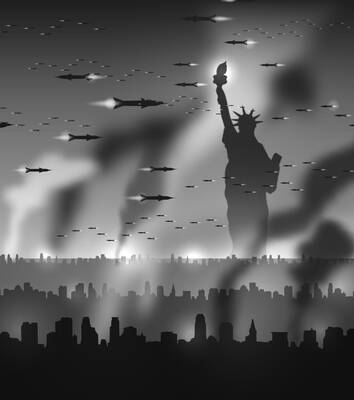
After declaring Iran’s military “gone,” US President Donald Trump appealed to the UK, France, Japan and South Korea — as well as China, Iran’s strategic partner — to send minesweepers and naval forces to reopen the Strait of Hormuz. When allies balked, the request turned into a warning: NATO would face “a very bad” future if it refused. The prevailing wisdom is that Trump faces a credibility problem: having spent years insulting allies, he finds they would not rally when he needs them. That is true, but superficial, as though a structural collapse could be caused by wounded feelings. Something


 RSS
RSS