


Recently, it seems no developing country is safe from sudden, unexpected protests.
In Brazil and Turkey, empowered middle classes pushed back against perceived governmental injustice. Protests erupted and leaders’ approval ratings dropped precipitously.
In Egypt, the economic picture was as ugly as the political one, and the military’s ouster of former president Mohamed Morsi has fomented conflict and instability.
China may look like a candidate for the type of protests currently sweeping the developing world. Not only is a newly empowered middle class demanding better services and more accountability from the government, but economic growth has also tapered off in recent quarters.
Do not hold your breath. At least for the time being, China is well-positioned to navigate such challenges far better than its emerging market competitors.
Let us start with the economy. For years, pundits and many Chinese government officials thought that if China’s GDP growth rate ever fell below 8 percent, it would set off an unemployment crisis that would raise the risk of social and political instability in the country.
Well, China’s finance minister was in Washington last week and said that the Chinese economy could handle 7 percent or even 6.5 percent growth, a lower rate than China has experienced in 23 years.
However, unlike many other emerging markets, China views slower growth as a manageable challenge. The government actually recognizes that a slowdown is necessary to meet its reform and rebalancing goals, and is working now to score political points among the population by arguing that it is doing so.
In particular, Beijing hopes that the slowdown will force industrial consolidation and less resource consumption.
This could slow environmental degradation, which has been a major point of political vulnerability for the government.
Slower growth should also calm the real estate sector, where rising prices have been a major sore point for urban Chinese.
China’s new leadership is betting that progress on these fronts will outweigh the downside risks they will face as job losses tick up in the face of slower growth.
From a global perspective, there is a strong case to be made that China’s slowing growth rate is actually a good sign.
The fact that Beijing has not just reflexively pumped capital into the system to keep growth rates up shows that it is willing to begin undertaking modest economic reforms.
It is, in effect, letting bubbles shrink rather than grow until they pop. This approach is characteristic of the new leadership that took charge in March. It is less risk-averse and has a more long-sighted handle on the necessary economic changes that China will have to undertake.
The new president himself is a cause for optimism. Chinese President Xi Jinping (習近平) has a more assertive, off-the-cuff style. He is a more spontaneous, charismatic leader than his predecessors and early reviews in China’s blogosphere suggest a favorable first impression.
Xi is using this boldness to work to consolidate his support within the Chinese Communist Party. And the extent to which he is successful will mean even more capacity for even more reform over time.
All of this does not mean that China’s stability should be taken for granted, or that there are not looming problems on the horizon.
The very fact that China does not face significant near-term instability could lead to complacency and give it wiggle room to delay necessary reforms.
China still needs long-term and significant economic and political transformations to get it from “developing” to “developed.” It has too many changes coming to its demographics, manufacturing costs and environmental needs to get away with ignoring them in perpetuity. (The US can sympathize.)
While it is a good sign that the current leadership is allowing lower growth rates in order to implement some economic reform, thus far, all changes are happening inside the system, not to the system itself.
Easy growth was the low-hanging fruit for China over the past 30 years. Now the government is reaching a bit further up the tree.
However, they still have a very long way to go to get to the upper branches. China’s other major threat is the stratification that any developing country has to navigate.
As I have written in the past, the growth of the Chinese economy has created a new middle class that has different demands from the largely rural population that China is still trying to lift out of poverty.
In the near term, the new government’s tolerance for slower growth is actually positive for helping to address some of these concerns.
Yet eventually, Beijing will have to reconcile two increasingly divergent populations. This, again, is a long-term issue.
However as these issues go unaddressed, and as more Chinese become rich enough to prioritize new sorts of rights and privileges, the chances of unrest will rise.
Do not believe the idea that China is a ripe victim for this wave of developing world protests, or that China’s slowing growth rate is a sign of an imminent hard landing.
China’s near-term picture looks surprisingly bright. However after that, the larger question still looms: Can Xi and his government handle the looming storm clouds while they are still a good way off?
Ian Bremmer is the president of Eurasia Group, a global political risk research and consulting firm, who created Wall Street’s first global political risk index. He is a Reuters columnist, but the opinions expressed here are his own.
On March 22, 2023, at the close of their meeting in Moscow, media microphones were allowed to record Chinese Communist Party (CCP) dictator Xi Jinping (習近平) telling Russia’s dictator Vladimir Putin, “Right now there are changes — the likes of which we haven’t seen for 100 years — and we are the ones driving these changes together.” Widely read as Xi’s oath to create a China-Russia-dominated world order, it can be considered a high point for the China-Russia-Iran-North Korea (CRINK) informal alliance, which also included the dictatorships of Venezuela and Cuba. China enables and assists Russia’s war against Ukraine and North Korea’s
After thousands of Taiwanese fans poured into the Tokyo Dome to cheer for Taiwan’s national team in the World Baseball Classic’s (WBC) Pool C games, an image of food and drink waste left at the stadium said to have been left by Taiwanese fans began spreading on social media. The image sparked wide debate, only later to be revealed as an artificially generated image. The image caption claimed that “Taiwanese left trash everywhere after watching the game in Tokyo Dome,” and said that one of the “three bad habits” of Taiwanese is littering. However, a reporter from a Japanese media outlet
Taiwanese pragmatism has long been praised when it comes to addressing Chinese attempts to erase Taiwan from the international stage. “Taipei” and the even more inaccurate and degrading “Chinese Taipei,” imposed titles required to participate in international events, are loathed by Taiwanese. That is why there was huge applause in Taiwan when Japanese public broadcaster NHK referred to the Taiwanese Olympic team as “Taiwan,” instead of “Chinese Taipei” during the opening ceremony of the Tokyo Olympics. What is standard protocol for most nations — calling a national team by the name their country is commonly known by — is impossible for
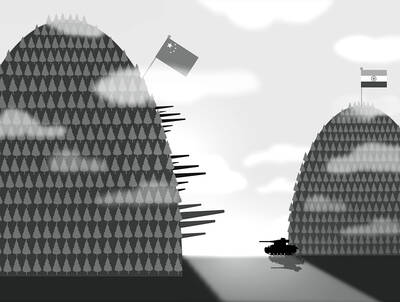
India is not China, and many of its residents fear it never will be. It is hard to imagine a future in which the subcontinent’s manufacturing dominates the world, its foreign investment shapes nations’ destinies, and the challenge of its economic system forces the West to reshape its own policies and principles. However, that is, apparently, what the US administration fears. Speaking in New Delhi last week, US Deputy Secretary of State Christopher Landau warned that “we will not make the same mistakes with India that we did with China 20 years ago.” Although he claimed the recently agreed framework


 RSS
RSS