


Public support for President Ma Ying-jeou (馬英九) has hit a low ebb and last Saturday’s huge demonstration to protest against his policies helped articulate that discontent only one day before his second-term inauguration.
In his swearing-in speech, Ma listed what he called the three legs of national security and the five pillars of national growth.
The “three legs” refer to cross-strait relations and in this respect, Ma has not made any changes to his previous position: Over the next four years his government will give priority to domestic policies; it will maintain stable development of relations across the Taiwan Strait; and it will continue to engage in economic and trade negotiations with China.
Ma outlined his “five pillars of national growth” in the opening part of his speech. The pillars are: economic growth, social justice, low carbon emissions and green energy, culture as a source of national strength and the cultivation of talent.
He said that Taiwan’s economic growth prospects are closely linked to regional economic integration and that the nation must change its protectionist mentality to create an open economic environment. These tasks are by no means simple and implementing them will require clear communication and careful coordination — not strong points in the Ma administration.
As Southeast Asian countries speed up their efforts toward economic integration, Ma’s government has failed to propose a comprehensive strategy for Taiwan to integrate into the global economy. Ma’s expectations rest on the country being able to speedily complete follow-up talks within the cross-strait Economic Cooperation Framework Agreement (ECFA), expediting economic cooperation agreements with Singapore and New Zealand and using the next eight years to fully prepare for Trans-Pacific Partnership (TPP) membership.
However, Singapore and New Zealand are not Taiwan’s main trading partners and the eight-year preparation period for joining the TPP extends well beyond Ma’s present term in office. Furthermore, he has failed to outline any plans for promoting economic integration agreements with the US, Japan, the EU, ASEAN and other important trading partners during the next four years.
Regarding cross-strait relations, Ma’s remarks show that his perspective has not changed since his first term in office, so we are unlikely to see any major breakthrough in this key issue.
Prior to Ma’s inauguration, Chinese government officials and academics said they hoped Ma could strengthen mutual trust on both sides of the Taiwan Strait, especially by expressing the standpoint that “both sides of the Taiwan Strait belong to one China.” However, Ma did not make such a statement in his speech. Moreover, he adjusted the “one country, two areas (一國兩區)” formula to that of “one Republic of China, two areas.” That is probably not what the Chinese government wanted to hear.
Ma’s attitude to cross-strait exchanges and his dialogue on democracy, human rights and the rule of law appeared too conservative and passive. He did not present a strategy for Taiwan to act as a beacon of democracy and he did not suggest any role for Taiwan’s government in this respect. He only said that he hoped civic groups from both sides would promote these things.
Regarding political reform and human rights safeguards in China, Ma simply stated that he hoped China would gradually allow greater popular participation in the political process and steadily improve its human rights situation and strengthen the rule of law. He said nothing about any active role that Taiwan’s government should play in cross-strait exchanges and negotiations.
Ma did not suggest any specific ways of promoting cooperation between ruling and opposition political parties on cross-strait issues. He only said that he was willing to engage in dialogue with opposition party leaders. Given Ma’s low public support and the antagonistic mood that exists between the government and its opposition, even if dialogue does occur, it will be hard to achieve consensus on this policy.
If Ma cannot build a consensus domestically and achieve cooperation between the government and the opposition, it will give China greater scope for manipulating the situation and dividing Taiwan. In that case, Taiwan will have even fewer cards to play in cross-strait talks and less chance of moving on to negotiations that touch on political issues.
Looking to future developments in cross-strait relations, we can expect the framework for cross-strait interaction and economic and trade talks to be maintained, but the pace of negotiation and exchange may slow down. It will be hard for Taiwan and China to move on to talks in the political sphere and harder still to reach a peace agreement or establish a mechanism of mutual trust on military matters.
Since China has not persuaded Taiwan to promise to adhere to the “one China” principle, Beijing will not make it easy for Taiwan to join and play an active role in international organizations.
Ma has said that Taiwan wants to join four subsidiary agencies of the UN, but the chances of achieving this political aim in the next four years are slight.
Tung Chen-yuan is a professor in the Graduate Institute of Development Studies at National Chengchi University.
Translated by Julian Clegg
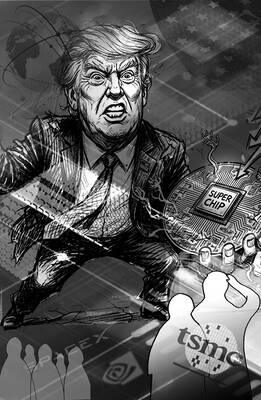
The White House’s decision to take a 9.9 percent stake in Intel Corp is looking like very shrewd business indeed. Since the government bought in at US$20.47 a share last August, the US chipmaker’s surging stock price has delivered the US a US$43 billion return. One of the reasons the investment has so far proved so sound is that the White House has made sure of it. According to The Wall Street Journal, Howard personally pushed deals on Intel’s behalf with some of the most lucrative clients imaginable. They include Nvidia Corp, the company at the heart of the AI
In a Taiwanese university classroom, a lecturer asks in English: “Can anyone give me an example from Taiwan?” Students look down. No one answers. After class, one student writes on the course platform in Mandarin: “I understood the concept, but I didn’t know how to answer in English.” That moment highlights a key issue in Taiwan’s English-medium instruction (EMI) reform: It is not just about more English-taught courses, but whether students can learn, participate and belong. EMI expansion is part of the Bilingual 2030 policy and the Ministry of Education’s BEST Program, aiming to improve English ability, support EMI teaching
A single photograph can cut through a lot of noise, but it can also be used to misrepresent the truth. At the very least, it can concentrate the mind on something that requires further investigation. On Monday last week, Ma Ying-jeou Foundation CEO Tai Hsia-ling (戴遐齡) and former National Security Council secretary-general King Pu-tsung (金溥聰) held a news conference in which they showed a photograph of former foundation CEO Hsiao Hsu-tsen (蕭旭岑), now Chinese Nationalist Party (KMT) deputy chairman. In the image Hsiao is seated next to Xiamen Taiwan Businessmen Association chairman Han Ying-huan (韓螢煥). The two men were holding
The Ministry of the Interior, working with the navy and coast guard, is organizing Taiwan’s first joint exercise simulating escort tankers carrying liquefied natural gas (LNG) and oil through a Chinese blockade. The drills simulate fuel transport along three maritime corridors leading toward Japan, the Philippines and the US. Deputy Minister of the Interior Sawyer Mars (馬士元) said that a blockade of the Taiwan Strait would amount to “almost a 100 percent blockade of the regional energy supply.” Minister of National Defense Wellington Koo said planning to counter a blockade is standard practice in Taipei. While the exercise is limited in


 RSS
RSS