


At a press conference on July 1, 2010, President Ma Ying-jeou (馬英九) said the Economic Cooperation Framework Agreement (ECFA) would ensure that Taiwan did not become economically marginalized. However, as can be seen from the two free-trade agreements (FTA) entered into by South Korea — with the EU last year and with the US this year, as well as the proposed FTA between South Korea, China and Japan — Taiwan will not be able to escape the shadow of economic isolation after all. It is clear that the ECFA is not the panacea it was promised to be and the public are right to be concerned for the future.
The ECFA is a framework agreement and as such, it only includes the preferential items on the early-harvest list and issues for planned future negotiations. It is not an FTA. The products on the early-harvest list account for only 16 percent of Taiwan’s exports to China and 10 percent of its imports from China. Issues to be discussed in follow-up negotiations include trade in goods and services and a mechanism for resolving disputes, although the two governments have not yet fixed a timetable for talks. That means that the economic effect of the ECFA is currently limited to the deregulation of early-harvest items, as well as the effects it has on the expectations of domestic and international companies.
Judging from export competitiveness alongside domestic and international investments, the overall effect of the ECFA is rather limited thus far. According to data from Chinese customs, China’s imports from Taiwan grew by 8 percent last year, while imports of early-harvest items grew by 9.9 percent, which is not much higher. It is true that some Taiwanese items on the early-harvest list saw rapid growth in exports to China, but this is limited to a few isolated items and will not do much to promote Taiwan’s overall exports to China.
Judging the export competitiveness of various countries by their share of China’s import market implies that the ECFA has not really been of great benefit to Taiwan. In the first six months after the ECFA came into effect early last year, Taiwan’s China market share dropped to 7.4 percent. It then dropped further to 6.9 percent in the second half of the year, the lowest figure since 1993.
Foreign direct investment in Taiwan remains low and real foreign investment dropped sharply for three consecutive years after Ma came to power. The figure increased slightly last year, by 7.6 percent to US$3.4 billion, but that is still relatively low. If we observe international capital flows, including both direct investment and securities investments, average net international investment in Taiwan was a negative US$27.67 billion per year during Ma’s first four years in power. That is twice as high as during the Democratic Progressive Party’s (DPP) eight-year rule, making it the period with the largest capital outflows ever.
Domestic investment momentum has also continued to decline: During the 1990s, the real investment rate was 28 percent and under the eight years of DPP rule, the figure was 23.7 percent. By contrast, during Ma’s first term, the average real investment rate was only 17.7 percent. The Directorate-General of Budget, Accounting and Statistics forecasts that the figure may even drop to 16.2 percent this year, an all-time record low.
As for a breakthrough in Taiwan’s participation in the process of East Asian economic integration, the ECFA might be able to help the nation initiate FTA talks with Singapore as well as a feasibility assessment on an FTA with New Zealand. However, trade with Singapore only accounts for 3.6 percent of Taiwan’s total external trade and a trifling 0.2 percent with New Zealand. Even if Taiwan signs FTAs with these countries, the contribution to the nation’s economic growth would be limited. On the other hand, there has been no progress on initiating FTA talks with major trade partners such as the US, the EU and Japan.
By comparison, Taiwan’s major economic rival South Korea has completed nine FTAs, including ones with ASEAN, India, the EU and the US, and it is currently holding FTA talks with another eight economies, including talks with China, which were launched on May 2. The impact on Taiwan’s exports of South Korea’s FTAs with the EU and the US alone could cost as much as NT$500 billion (US$16.9 billion) in lost revenue. At the moment, China, Japan and South Korea have agreed to start FTA talks by the end of the year. Such an agreement would mean that 90 percent of Taiwan’s exports would be affected by South Korea’s FTAs.
In the face of the severe challenge posed to Taiwan by its inability to participate in East Asian economic integration, Ma should display sincerity, determination and executive ability by fully integrating domestic opinions and interests and switching to a balanced and multilateral strategy. Apart from actively pushing for a multilateral international free-trade system and a unilateral liberalization of Taiwan’s economic system, the nation should concentrate its resources on simultaneous completion of free-trade talks with China and the US. That would be the only way to minimize China’s international political containment of Taiwan and maximize Taiwan’s own international economic benefits at the same time.
Tung Chen-yuan is a professor in the Graduate Institute of Development Studies at National Chengchi University.
Translated by Eddy Chang
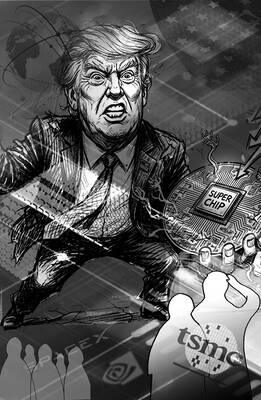
The White House’s decision to take a 9.9 percent stake in Intel Corp is looking like very shrewd business indeed. Since the government bought in at US$20.47 a share last August, the US chipmaker’s surging stock price has delivered the US a US$43 billion return. One of the reasons the investment has so far proved so sound is that the White House has made sure of it. According to The Wall Street Journal, Howard personally pushed deals on Intel’s behalf with some of the most lucrative clients imaginable. They include Nvidia Corp, the company at the heart of the AI
In a Taiwanese university classroom, a lecturer asks in English: “Can anyone give me an example from Taiwan?” Students look down. No one answers. After class, one student writes on the course platform in Mandarin: “I understood the concept, but I didn’t know how to answer in English.” That moment highlights a key issue in Taiwan’s English-medium instruction (EMI) reform: It is not just about more English-taught courses, but whether students can learn, participate and belong. EMI expansion is part of the Bilingual 2030 policy and the Ministry of Education’s BEST Program, aiming to improve English ability, support EMI teaching
A single photograph can cut through a lot of noise, but it can also be used to misrepresent the truth. At the very least, it can concentrate the mind on something that requires further investigation. On Monday last week, Ma Ying-jeou Foundation CEO Tai Hsia-ling (戴遐齡) and former National Security Council secretary-general King Pu-tsung (金溥聰) held a news conference in which they showed a photograph of former foundation CEO Hsiao Hsu-tsen (蕭旭岑), now Chinese Nationalist Party (KMT) deputy chairman. In the image Hsiao is seated next to Xiamen Taiwan Businessmen Association chairman Han Ying-huan (韓螢煥). The two men were holding
The Ministry of the Interior, working with the navy and coast guard, is organizing Taiwan’s first joint exercise simulating escort tankers carrying liquefied natural gas (LNG) and oil through a Chinese blockade. The drills simulate fuel transport along three maritime corridors leading toward Japan, the Philippines and the US. Deputy Minister of the Interior Sawyer Mars (馬士元) said that a blockade of the Taiwan Strait would amount to “almost a 100 percent blockade of the regional energy supply.” Minister of National Defense Wellington Koo said planning to counter a blockade is standard practice in Taipei. While the exercise is limited in


 RSS
RSS