


President Ma Ying-jeou (馬英九) has challenged Democratic Progressive Party (DPP) Chairperson Tsai Ing-wen (蔡英文) to a debate, but is there really any need to debate whether the government’s policies are pro-Chinese? The way the Chinese Nationalist Party (KMT) forced through the Economic Cooperation Framework Agreement (ECFA) without paying any attention to public opinion is clear proof of the party’s pro-China stance.
Beijing made it clear long ago that using economic means to spur unification and using business to force political talks is a core component of the Chinese Communist Party’s Taiwan policy. The Ma government rushed to sign the agreement and has kept on insisting that it has nothing to do with politics or sovereignty. However, the ECFA does have political premises and poses a huge threat to Taiwan’s existence.
To make matters worse, Taiwan’s economy has been deeply affected by the ECFA. Here are a few random examples.
First is the stock market crisis. On Sept. 27, the TAIEX -plummeted 169 points, falling below the psychological 7,000 mark to its lowest level in two years. The government blamed the crisis on international factors, but does not explain why the TAIEX has dropped more than markets in other nations. Since the ECFA was signed more than a year ago, the TAIEX has dropped more than other Asian stock markets, making it clear that the ECFA was mostly to blame for the recent crisis.
Second is the salary crisis. Taiwan employs 6.64 million people and 60 percent of these are blue-collar workers. The month the ECFA was signed, the average monthly salary was NT$33,957 (US$1,115), but a year later this had dropped to NT$33,772. Compared with the average salary of NT$35,049 in 2000, it has dropped NT$1, 277, or 3.6 percent. This is exactly what happened in Hong Kong after it signed the Closer Economic Partnership Arrangement with China, which sent the average salary from HK$27,708 (US$3,559) down to HK$24,244. There are now 114,000 Taiwanese households living below the poverty line, and it seems salaries in the ECFA age will continue to plummet.
Third is the housing crisis. Housing is a basic human right, but it has become very hard to find suitable housing in Taipei because of worsening speculation. Last quarter, the average price per ping (3.3m2) was NT$570,000, an increase of 13 percent for the quarter, with the total cost for an apartment averaging NT$27.87 million, which means that people would have stop eating and drinking for 16 years before they could buy a home. The average person would never have a chance to own their own home.
Fourth is the large drop in the export growth rate. As of August, exports to China grew by 7.9 percent, 1.96 percentage points lower than the growth rate of 9.86 percent that was experienced from January to June. However, for the same month, South Korea experienced a growth rate of 21.2 percent. In terms of export growth to the rest of the world, from January to August, Taiwan’s exports grew by 15.7 percent, well behind South Korea’s 24.6 percent and Singapore’s 21.1 percent growth rates.
Fifth is the outflow of business and industry. As more companies move to China in search of the first opportunities of the ECFA, instances of investments of NT$480 billion and NT$180 billion have gone to China. Such numbers are astonishing. This has caused a serious shortage of domestic Taiwanese investment and foreign investment has also stopped as a result. Economic momentum is dropping off day by day.
There may be little for Taiwanese to like about the ECFA, but the government is still in love with it. If it didn’t lean toward China, it would have never thought the ECFA was a good idea.
Huang Tien-lin is a former national policy adviser to the president.
Translated By Drew Cameron
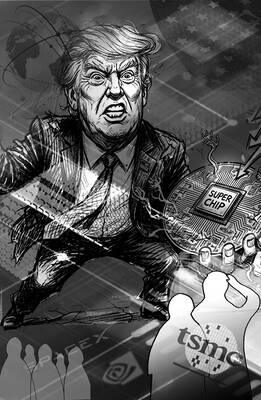
The White House’s decision to take a 9.9 percent stake in Intel Corp is looking like very shrewd business indeed. Since the government bought in at US$20.47 a share last August, the US chipmaker’s surging stock price has delivered the US a US$43 billion return. One of the reasons the investment has so far proved so sound is that the White House has made sure of it. According to The Wall Street Journal, Howard personally pushed deals on Intel’s behalf with some of the most lucrative clients imaginable. They include Nvidia Corp, the company at the heart of the AI
A single photograph can cut through a lot of noise, but it can also be used to misrepresent the truth. At the very least, it can concentrate the mind on something that requires further investigation. On Monday last week, Ma Ying-jeou Foundation CEO Tai Hsia-ling (戴遐齡) and former National Security Council secretary-general King Pu-tsung (金溥聰) held a news conference in which they showed a photograph of former foundation CEO Hsiao Hsu-tsen (蕭旭岑), now Chinese Nationalist Party (KMT) deputy chairman. In the image Hsiao is seated next to Xiamen Taiwan Businessmen Association chairman Han Ying-huan (韓螢煥). The two men were holding
I first met Professor Ray Jiing (井迎瑞) as a film and documentary student at Shih Hsin University’s (SHU) Department of Radio Television and Film in 1988. The following year, he went on to become the director of the Chinese Taipei Film Archive — forerunner of the Taiwan Film and Audiovisual Institute (TFAI). Over his eight-year tenure, Jiing rescued and restored over 200 classic Taiwanese films. In 1997, he established the Graduate Institute of Studies in Documentary and Film Archiving at Tainan National University of the Arts (TNNUA), and I joined the program in his third cohort of students. Beyond a
A recent report concerning a student who is suing his teacher posed the question in its headline: Does failing a student in two subjects constitute bullying? The college student in Chiayi County apparently sought NT$2 million (US$63,603) in state compensation, but a court dismissed the case. The first reaction of many might have been to ask: What has happened to students nowadays? Some say that teachers have lost their authority, while others say students are overindulged. Some even start reminiscing over the days when “whatever the teacher says goes.” However, the real issue might be overlooked if emotional reactions like that are the


 RSS
RSS