


As a close observer of Taiwan’s public diplomacy for almost 20 years, I recognize the government’s intentions in this area and respect them. Taiwan is in a very difficult international situation and must struggle to be heard by a world that on the whole chooses to avoid listening to it.
In such an environment, public diplomacy must remain an instrument of Taiwan’s foreign policy. In the absence of hard power — diplomatic recognition, international legitimacy and membership in leading international organizations — and with a contested sovereignty that involves a bigger and more powerful neighbor, Taiwan will only survive and prosper by devoting more attention and resources to the study and application of soft power.
However, my research has revealed a fundamental flaw in Taiwan’s current strategy, and this is the over-dependence on culture (ie, traditional Chinese culture) as the dominant theme in international communications and engagement.
The government has proposed establishing Taiwan Academies to help project this culture, teach traditional Chinese characters and history, and hence generate interest in the country. This, however, is a false logic.
The Taiwan Academies will not add any value or benefit to current endeavors and will certainly not alleviate the many serious problems facing Taiwan in the international arena.
The first reason is the academies demonstrate how Taiwan is trying to run before it can walk. Despite all the excellent work of the Government Information Office (which needs reorganizing, not abolishing), the Ministry of Foreign Affairs, the Council of Cultural Affairs and the Tourism Bureau, few people across the world either know or care about Taiwan. Many would have great difficulty locating Taiwan on a map.
Why does the government think that the Taiwan Academies will make any difference? If no one knows where Taiwan is, why would they seek out and engage with the academies? Before Taiwan begins to think about creating anything resembling the academies, it is essential to first make sure the world is aware of Taiwan and starts to know its story.
The second reason the academies are a bad idea is the most important: They will be in direct competition with the Confucius Institutes of the People’s Republic of China (PRC). The government and the civil service may assure me that this is not the case, and I concede that it is not Taiwan’s intention to engage in such competition. However, in the realm of public diplomacy, sometimes the intention is less significant than the message, and it is certainly less important than the perception of actions among global audiences.
For the international community the Taiwan Academies will be a direct competitor with the Confucius Institutes, and whatever the government says to the contrary will not make the slightest difference. This perception will make competition the story, and Taiwan’s good intentions will be ignored. Once again, Taiwan will be seen as lacking innovation and will be accused of simply riding the coattails of the PRC. (For example, why did the Taipei International Floral Expo use almost exactly the same five mascots as the 2008 Beijing Olympics? Did no one spot the similarity and consider how this would project a negative image of Taiwan?)
The academies are a symptom of a larger and more serious problem in Taiwan’s public diplomacy that has revealed itself during my research this year. Taiwan is telling the wrong story to the world. By emphasizing culture as the priority in the public diplomacy strategy — Taiwan as the preserver of traditional Chinese culture — it is missing the opportunity to define itself and tell a more exciting and relevant story that would generate international interest.
Taiwan is the first Chinese democracy. It has experienced one of the smoothest and most successful political transitions in Asia and is today a vibrant challenge to the crazy idea that democracy is somehow inimical to Asian or Chinese culture (the nonsense of the so-called “Asian Values” theory). Remember that whatever happens or does not happen in the PRC — whether China marches forward to democracy or retrenches under internal pressures and fervent nationalism — Taiwan will always be the first Chinese democracy.
How this happened is a fascinating and often moving story, but where is it being told? Who is telling it? It may come as a surprise to learn that few people across the world are interested in the history and calligraphy of traditional Chinese characters (How many visitors to the exhibitions being organized around the world know the difference between traditional and simplified characters?).
Culture must be part of a more holistic strategy; it has an important and strategic role to play and certainly helps to define Taiwan. However, it is not the whole story and should not be the entire focus of Taiwan’s public diplomacy strategy.
In the struggle to define Taiwan, in the noble efforts to identify what is unique and different about this country, the current strategy is deliberately ignoring the one narrative that makes Taiwan stand out and differentiate it from the PRC. To repeat, Taiwan is the first Chinese democracy.
Moreover, Taiwan is not “the heart of Asia” despite claims in the new advertising campaign. Every country in Asia claims it is the true heart of the continent (think “Malaysia, truly Asia”). “Touch your Heart” was a far more successful brand. It suggests warmth, friendship, intimacy, the promise of a genuinely touching experience. “The heart of Asia” tells us nothing, promises nothing. Taiwan no longer stands out from the crowd. Moreover, by changing the brand, Taiwan has destroyed the brand-familiarity among the audience, the result no doubt of many years and a considerable amount of finance.
Taiwan has many opportunities to improve its public diplomacy, to persuade the world that this is a vibrant, modern, democratic society. Taiwan has an enviable amount of “soft power” capital at its disposal because of its recent history (not because of ancient Chinese history — the PRC has that market cornered and Taiwan cannot compete). This involves telling a political and social rather than a cultural story.
By creating the academies, Taiwan is suggesting that it knows nothing about itself — what makes this country a unique and fascinating place. Moreover, it reveals that Taiwan neither knows nor cares about its target audience (a fatal error), preferring instead to believe that its audience will accept whatever it gives them.
Above all, Taiwan is creating a narrative that suggests Taiwan is (at best) competing with and (at worst) copying the PRC and its Confucian Institutes. It is not too late to face the facts: The Taiwan Academies are a bad idea, and it would be in Taiwan’s long-term interest to abandon their creation immediately.
Gary Rawnsley is a professor of international communications at the University of Leeds, UK. He was awarded a Taiwan Studies Fellowship by the Ministry of Foreign Affairs this year to research Taiwan’s public diplomacy and soft power.
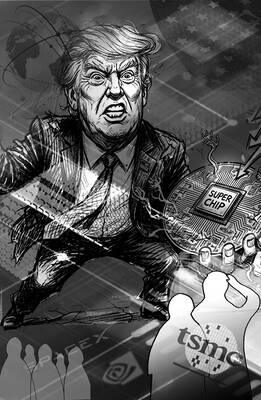
The White House’s decision to take a 9.9 percent stake in Intel Corp is looking like very shrewd business indeed. Since the government bought in at US$20.47 a share last August, the US chipmaker’s surging stock price has delivered the US a US$43 billion return. One of the reasons the investment has so far proved so sound is that the White House has made sure of it. According to The Wall Street Journal, Howard personally pushed deals on Intel’s behalf with some of the most lucrative clients imaginable. They include Nvidia Corp, the company at the heart of the AI
KMT Chairwoman Cheng Li-wun’s (鄭麗文) recent visit to Beijing and her upcoming visit to Washington will serve as a high-level test of her diplomatic mettle. In Beijing, Cheng was received with symbolic gestures, a warm reception, and high-level access. In Washington, she will receive far less pomp and far sharper questions about the KMT’s vision for the future of Taiwan. Her challenge will be to persuade Washington that the KMT’s engagement with China can coexist with strong deterrence. Cheng’s April 7-12 visit to mainland China coincided with an intense period of conflict in Iran. Despite the strategic significance of Cheng’s trip,

The closure of the Strait of Hormuz has sent the vast Asian chemicals industry into a tailspin. Deprived of the likes of Qatari natural gas and Saudi Arabian oil, the region’s fertilizer and plastics plants are slowing production or even shutting down. Everywhere except China, that is. In petrochemicals, China is unique. As well as a traditional industry that uses oil and gas as feedstock, it has parallel output that relies on its abundant domestic coal. Unsurprisingly, India and other regional powers want to copy and paste the Chinese method. This would not be easy — or climate friendly. The
Indonesian President Prabowo Subianto says he knows how to fix the problems facing Indonesia. Yet his economic mismanagement and authoritarian tendencies are steering the nation toward a familiar mix of currency instability and political chaos. The world’s fourth-most populous nation risks reversing the hard-won democratic and business reforms that came after the Asian Financial Crisis in 1997. At that time, the rupiah collapsed and the political upheaval that followed forced former president Haji Mohamed Suharto from power. Prabowo’s administration is ignoring similar warning signs. That disconnect was apparent in a national address on Wednesday, when Prabowo projected the swagger that has


 RSS
RSS