

Members of the public rarely get a chance to express their frustration face to face with the president. However, banana growers recently got the chance to complain to President Ma Ying-jeou (馬英九) about the government’s handling of the current banana surplus, but Ma simply replied: “Why didn’t you tell me earlier?”
This stunning response was enough to leave one in despair and it just goes to show what little regard the government has for farmers and agriculture in this country.
The past couple of years have been particularly bad for farmers. The stress from a wave of land expropriations last year led some to attempt or commit suicide and more were driven to suicide this year with a drop in grain prices. Toiling on the land under the fierce summer sun reportedly caused further deaths.
In contrast, speculators benefited from big cuts in land appreciation taxes thanks to amendments to the Land Tax Act (土地稅法) in 2005. Capitalists did well from a significant fall in inheritance and gift taxes that followed from amendments to the Estate and Gift Tax Act (遺產及贈與稅法) in 2009. Similarly, corporations were helped out by additional tax breaks, financial incentives and cheaper long-term water and electricity bills introduced under last year’s Industrial Innovation Act (產業創新條例). On top of that, public servants received a 3 percent salary increase, while benefits for armed forces veterans have gone up by NT$600 a month.
However, as soon as the idea of increasing agricultural subsidies is broached, the government says the coffers are empty. Fertilizer and insecticide keep getting more expensive, while prices for agricultural products and land are constantly fluctuating. Farmers are left with nothing and yet are saddled with the responsibility of providing inexpensive grain to feed people in the cities. How is this fair?
On July 17 and July 18 last year, thousands of farmers and supporters packed Ketagalan Boulevard in Taipei to protest against the government’s policy of abusive land expropriations. Premier Wu Den-yih (吳敦義) responded by saying the government would set aside and conserve areas of land for agricultural use. He said that such land would only be used for national development projects when absolutely necessary and only when there was no other suitable land available.
The problem is that this designated agricultural use land is often flat terrain, complete with farm roads and waterways, which makes it ideal for redevelopment, as costs can be kept low and profits high. For this reason, expropriations have continued.
Studies show that during the past year at least 10,000 hectares of farmland nationwide, the vast majority of which is in areas zoned for agricultural use, have come under threat of being reassigned for non-agricultural development. Projects in the planning stages include the Taiwan Northeast Coast National Scenic Area, the Jiyang (吉洋)-designated area in Greater Kaohsiung and the areas surrounding the Central Taiwan Science Park’s (CTSP) Erlin (二林) development site in Changhua County.
Those being implemented include: urban expansion in Tucheng District (土城) and the area around Taipei Harbor in New Taipei City (新北市); the Hsinchu Science Park, Taiwan Knowledge Economic Flagship Park and the Cyonglin Township (芎林) expansion — all in Hsinchu County; and the Sinan (溪南) industrial zone in Wurih District (烏日), the Taichung High Speed Rail (HSR) Station gateway area and the area surrounding the CTSP’s Taichung base — all in Greater Taichung.
Expropriation is under way in areas around HSR stations throughout the country, the core part of CTSP’s Erlin development site and Dapu (大埔) in Miaoli County’s Jhunan Township (竹南), among others. It appears that the proposed Houlong (後龍) technology park in Miaoli County is the only project for which permission for development has actually been denied.
Another complication comes from the government’s decision to implement a luxury tax to discourage property speculation that has been driving up land prices in the greater Taipei area. However, it has been reported this has only prompted speculators to shift their attention onto farmland, where the tax does not apply.
During a recent public meeting held by the Ministry of the Interior’s Construction and Planning Agency on amendments dealing with the construction of agricultural buildings on farmland, the majority of those attending were not farmers, but rather representatives of construction companies and real-estate agents, who were united in their objection to the strict amendments proposed.
To be fair, the government — and particularly the Ministry of the Interior and the Council of Agriculture — have responded to the public’s demands about the farmland expropriation issue, but have failed because the heads of local governments run by the Chinese Nationalist Party (KMT) see expropriating tracts of farmland as a lucrative way to develop land, and so they continue to do so.
In an interview on Dec. 5 last year, Taichung Deputy Mayor Hsiao Chia-chi (蕭家旗) said with pride that the Taichung area was in the best financial shape among the then-impending four special municipalities plus Taipei City. He said that the city had achieved this by developing resources through the redesignation of city land, zoning and land expropriation, with tax-exempt agricultural land being turned into land for construction use. The city was not only able to make money from the sale of land, he said, but also to greatly increase its revenues from land value, land-value appreciation and property taxes.
Whether it is huge swathes of land swallowed up by new cities and urban expansion or industrial zones, science parks and residential development projects slowly eating away at undeveloped land, there is more at stake than simply losing more prime farmland: There are also issues of climate change and food security and, by extension, the nation’s future.
This weekend saw a repeat of last year’s demonstration on Ketagalan Boulevard and the significance of this protest goes beyond the fight for individual farmers’ right to survive. It involves the very future of farming in Taiwan, food security and indeed the future of the nation as a whole. This is a cause that every Taiwanese should support, taking to the streets if necessary.
Chan Shun-kuei is a lawyer and chairman of the Taiwan Bar Association’s environmental law committee.
TRANSLATED BY PAUL COOPER
Taiwan’s democracy and high-tech economy play a crucial role in global affairs and are central to the world’s embrace of a raft of next-generation technologies, including AI. It is underpinned by a security relationship with the United States that’s existed in several iterations since 1949 and the Chinese Nationalist Party’s (KMT) retreat from China. A central pillar of that security relationship is the American willingness to sell arms to Taiwan. Indeed, since 1979 it has been embedded in US law, with the Taiwan Relations Act (TRA) charging the US with helping to improve the island’s ability to deter an attack from
Academia Historica director Chen Tsui-lien (陳翠蓮), speaking at the handover ceremony for her new role on Monday, said that when she accepted the position, she knew that her peaceful life as a history professor was a thing of the past, and that from now on she would have to “wear a helmet.” A specialist in Taiwan’s post-World War II history and the 228 Incident, she has been accused of being politically divisive. A phrase she used in her acceptance speech set headlines alight this week, putting her in the sights of editorials in blue-leaning media. She said opposition figures calling for
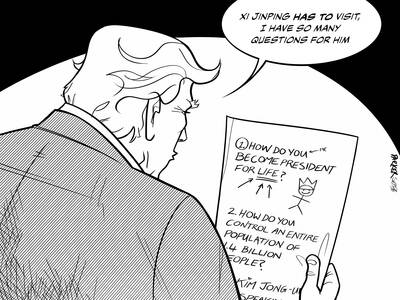
EDITORIAL CARTOON
Taiwanese-Americans, lawmakers and civic groups marched through Manhattan on Saturday last week in support of Taiwan’s participation in the UN. Marshall Islands Permanent Representative to the UN John Silk joined the demonstration, saying he hoped Taiwan would one day be able to participate in UN meetings as a member, and Democratic Progressive Party Legislator Wang Yi-chuan (王義川) took part while visiting New York City with a delegation. Taiwanese communities in Vancouver held a “UN for Taiwan” event. The campaign comes as the 81st UN General Assembly gets under way. In Taipei, President William Lai (賴清德) said China was deliberately misinterpreting UN


 RSS
RSS