


Democratic Progressive Party (DPP) Chairperson Tsai Ing-wen(蔡英文) is making an overseas visit to the UK and Germany in her capacity of the party’s official presidential candidate.
In Taiwan’s electoral politics, foreign visits always have domestic implications. Contrary to her predecessors’ decisions to visit the US, Tsai specifically chose Europe as first stop. The main purpose of the trip, according to Tsai’s spokesperson Chen Chi-mai (陳其邁), is to discuss her nuclear-free and green energy policies following the German government’s decision to shut down its nuclear power plants.
In London, Tsai is expected to elaborate on her cross-strait and foreign policy blueprints by connecting Taiwan’s position to regional and global security strategies.
Previous presidential candidates, including former president Chen Shui-bian(陳水扁), former DPP candidate Frank Hsieh (謝長廷), as well as President Ma Ying-jeou (馬英九), all made trips to Washington in the early part of their campaigns.
As China has had a huge mistrust of DPP leaders, Tsai’s trip abroad is a delicate issue, largely because of possible interference from Beijing. However, Beijing could be making a mistake if it tries to pressure Germany or the UK into blocking Tsai’s visits. Such obstructive measures would only boost Tsai’s campaign.
Next January’s presidential election will be held two months earlier than is the norm, so Tsai’s visit to the US is strategically proposed for September.
Tsai can make the best use of her trip to the US and probably score points if she portrays herself as a potential national leader with a comprehensive understanding of the triangular relationship between Washington, Taipei and Beijing.
Tsai has built up a reputation as a “professional negotiator” since she consulted with the former Chinese Nationalist Party (KMT) government on participation in the WTO and gained experience as a national security and cross-strait policy adviser to both former presidents Lee Teng-hui (李登輝) and Chen. This has deepened the public’s impression of her having a more international vision than her DPP predecessors. Her trip to Washington will be a plus to her campaign.
Nevertheless, Tsai will meet tremendous challenges on her way to the US as the Washington establishment will want all the details of her cross-strait policy. Tsai and the DPP have already renounced the use of the so-called “1992 consensus” as the political basis for future dialogue with the Chinese Communist Party (CCP).
However, if the DPP is to regain power, Tsai will have come up with either a more persuasive rationale behind what is currently an ambiguous position or explain an alternative scenario for possible DPP-CCP talks in the future.
Also, Tsai faces a huge political hurdle to “re-brand” the DPP’s “troublemaker” image in US-China relations. Although such an image is mostly twisted and politicized, Tsai will have to present herself as a responsible and consistent DPP leader who can bridge ideological divisions with her US counterparts. On cross-strait and foreign policy, Tsai has no room to be ambiguous. She must demonstrate clear vision.
Since Tsai’s team has targeted mostly domestic issues — such as the widening gap between the rich and the poor, nuclear programs, food safety and government efficiency — as key campaign agenda, it is expected that Tsai will discuss her cross-strait policy in a safe way without illustrating a methodology in too much detail.
In that case, the US will definitely push Tsai to offer “strategic reassurance” on the cross-strait situation. Whether Tsai should follow in Chen’s footsteps by promising Washington several “noes” — as he did in his 2000 presidential campaign — constitutes the greatest challenge to her planned trip to the US. Moreover, as Tsai’s chances of unseating Ma increase, Washington will be on full alert to the cross-strait situation, especially on how Beijing might react to a potential DPP return.
Ma also has the foreign policy card to play in reaction to Tsai’s manipulation of overseas visits. In his capacity as the president, Ma is forbidden to travel to Washington.
However, he could incorporate the “transit” card on the east coast of the US if there is a need to downplay Tsai’s trip to the US capital. Vice President Vincent Siew’s (蕭萬長) recent transit in New York City could be interpreted as paving the way for Ma’s possible “transit.”
In sum, Tsai stands a better chance than Ma to build up a fresh international image as Taiwan’s next president and possibly the first female president in East Asia. However, she will have to present herself as more than just a new face. She will need a clear and detailed agenda.
Liu Shih-chung is a senior research fellow at the Taipei-based Taiwan Brain Trust.
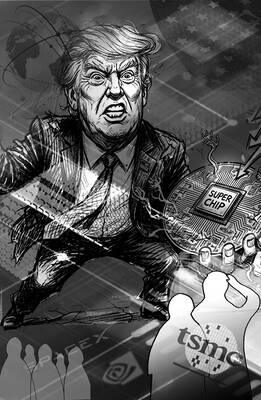
The White House’s decision to take a 9.9 percent stake in Intel Corp is looking like very shrewd business indeed. Since the government bought in at US$20.47 a share last August, the US chipmaker’s surging stock price has delivered the US a US$43 billion return. One of the reasons the investment has so far proved so sound is that the White House has made sure of it. According to The Wall Street Journal, Howard personally pushed deals on Intel’s behalf with some of the most lucrative clients imaginable. They include Nvidia Corp, the company at the heart of the AI
A single photograph can cut through a lot of noise, but it can also be used to misrepresent the truth. At the very least, it can concentrate the mind on something that requires further investigation. On Monday last week, Ma Ying-jeou Foundation CEO Tai Hsia-ling (戴遐齡) and former National Security Council secretary-general King Pu-tsung (金溥聰) held a news conference in which they showed a photograph of former foundation CEO Hsiao Hsu-tsen (蕭旭岑), now Chinese Nationalist Party (KMT) deputy chairman. In the image Hsiao is seated next to Xiamen Taiwan Businessmen Association chairman Han Ying-huan (韓螢煥). The two men were holding
I first met Professor Ray Jiing (井迎瑞) as a film and documentary student at Shih Hsin University’s (SHU) Department of Radio Television and Film in 1988. The following year, he went on to become the director of the Chinese Taipei Film Archive — forerunner of the Taiwan Film and Audiovisual Institute (TFAI). Over his eight-year tenure, Jiing rescued and restored over 200 classic Taiwanese films. In 1997, he established the Graduate Institute of Studies in Documentary and Film Archiving at Tainan National University of the Arts (TNNUA), and I joined the program in his third cohort of students. Beyond a
President William Lai Ching-te’s (賴清德) May 20 second-anniversary address was not just a routine policy review; it was damage control. US President Donald Trump’s remarks — that he did not want to see anyone move toward independence and that the delivery of a major Taiwan arms package could depend on the progress of US-China relations — unsettled Taiwan’s public and created an opening for opposition parties to question whether Taiwan was being treated as a bargaining chip in Washington’s dealings with Beijing. Lai’s speech was designed to close that opening. The address covered the expected ground: sovereignty, cross-strait relations, defense spending,


 RSS
RSS