


Make your password strong, with a unique jumble of letters, numbers and punctuation marks, but memorize it — never write it down and, oh yes, change it every few months.
These instructions are supposed to protect us, but they don’t.
Some computer security experts are advancing the heretical thought that passwords might not need to be “strong,” or changed constantly. They say onerous requirements for passwords have given us a false sense of protection against potential attacks. In fact, they say, we aren’t paying enough attention to more potent threats.
Here’s one threat to keep you awake at night — keylogging software. It is deposited on a PC by a virus, records all the keystrokes — including the strongest passwords you can concoct — and then sends the data surreptitiously to a remote location.
“Keeping a keylogger off your machine is about a trillion times more important than the strength of any one of your passwords,” says Cormac Herley, a principal researcher at Microsoft Research who specializes in security-related topics.
He said antivirus software could detect and block many kinds of keyloggers, but “there’s no guarantee that it gets everything.”
After investigating password requirements in a variety of settings, Herley is critical not of users, but of system administrators who aren’t paying enough attention to the inconvenience of making people comply with arcane rules.
“It is not users who need to be better educated on the risks of various attacks, but the security community,” he said at a meeting of security professionals, the New Security Paradigms Workshop, at Queen’s College in Oxford, England. “Security advice simply offers a bad cost-benefit trade-off to users.”
One might guess that heavily trafficked Web sites — especially those that provide access to users’ financial information — would have requirements for strong passwords, but it turns out that password policies of many such sites are among the most relaxed.
These sites don’t publicly discuss security breaches, but Herley said it “isn’t plausible” that these sites would use such policies if their users weren’t adequately protected from attacks by those who do not know the password.
Herley, working with Dinei Florencio, also at Microsoft Research, looked at the password policies of 75 Web sites. At the Symposium on Usable Privacy and Security, held in July in Redmond, Washington, they reported that the sites that allowed relatively weak passwords were busy commercial destinations, including PayPal, Amazon.com and Fidelity Investments. The sites that insisted on very complex passwords were mostly government and university sites.
What accounts for the difference?
They suggest that “when the voices that advocate for usability are absent or weak, security measures become needlessly restrictive.”
Donald Norman, one of the cofounders of the Nielsen Norman Group, a design consulting firm in Fremont, California, makes a similar case.
In “When Security Gets in the Way”, an essay published last year in Interactions, he noted the password rules of Northwestern University, where he then taught. It was a daunting list of 15 requirements. He said unreasonable rules can end up rendering a system less secure — users end up writing down passwords and storing them in places that can be readily discovered.
“These requirements keep out the good guys without deterring the bad guys,” he said.
Northwestern has reduced its password requirements to eight, but they still constitute a challenging maze. For example, the password can’t have more than four sequential characters from the previous seven passwords and a new password is required every 120 days.
By contrast, Amazon.com has only one requirement — that the password be at least six characters. That’s it, and you can hold on to it as long as you like.
A short password wouldn’t work well if an attacker could try every possible combination in quick succession, but as Herley and Florencio note, commercial sites can block “brute-force attacks” by locking an account after a given number of failed log-in attempts.
“If an account is locked for 24 hours after three unsuccessful attempts, a six-digit PIN can withstand 100 years of sustained attack,” they wrote.
Roger Safian, a senior data security analyst at Northwestern University, says that unlike Amazon, the university is unfortunately vulnerable to brute-force attacks in that it doesn’t lock out accounts after failed log-ins. The reason, he says, is that anyone could use a lockout policy to try logging in to a victim’s account, “knowing that you won’t succeed, but also knowing that the victim won’t be able to use the account, either.”
(Such thoughts may occur to a student facing an unwelcome exam, who could block a professor from preparations.)
Very short passwords, taken directly from the dictionary, would be permitted in a password system that Herley and Stuart Schechter at Microsoft Research developed with Michael Mitzenmacher at Harvard University.
At the Usenix Workshop on Hot Topics in Security conference, held last month in Washington, the three suggested that Web sites with tens or hundreds of millions of users could let users choose any password they liked —as long as only a tiny percentage selected the same one. That would render a list of most often used passwords useless by limiting a single password to, say, 100 users among 10 million, the odds of an attacker getting lucky on one attempt per account are astronomically long, Herley explained in a conversation last month.
Herley said the proposed system hadn’t been tested and that users might become frustrated in trying to select a password that was no longer available, but he said he believed an anything-is-permitted password system would be welcomed by users sick of being told: “Eat your broccoli, a strong password is good for security.”
Randall Stross is an author based in Silicon Valley, California, and a professor of business at San Jose State University.
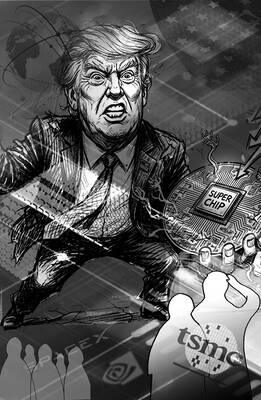
The White House’s decision to take a 9.9 percent stake in Intel Corp is looking like very shrewd business indeed. Since the government bought in at US$20.47 a share last August, the US chipmaker’s surging stock price has delivered the US a US$43 billion return. One of the reasons the investment has so far proved so sound is that the White House has made sure of it. According to The Wall Street Journal, Howard personally pushed deals on Intel’s behalf with some of the most lucrative clients imaginable. They include Nvidia Corp, the company at the heart of the AI
The Ministry of the Interior, working with the navy and coast guard, is organizing Taiwan’s first joint exercise simulating escort tankers carrying liquefied natural gas (LNG) and oil through a Chinese blockade. The drills simulate fuel transport along three maritime corridors leading toward Japan, the Philippines and the US. Deputy Minister of the Interior Sawyer Mars (馬士元) said that a blockade of the Taiwan Strait would amount to “almost a 100 percent blockade of the regional energy supply.” Minister of National Defense Wellington Koo said planning to counter a blockade is standard practice in Taipei. While the exercise is limited in
A single photograph can cut through a lot of noise, but it can also be used to misrepresent the truth. At the very least, it can concentrate the mind on something that requires further investigation. On Monday last week, Ma Ying-jeou Foundation CEO Tai Hsia-ling (戴遐齡) and former National Security Council secretary-general King Pu-tsung (金溥聰) held a news conference in which they showed a photograph of former foundation CEO Hsiao Hsu-tsen (蕭旭岑), now Chinese Nationalist Party (KMT) deputy chairman. In the image Hsiao is seated next to Xiamen Taiwan Businessmen Association chairman Han Ying-huan (韓螢煥). The two men were holding
I first met Professor Ray Jiing (井迎瑞) as a film and documentary student at Shih Hsin University’s (SHU) Department of Radio Television and Film in 1988. The following year, he went on to become the director of the Chinese Taipei Film Archive — forerunner of the Taiwan Film and Audiovisual Institute (TFAI). Over his eight-year tenure, Jiing rescued and restored over 200 classic Taiwanese films. In 1997, he established the Graduate Institute of Studies in Documentary and Film Archiving at Tainan National University of the Arts (TNNUA), and I joined the program in his third cohort of students. Beyond a


 RSS
RSS