


The gunmen arrived in the Amazon dusk, circling the house where Sister Leonora was hiding, rifles and pistols poking out the windows of three muddy pickup trucks.
A violent death was meant for the diminutive 64-year-old Roman Catholic nun, who has spent decades defending poor, landless workers — and collecting countless threats from ranchers she blocked from stealing Amazon land.
Leonora Brunetto faced the fate of Brazil’s renowned rain forest protector Chico Mendes and US nun Dorothy Stang, whose accused killer is scheduled for retrial on Wednesday in the jungle city of Belem.
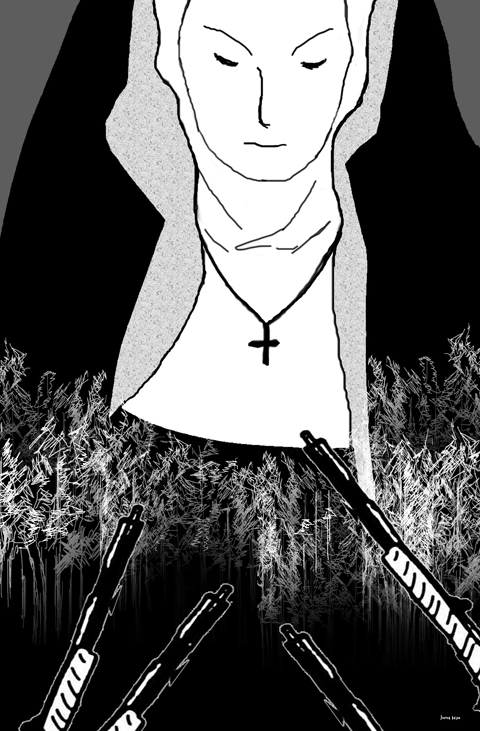
But before the gunmen could put her among the 1,200 activists, small farmers, judges, priests and others killed over preserving the rain forest since Mendes’ murder in 1988, a car full of landless workers pulled up to defend Brunetto.
The gunmen left, opting to take their shot at the gray-haired woman another day. One of those who came to her rescue, though, was shot dead the next afternoon. As in many of the cases, his killer still walks free.
Impunity in the Amazon because of a weak judicial system and corruption among local officials is endemic, a problem not only for people like Brunetto, but for the Brazilian government trying to preserve a rain forest the size of the US west of the Mississippi.
More than 20 percent of the forest already has been destroyed.
Rancher Vitalmiro Moura, who is accused of ordering Stang’s murder in 2005, served three years in prison before being acquitted in a retrial. Now prosecutors are trying to get a conviction again in a third trial, which his defense team is seeking to delay.
Among hundreds of cases of activist killings, Moura is the only accused mastermind imprisoned while he awaits retrial, according to the Catholic Land Pastoral, a watchdog group that tracks rural violence in Latin America’s largest nation.
He has said he had nothing to do with Stang’s killing and had no involvement with the land dispute that led to her death.
Stang’s prosecutor Edson Souza said bringing killers to justice and stopping the bloodshed is the only way Brazil will halt the destruction of the jungle.
“Without a doubt, leaders like Dorothy are targeted,” Souza said. “If they get away with killing leaders like Dorothy, the poor rightly assume they could easily be murdered as well.”
The main cause of deforestation, the government says, are ranchers who illegally clear jungle to graze cattle and grow soy — often using threats and violence to remove the poor farmers eking a living there.
The Brazilian government aims to give land titles to poor farmers, who some argue are less destructive to the forests because they have small plots and do less clearing. However, the process has required people like Stang and Brunetto, who help locals stand up to intimidation against their claims on unused land.
The episode in 2007 of gunmen circling Brunetto’s safe house was just one of many brushes with death she recounted as she showed us around an area of Mato Grosso state where she works, raising the spirits of those who camp on unused property and wait years for titles.
A Brazilian who studied to join the convent from age 12, Brunetto used to travel only with armed military police. But she has stopped.
“I have many friends under death threats, but they have no protection,” she said. “How can I lead people if I have protection and they don’t? Besides, it’s the people who protect me most.”
Mato Grosso — “thick jungle” in Portuguese — was once rain forest but is now the breadbasket of Brazil with its vast soy plantations and cattle ranches.
The ranchers and farmers who rule the state live well, employing legions of landless farm workers for a pittance.
Those workers face hunger and disease in makeshift shelters built from scrap wood and black plastic, with no electricity or running water.
“A few with much, and many with so little,” Brunetto said. She spoke at a dusty camp of squatters, who live at the edge of a local farmer’s land they say is unproductive — and thus, according to Brazil’s constitution, available for redistribution.
“How can you fold your arms in front of this injustice? I can’t,” Brunetto said.
Brunetto, 1.5m tall and 50kg, walks through the camps in jeans and leather sandals, firmly shaking hands and giving hugs. She patiently listens as a shirtless man tells her about hothouse-grown plants residents sell for US$0.50 each, then turns to a nearly toothless woman who worries about getting enough food to eat.
The squatters are star-struck.
“Sister Leonora is a warrior for the people,” said Linda Maria de Jesus, a 59-year-old camp resident who was on the verge of tears at seeing Brunetto. “She is threatened; she is in a battle just like us. It raises our spirits to have her here.”
Brunetto is rarely out of the watchful gaze of one hulking — though unarmed — poor farmer or another. They pick her up at bus stations, drive her 160km, then hand her off like a sacred package to another rural worker, who will take her on to her destination.
She meets with local, state and federal officials to press the numerous cases of small farmers fighting for land. She helps impoverished, illiterate people work their way through the onerous process of winning a title to a piece of property.
“I’m always looking over my shoulder wherever I go,” Brunetto said after offering the squatters praise for their makeshift plant nursery.
Souza, the prosecutor, has seen numerous killers walk free in neighboring Para, the Amazon region’s most violent state, where the 73-year-old Stang was gunned down on a muddy dirt road. He argues she was ordered killed by Moura and fellow rancher Regivaldo Galvao because she was blocking them from obtaining land the government had given to a group of poor farmers.
The confessed gunman who shot her is serving a 27-year sentence in prison. Two other men were convicted as accomplices in 2005 and given 17-year sentences. Galvao has managed to remain free — but is scheduled to go to trial at the end of this month.
Brazil is trying to bring law to the Amazon, mostly through increased environmental agent patrols the government says resulted in the lowest recorded levels of deforestation last year.
What remains to be seen is what can be done to protect those protecting the forest.
“I cannot lie and say I’m not scared,” Brunetto said. “But at the same time I know God is with us. My two great protections are God and these people we help.”
A gap appears to be emerging between Washington’s foreign policy elites and the broader American public on how the United States should respond to China’s rise. From my vantage working at a think tank in Washington, DC, and through regular travel around the United States, I increasingly experience two distinct discussions. This divergence — between America’s elite hawkishness and public caution — may become one of the least appreciated and most consequential external factors influencing Taiwan’s security environment in the years ahead. Within the American policy community, the dominant view of China has grown unmistakably tough. Many members of Congress, as
The Hong Kong government on Monday gazetted sweeping amendments to the implementation rules of Article 43 of its National Security Law. There was no legislative debate, no public consultation and no transition period. By the time the ink dried on the gazette, the new powers were already in force. This move effectively bypassed Hong Kong’s Legislative Council. The rules were enacted by the Hong Kong chief executive, in conjunction with the Committee for Safeguarding National Security — a body shielded from judicial review and accountable only to Beijing. What is presented as “procedural refinement” is, in substance, a shift away from
The shifting geopolitical tectonic plates of this year have placed Beijing in a profound strategic dilemma. As Chinese President Xi Jinping (習近平) prepares for a high-stakes summit with US President Donald Trump, the traditional power dynamics of the China-Japan-US triangle have been destabilized by the diplomatic success of Japanese Prime Minister Sanae Takaichi in Washington. For the Chinese leadership, the anxiety is two-fold: There is a visceral fear of being encircled by a hardened security alliance, and a secondary risk of being left in a vulnerable position by a transactional deal between Washington and Tokyo that might inadvertently empower Japan
After declaring Iran’s military “gone,” US President Donald Trump appealed to the UK, France, Japan and South Korea — as well as China, Iran’s strategic partner — to send minesweepers and naval forces to reopen the Strait of Hormuz. When allies balked, the request turned into a warning: NATO would face “a very bad” future if it refused. The prevailing wisdom is that Trump faces a credibility problem: having spent years insulting allies, he finds they would not rally when he needs them. That is true, but superficial, as though a structural collapse could be caused by wounded feelings. Something


 RSS
RSS