


Walls designed to keep people in or out — whether they are in Berlin, Nicosia, Israel or Korea — are always the product of fear. East German leaders’ fear of a mass exodus by their citizens seeking freedom and dignity; Greek and Turkish Cypriot leaders’ fear of continued war; Israelis’ fear of terrorism; or the North Korean leadership’s fear of “abandonment” by their martyred people.
To freeze a fragile status quo, to consolidate one’s position, or to remain separate from others perceived as temptations or threats (or both) — such have always been the goals of politicians who build walls.
Why is there such a difference between the fate of Berlin — now a capital city where the progress of the present is slowly covering the many scars of the past — and the fate of Nicosia, where time has been frozen, or that of Israel, whose “security wall” is expanding like a fresh scar, not to mention the North Korean regime’s unlikely consolidation behind its walls of paranoia and oppression?
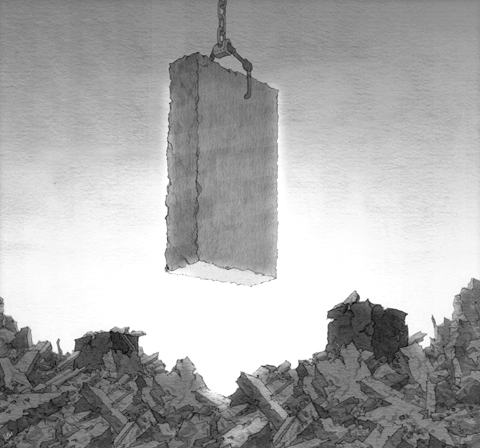
To understand these different situations, one must consider the will of people to destroy their walls in the case of East Germany, to expand them in the case of Israel and to freeze them in the case of Cyprus and the government of North Korea. Of course, the qualities — or lack of them — of the respective leaders are also an important factor.
The Berlin Wall collapsed in 1989 much more rapidly than most West Germans would have dreamed (or dreaded). They had underestimated the strength of “German national feeling” in the East and they grossly overestimated the Soviet Union’s ability and will to keep its empire at all costs. Above all, Mikhail Gorbachev will remain the man who had the vision and the courage not to oppose the course of history. He may not have fully understood what was happening before his eyes and the forces that he had unleashed, but his restraint constitutes true greatness.
The miracle of today’s reunified Berlin is a challenge — even a provocation — to all walls. It is proof that in a globally interdependent world, walls are unnatural and artificial — and therefore doomed. Yet the truth is far more complex, for walls are a multilayered reality and it is always dangerous to rewrite history in a Manichean manner, while confusing the realities of the past with those of the present.
Nicosia, the divided capital of Cyprus, is the perfect antithesis to Berlin and as such the best illustration of what happens when history does freeze. There, empty windows filled with sandbags continue to face each other defiantly, symbols of a past that has not passed for decades. Of course, crossing the Green Line that separates the Greek and Turkish parts of the city is nothing like crossing Berlin’s infamous Checkpoint Charlie. It is no longer a traumatic experience, just a bureaucratic hassle.
East Germans wanted to unify the German state for the sake of the unity of their nation: “We are one people” was their motto.
Are Greek Cypriots seriously interested in reunifying their island? Do they wish to extend to the Turkish Northern Cyprus the evident benefits that they derive from membership of the EU, which came in 2004? Most likely, they do not.
As for Turkey’s government, its official priority remains its own entry into the EU. It cannot say loud and clear that it is not seriously interested in the fate of Cyprus, but that is probably not far from the truth. In any case, the two sides have wasted so many opportunities in the past decades — owing in part to leaders characterized by what might best be described as “competitive mediocrity” — that it is difficult to see a miracle on the horizon.
Israel is closer to Nicosia than to Berlin, not only in geographic but also in political terms, because successive Israeli and Palestinian leaders have likewise failed to demonstrate qualities of vision and imagination. A wall is a bad international symbol, especially at the time when the fall of the Berlin Wall is being commemorated. It is also a symbol of futility, because it does not constitute a viable long-term solution.
The situation, however, is unfortunately more complex. As time goes by, Israelis and Palestinians increasingly want to divorce themselves from each other and Israel, contrary to North Korea — a regime doomed to disappear into a single Korea united by freedom and capitalism — is here to stay.
Israel’s wall constitutes a sad, but probably inevitable component of its security. What must be discussed is the security wall’s unnecessary and aggressive geography, accompanied by the provocation of further Israeli settlements on the West Bank, not the principle that stands behind it. After all, security alternatives that would prevent further bloodshed at the time of the Second Intifada did not exist.
Ultimately, “walls” represent the realities that lay behind their construction — realities that, unfortunately, later generations may be unable or unwilling to change.
Dominique Moisi is a visiting professor at Harvard University and the author of The Geopolitics of Emotion.
COPYRIGHT: PROJECT SYNDICATE
Recently, China launched another diplomatic offensive against Taiwan, improperly linking its “one China principle” with UN General Assembly Resolution 2758 to constrain Taiwan’s diplomatic space. After Taiwan’s presidential election on Jan. 13, China persuaded Nauru to sever diplomatic ties with Taiwan. Nauru cited Resolution 2758 in its declaration of the diplomatic break. Subsequently, during the WHO Executive Board meeting that month, Beijing rallied countries including Venezuela, Zimbabwe, Belarus, Egypt, Nicaragua, Sri Lanka, Laos, Russia, Syria and Pakistan to reiterate the “one China principle” in their statements, and assert that “Resolution 2758 has settled the status of Taiwan” to hinder Taiwan’s
Can US dialogue and cooperation with the communist dictatorship in Beijing help avert a Taiwan Strait crisis? Or is US President Joe Biden playing into Chinese President Xi Jinping’s (習近平) hands? With America preoccupied with the wars in Europe and the Middle East, Biden is seeking better relations with Xi’s regime. The goal is to responsibly manage US-China competition and prevent unintended conflict, thereby hoping to create greater space for the two countries to work together in areas where their interests align. The existing wars have already stretched US military resources thin, and the last thing Biden wants is yet another war.
As Maldivian President Mohamed Muizzu’s party won by a landslide in Sunday’s parliamentary election, it is a good time to take another look at recent developments in the Maldivian foreign policy. While Muizzu has been promoting his “Maldives First” policy, the agenda seems to have lost sight of a number of factors. Contemporary Maldivian policy serves as a stark illustration of how a blend of missteps in public posturing, populist agendas and inattentive leadership can lead to diplomatic setbacks and damage a country’s long-term foreign policy priorities. Over the past few months, Maldivian foreign policy has entangled itself in playing
A group of Chinese Nationalist Party (KMT) lawmakers led by the party’s legislative caucus whip Fu Kun-chi (?) are to visit Beijing for four days this week, but some have questioned the timing and purpose of the visit, which demonstrates the KMT caucus’ increasing arrogance. Fu on Wednesday last week confirmed that following an invitation by Beijing, he would lead a group of lawmakers to China from Thursday to Sunday to discuss tourism and agricultural exports, but he refused to say whether they would meet with Chinese officials. That the visit is taking place during the legislative session and in the aftermath


 RSS
RSS