


The West’s admiration for China’s rush for wealth is becoming like the left’s interwar praise for Josef Stalin’s Soviet Union. It is a triumph of materialism over humanity. If there is one place on earth I have long wanted to visit, it is old Kashgar, fulcrum of the silk road, author Peter Fleming’s “oasis of civilization” hovering between the Pamir mountains and the Taklamakan desert. It was used for the Afghan movie The Kite Runner, NATO having rendered the real location, Kabul, too dangerous for filming. Now the old city is to be systematically demolished. The steamroller of destruction that is China’s rush for wealth is claiming yet another casualty for world culture.
Reports from Beijing indicate that 65,000 houses, dating in layers back over two millennia, are decrepit and at risk from earthquakes. They will be cleared and their native Uighur inhabitants forcibly removed from the maze of alleys, mud-brick walls, courtyard houses and 40 mosques to new estates 8km from the city. Already the city walls and moat have gone. Now the old city itself is coming down, with only a zone to be rebuilt “in Uighur style” for the million tourists who visit Kashgar in search of silk road romance. They will be shown what a local official calls “an international heritage scenery.”
Kashgar was deliberately omitted from Beijing’s list of candidates for World Heritage status. As in Tibet’s Lhasa, Han Chinese are expected to replace the original Uighur citizens in the new city. The message is that minorities will not only have their political aspirations repressed but their cultural inheritance wiped out as well. The Washington Post quoted a bold Beijing architectural professor, Wu Dianting (吳殿廷), to commend the old mud buildings of Kashgar and warn that “if they are torn down their affiliated culture is destroyed.”
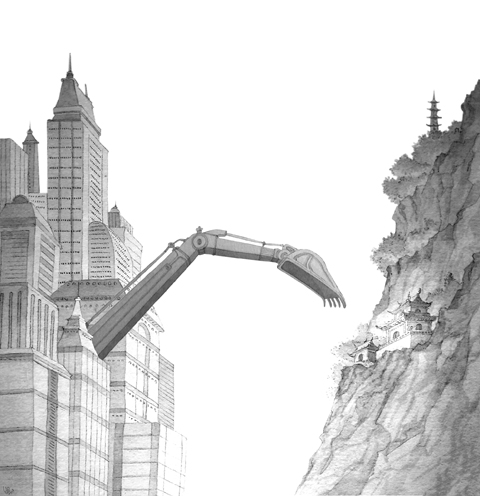
Western lobbyists rightly championed civil rights in China during the brief (and mostly sycophantic) period of the Olympics, to scant obvious effect. It is tempting to say that civil rights command headlines, but cultural heritage — where foreign pressure can sometimes shame a regime into caution — goes by the board. The monuments of the silk road, their oases, caravanserais, bazaars and towns, were not just memorials of old Asia but of Europe and Asia combined, a true entrepot of civilizations.
Visiting Chengdu in Sichuan in 1982, I was taken to see how the authorities were bulldozing the last remaining sector of “rice-paper houses,” an ancient area of delicate overhanging properties and courts with persimmon-lined streets, kept immaculate by residents for whom house and communal street were one living space. Desperate people were frantically packing their belongings in advance of the invader.
I pathetically pleaded with my guides to stop, if only because they were destroying what would one day be a tourist jewel of the city. They seemed utterly mystified, as might Romania’s dictator, Ceausescu, to pleas for the salvation of old Bucharest or, I suppose, the Greater London Council to pleas to save Covent Garden. To those in power, old is always past and new is always good. Demolition is potency and rebuilding is glory.
To prepare for the obscenity of extravagant chauvinism that is the Olympics, the Chinese promised the International Olympic Committee that they would spend US$30 billion redesigning an entire quarter of Beijing and build a dozen pavilions and a new thoroughfare, Jinbao Avenue. The avenue alone consumed 22 hectares and evaporated the homes of 2,100 families.
The Geneva-based Center on Housing Rights and Evictions said some 1.25 million people were evicted to make way for last year’s Olympics, a devastation chronicled in Michael Meyer’s moving new book, The Last Days of Old Beijing. This astonishing clearance was bigger even than Mao Zedong’s (毛澤東) extension of Tiananmen Square to create a desert of tarmac for the ritual glorification of his regime. Former British prime minister Tony Blair viewed the Olympics in much the same light.
The common accusation from those who shrug shoulders at the overseas destruction of historic buildings is that it reflects a civilization that does not care. Commenting on the cultural poverty of Hong Kong, the writer Jan Morris could dismiss it as a “dismally philistine colony.” Chinese people are charged not only with a lack of concern for human rights but with a dismissive view of their past. They care nothing for art.
This may be true of all societies at some time in their emergence from poverty. Yet it is one thing to want one’s house repaired, plumbed and electrified, quite another to see superior authority arrive with a bulldozer and architect in tow and, without a word, destroy house, neighborhood and civic identity in one fell swoop.
I have never believed that Chinese people are any different from others in their concern for the past. Westerners just say so. Much of the campaign to draw attention to the fate of Kashgar has been led by conservationists in Beijing, whose safety I respect by not naming them. But it is noticeable that in the freer climate of Hong Kong, it is Chinese who are teaching a lesson in heritage to the British who so shockingly ignored it when ruling the place.
Long ago I pleaded with such Hong Kong governors as David Wilson and Chris Patten that, if they bequeathed nothing else, at least install the British law protecting historic buildings without compensation. Each told me that there was no point. The Chinese cared only for money and would overturn any such designation for corrupt profit.
Two weeks ago I visited heritage sites in Hong Kong now being meticulously protected by the local Chinese government — including such relics of British rule as the central prison, the Tai O police station and Kowloon magistrates court. Old shop-houses and early council flats are being restored for new uses. The dynamic development secretary, Connie Lam, has heritage in her official title and declares emphatically that heritage, tourism and development are of the same coin.
Most remarkable is the central police station, a great colonial survival left derelict and doomed by Britain. This rambling warren of barracks, cells, prisons and courtyards lies in the shadow of mighty skyscrapers as if abandoned overnight. Giant woks lie idle in the kitchens. Rows of plastic scissors adorn the wall in the women’s prison workshop. Racks mourn for their rifles, stables for their horses. Trees still shade the parade ground.
The council houses are to be youth hostels, and Kowloon magistracy a US college. Plans are afoot to reopen the central police station as possibly a museum, hotel or apartments. What the British would have demolished, as they tore down the Victoria Barracks and the Repulse Bay Hotel, the Chinese are trying to save.
Sensitivity to the past is not some Western foible, nor is it a barrier to economic growth. It is a response to what should be the civilizing force of wealth and, in a leisure economy, a source of further wealth. Thousands of Hong Kong people demonstrated against the demolition of the old Star ferry terminal. They can be sure to support the saving of what few relics of the colonial past remain. It is not the right culture these places need, just the right politics.

A recent report concerning a student who is suing his teacher posed the question in its headline: Does failing a student in two subjects constitute bullying? The college student in Chiayi County apparently sought NT$2 million (US$63,603) in state compensation, but a court dismissed the case. The first reaction of many might have been to ask: What has happened to students nowadays? Some say that teachers have lost their authority, while others say students are overindulged. Some even start reminiscing over the days when “whatever the teacher says goes.” However, the real issue might be overlooked if emotional reactions like that are the
When I visited Taiwan last summer, I called on the nation to use its status as a technology superpower to build superweapons. It is obvious to me as I return a year later that Taiwan is now answering that call. By 2030, Taiwan envisions a domestic drone hub, capable of producing large quantities of drones per year. The nation continues to tighten cooperation across the private sector, scientific researchers and the elected government, on creating new and innovative production avenues for defense, while efforts to become central to the “democratic supply chain” are only increasing. Anduril is seeing all of these positive
Singaporean former Prime Minister and current senior minister Lee Hsien- Loong(李顯龍) last month stood on Chinese soil and told Beijing that Singapore cooperates because of “shared interests”, not because of common “ethnic descent,” a significant statement that has upended China’s cognitive warfare tactics of “ethnic nationalism.” Along with using its military buildup and economic growth to expand its international dominance, China has long deployed ethnic politics to promote the idea that all ethnic Chinese around the world, regardless of citizenship, share a tight bond with the Chinese motherland, by which it means the regime of the People’s Republic of China (PRC)
Taiwan’s economic momentum, driven by demand for artificial intelligence (AI) products, remains strong, with booming demand for advanced semiconductors, servers and key components. In the first quarter, GDP expanded 14.55 percent year-on-year, the second consecutive quarter of double-digit percentage growth and accelerating from the 12.95 percent expansion in the previous quarter, the Directorate-General of Budget, Accounting and Statistics (DGBAS) reported on Friday. Net exports remained the dominant driver of growth, contributing 10.33 percentage points to Taiwan’s GDP growth in the first quarter. That came as exports rose 35.76 percent year-on-year in the first quarter, outpacing 26.34 percent growth in imports, the


 RSS
RSS