


The publication of secret, audiotaped memoirs by fallen Chinese Communist Party (CCP) reformer Zhao Ziyang (趙紫陽), who sought to “eradicate the malady of China’s economic system at its roots” and died under house arrest for his efforts, is reigniting debate over the complex legacy of the 1989 Tiananmen Square protests.
Indeed, as China looms ever larger in the world economy, it is worth remembering that 20 years ago next month, the People’s Republic of China (PRC) almost fell apart. The protest movement that gathered in Tiananmen that year posed an existential threat to the CCP state, proclaimed in that very spot 40 years earlier by Mao Zedong (毛澤東).
The threat came from two directions — from within the highest echelons of the CCP leadership, where ideological differences over reform split the ruling Politburo, and from the urban masses, who, with Beijing’s university students at the vanguard, stood in open, peaceful revolt against state authority.
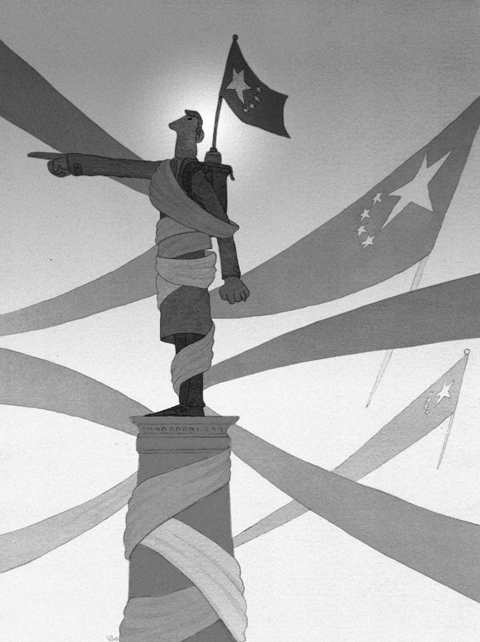
Amazingly, the CCP emerged from the crisis unified around Deng Xiaoping’s (鄧小平) vision of a “socialist market economy” and regained legitimacy with the urban population through implementing that vision. The CCP restored unity on the platform of globally integrated, market-driven growth, to be achieved without the intercession of the students’ “Goddess of Democracy,” but bringing tangible material benefit to city residents.
Sure enough, urban development, investment and GDP growth accelerated throughout the 1990s, but so did the gap between urban winners and rural losers. The protest energy that briefly electrified Tiananmen Square dissipated out of the cities and spread across the countryside.
At the euphoric outset of the 1989 demonstrations, more than 80,000 students marched through the streets of Beijing demanding a more responsive government. By 2005, there were more than 80,000 mass disturbances reported across the country — but mostly not in the booming coastal cities and certainly not at the elite national universities.
Over the past 20 years, laid-off workers, dispossessed farmers, Falun Gong practitioners and angry Tibetans have organized protests. No student-led, urban protests like those of Tiananmen Square of 1989, however, have occurred.
The economic boom under former Chinese president Jiang Zemin (江澤民)and his successor, Hu Jintao (胡錦濤), which channeled youthful revolt into entrepreneurship and professional success, was possible only because Deng prevented the CCP leadership from fracturing during the student protests of the late 1980s and the conservative backlash of the early 1990s.
As the protests began, Deng’s chosen successor, Zhao, was tempted to use the mass movement as a lever to push harder for market reform, and possibly political reform.
If China was going to have its own Mikhail Gorbachev, it would have been Zhao.
Deng supported Zhao’s drive to liberalize the economy, even though it was creating mixed results in 1988 and 1989, with inflation spiking and economic anxiety pervasive. But Deng, scarred from decades of Maoism — particularly the chaos unleashed by the Cultural Revolution — had limited tolerance for political instability. And Zhao’s toleration of the demonstrators was dividing the Politburo into factions. So Deng fed Zhao to the party’s more conservative lions.
Hardliners emerged triumphant in the wake of the crackdown. In their eyes, the tumult of 1989 proved that “reform and opening” were leading to chaos and collapse. Deng temporarily withdrew, letting the central planners around CCP elder Chen Yun (陳雲) slow down marketization and weather the PRC’s international isolation in Tiananmen’s wake.
But then, with his famous “southern tour” in early 1992, Deng orchestrated the eclipse of the anti-market, conservative faction.
In the boomtown of Shenzhen, with TV cameras rolling, Deng jabbed his finger in the air, admonishing his CCP: “If China does not practice socialism, does not carry on with ‘reform and opening’ and economic development, does not improve people’s standards of living, then no matter what direction we go, it will be a dead end.”
Having begrudgingly purged the reformers in 1989, Deng in 1992 seized the opportunity to sideline the central planners, bringing in China’s neo-liberal hero, Zhu Rongji (朱鎔基), to refire the engines of the economy. Deng judged the mood of the nation shrewdly: The people were ready to be told that “to get rich is glorious.”
The new CCP leadership of the 1990s and 2000s did not waver from Deng’s line: steady expansion of market reforms, active involvement in international commerce, massive urbanization and urban development and total dedication to CCP unity.
June 4, the day Peoples’ Liberation Army troops drove the students and their supporters from Tiananmen Square, is remembered in the West as a tragic example of state violence against unarmed citizens and a memorial to the suppressed yearnings of the Chinese people for freedom and democracy.
But, in the cold eyes of history, the 1989 movement and its aftermath may eventually be seen as the CCP’s “Machiavellian moment,” when Deng confronted the mortality of his republic and saw what it would take to survive: CCP unity based on urban growth.
By reunifying the party leadership and re-establishing solidarity between the party and the urban population, the crisis consolidated CCP rule, and accelerated China’s momentum down its current path of rapid economic growth.
In her classic study On Revolution, Hannah Arendt observed darkly that “whatever brotherhood human beings may be capable of has grown out of fratricide, whatever political organization men may have achieved has its origin in crime.”
The bloodstained square on the morning of June 4 was in this sense perhaps the birthplace of post-revolutionary China.
John Delury is associate director of the Center on US-China Relations and director of the China Boom Project at the Asia Society.
COPYRIGHT: PROJECT SYNDICATE
Recently, China launched another diplomatic offensive against Taiwan, improperly linking its “one China principle” with UN General Assembly Resolution 2758 to constrain Taiwan’s diplomatic space. After Taiwan’s presidential election on Jan. 13, China persuaded Nauru to sever diplomatic ties with Taiwan. Nauru cited Resolution 2758 in its declaration of the diplomatic break. Subsequently, during the WHO Executive Board meeting that month, Beijing rallied countries including Venezuela, Zimbabwe, Belarus, Egypt, Nicaragua, Sri Lanka, Laos, Russia, Syria and Pakistan to reiterate the “one China principle” in their statements, and assert that “Resolution 2758 has settled the status of Taiwan” to hinder Taiwan’s
Can US dialogue and cooperation with the communist dictatorship in Beijing help avert a Taiwan Strait crisis? Or is US President Joe Biden playing into Chinese President Xi Jinping’s (習近平) hands? With America preoccupied with the wars in Europe and the Middle East, Biden is seeking better relations with Xi’s regime. The goal is to responsibly manage US-China competition and prevent unintended conflict, thereby hoping to create greater space for the two countries to work together in areas where their interests align. The existing wars have already stretched US military resources thin, and the last thing Biden wants is yet another war.
As Maldivian President Mohamed Muizzu’s party won by a landslide in Sunday’s parliamentary election, it is a good time to take another look at recent developments in the Maldivian foreign policy. While Muizzu has been promoting his “Maldives First” policy, the agenda seems to have lost sight of a number of factors. Contemporary Maldivian policy serves as a stark illustration of how a blend of missteps in public posturing, populist agendas and inattentive leadership can lead to diplomatic setbacks and damage a country’s long-term foreign policy priorities. Over the past few months, Maldivian foreign policy has entangled itself in playing
A group of Chinese Nationalist Party (KMT) lawmakers led by the party’s legislative caucus whip Fu Kun-chi (?) are to visit Beijing for four days this week, but some have questioned the timing and purpose of the visit, which demonstrates the KMT caucus’ increasing arrogance. Fu on Wednesday last week confirmed that following an invitation by Beijing, he would lead a group of lawmakers to China from Thursday to Sunday to discuss tourism and agricultural exports, but he refused to say whether they would meet with Chinese officials. That the visit is taking place during the legislative session and in the aftermath


 RSS
RSS