


US President Barack Obama’s dramatic intervention into the fate of the US’ big three carmakers has sent a signal to the global auto sector to get its act together or drown.
The ouster of Rick Wagoner and Christian Streiff as chief executives of General Motors (GM) and Peugeot Citroen on Monday sent tremors through the boardrooms of the battered auto industry.
Lacking the systemic importance of the banking sector, which has been bailed out with trillions of dollars, the car industry is being left to bleed to death — or consolidate.
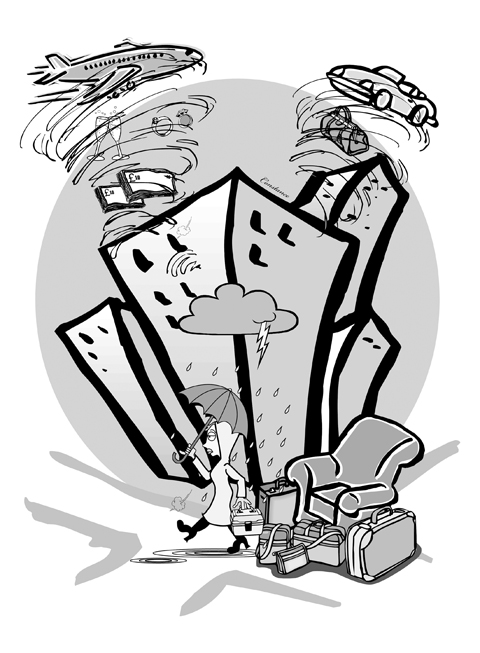
This month, Martin Winterkorn, chief executive of Volkswagen — the world’s third-largest car maker and sure-fire survivor of the financial crisis — told 200 analysts and reporters he could see the survival of one Japanese firm, perhaps a few Chinese, two or three Europeans and an American — Ford, clearly.
Even Toyota, the most likely Japanese survivor, which is run by a close-knit team of visionary engineers dedicated to eco-friendly technological innovation, is in trouble as the industry’s expectations for global sales of 70 million have turned into, at best, 50 million this year. US sales alone could halve to little more than 8.5 million.
In Europe sales could fall by between 20 percent and 30 percent and are now held up in a dozen countries by “scrappage” — payments for scrapping older cars. The 780 billion euro (US$1.04 trillion) European car industry suffers from at least 20 percent overcapacity and structural problems pre-dating the crisis.
The industry will see a shake-out in the coming year that could mean only a handful of firms remain in business. Volswagen, which is virtually in Porsche’s hands, will be one of them. French President Nicolas Sarkozy will do his damnedest to ensure that at least Renault — part-owner of Nissan and itself 30 percent state-owned — survives.
Daimler, owner of Mercedes, and BMW may be forced into a premium merger. Even in an Obama-backed shotgun marriage with Chrysler, Italy’s Fiat may bite the dust.
In Asia, China’s 150 auto firms will be forced by Beijing into a series of mergers and acquisitions. India’s Tata will — if it survives its expensive Jaguar Land Rover takeover — dominate the landscape, and in South Korea Kia is likely to emerge as the big player, with Hyundai — linked to GM — on a funeral pyre.
Wagoner was fired by Obama because he had failed to lay the ground for the “green” revolution and had driven what was the world’s biggest carmaker for 80 years into a brick wall as it ran out of cash. Insiders say that, with more genuine independent directors on his board, he would have gone years ago.
His departure underlines that Obama meant what he said during his presidential campaign when he warned the industry it should be on a sustainable path in an era of “peak oil” and the need for fuel-efficiency. The global industry, with a few exceptions, ignored his message. Top carmakers have been lobbying the EU for years to get Brussels to water down its environmental plans to cut car emissions levels.
But other car bosses could now be vulnerable as the industry looks for new leadership to reflect the changed agenda. Daimler CEO Dieter Zetsche and BMW head CEO Norbert Reithofer could be next in the firing line as premium carmakers suffer disproportionately from the global collapse of sales.
At Daimler, Zetsche, the walrus-mustached former head of Chrysler during a disastrous 10-year marriage, is struggling to contain a plunge in Mercedes sales after a profit warning, amid speculation it might be forced to merge with BMW, its bitter rival.
BMW’s Reithofer has so far retained the support of the Quandt family, who owns 46 percent of the firm. But the family, which rescued a near-bankrupt BMW 50 years ago, is expanding its interests elsewhere. Reithofer is also surrounded by a new, more youthful board, including sales chief, Ian Robertson.
Carl-Peter Forster, president of GM Europe and a former BMW director, may also feel the heat as a US$3.3 billion rescue plan for Opel, Vauxhall and Saab falters in the wake of the White House’s rejection of Wagoner’s restructuring program. At most, it buys German Chancellor Angela Merkel more time to sort out the threat to a quarter of a million jobs before the Sept. 29 general election.
Streiff, victim of a boardroom coup, was not even thanked for his stint as Peugeot chief in a curt statement from chairman Thierry Peugeot, who is appointing Corus boss, Philippe Varin, to succeed him.
Varin, former head of aluminium group Pechiney, is highly regarded after turning around Anglo-Dutch Corus, integrating British Steel and Hoogovens and presiding over the sale to India’s Tata group. Streiff, the former deputy chief executive of glassmaker St Gobain and who reportedly suffered a mini-stroke last year, made enemies in the boardroom and lost its confidence — including crucially that of the controlling Peugeot family — with his abrasive style, sole focus on cost-cutting that shed 11,000 jobs and lack of strategic vision, including for mergers.
He had previously lasted just 100 days as head of Airbus as his drive to cut costs and lack of diplomatic skills alienated the key Franco-German players, including both governments, at the planemaker’s owner, EADS.
There will be upheavals not only in boardrooms as the tarnished old guard makes way for the “green new deal” protagonists of electric cars, but in the industry as a whole.
Obama has ensured this with the stroke of a pen — and an unprecedentedly blunt intervention.
What began on Feb. 28 as a military campaign against Iran quickly became the largest energy-supply disruption in modern times. Unlike the oil crises of the 1970s, which stemmed from producer-led embargoes, US President Donald Trump is the first leader in modern history to trigger a cascading global energy crisis through direct military action. In the process, Trump has also laid bare Taiwan’s strategic and economic fragilities, offering Beijing a real-time tutorial in how to exploit them. Repairing the damage to Persian Gulf oil and gas infrastructure could take years, suggesting that elevated energy prices are likely to persist. But the most
Taiwan should reject two flawed answers to the Eswatini controversy: that diplomatic allies no longer matter, or that they must be preserved at any cost. The sustainable answer is to maintain formal diplomatic relations while redesigning development relationships around transparency, local ownership and democratic accountability. President William Lai’s (賴清德) canceled trip to Eswatini has elicited two predictable reactions in Taiwan. One camp has argued that the episode proves Taiwan must double down on support for every remaining diplomatic ally, because Beijing is tightening the screws, and formal recognition is too scarce to risk. The other says the opposite: If maintaining
Chinese Nationalist Party (KMT) Chairwoman Cheng Li-wun (鄭麗文), during an interview for the podcast Lanshuan Time (蘭萱時間) released on Monday, said that a US professor had said that she deserved to be nominated for the Nobel Peace Prize following her meeting earlier this month with Chinese President Xi Jinping (習近平). Cheng’s “journey of peace” has garnered attention from overseas and from within Taiwan. The latest My Formosa poll, conducted last week after the Cheng-Xi meeting, shows that Cheng’s approval rating is 31.5 percent, up 7.6 percentage points compared with the month before. The same poll showed that 44.5 percent of respondents
India’s semiconductor strategy is undergoing a quiet, but significant, recalibration. With the rollout of India Semiconductor Mission (ISM) 2.0, New Delhi is signaling a shift away from ambition-driven leaps toward a more grounded, capability-led approach rooted in industrial realities and institutional learning. Rather than attempting to enter the most advanced nodes immediately, India has chosen to prioritize mature technologies in the 28-nanometer to 65-nanometer range. That would not be a retreat, but a strategic alignment with domestic capabilities, market demand and global supply chain gaps. The shift carries the imprimatur of Indian Prime Minister Narendra Modi, indicating that the recalibration is


 RSS
RSS