


The commander of US forces in Asia, Admiral Timothy Keating, speaking in Hong Kong this week, said he had reason to believe that Beijing was ready to revive discussions of military exchanges with the US.
Pressed by news correspondents gathered at the US consulate to explain why he thought so, Keating was reluctant to provide details, but said “we are not living in a void.”
He said there had been “indirect but unmistakable forms of communication” through third parties, including visitors to his headquarters in Hawaii, indicating that the Chinese were open to negotiation.
Backed symbolically by the US aircraft carrier John Stennis anchored for a port visit, Keating also met informally with senior officers of China’s People’s Liberation Army (PLA) in garrison in Hong Kong.
The admiral said an initiative was under way to forge an agreement intended to prevent hostile incidents between the US and Chinese warships at sea. The US and the Soviet Union had an agreement during the Cold War that each navy would not train its guns on the other’s warships or fly fighters over each other’s ships. Keating said the new effort was in its earliest stages.
Sino-US military exchanges, which expanded in fits and starts for more than a decade, were abruptly broken off by the Chinese in October after the US announced that it would sell US$6.5 billion in arms to Taiwan. US policy under the Taiwan Relations Act is to provide Taiwan with arms to defend itself.
The impasse appeared to have been broken when US Secretary of State Hillary Clinton said on the eve of her trip to Asia that the US and China “will resume mid-level military-to-military discussions later this month.”
Clinton’s disclosure caused mild surprise in the Pentagon and at the Pacific Command in Hawaii, where defense officials wondered why such an announcement had not come from Secretary of Defense Robert Gates or Keating, who is responsible for military exchanges with the Chinese. One official shrugged it off as a “rookie mistake” from an administration still getting its feet on the ground.
Keating argued vigorously for a resumption of military dialogue with China, asserting that it would be “very much in our mutual benefit” and would lessen the chances of a confrontation degenerating into a crisis or even into armed conflict.
On a trip through Thailand, Hong Kong, Japan and South Korea, Keating recalled that a Chinese officer had once suggested that the US and China divide the Pacific Ocean, with China responsible for keeping the peace west of Hawaii while the US was confined to the waters east of Hawaii. Keating said “no thanks.”
Instead, the admiral said, the US and China “should work more together.”
He said three Chinese warships had been patrolling in the Gulf of Aden against pirates. Chinese ship captains often communicated with the commander of a US naval task force in that region, he said.
On the other hand, Keating said, the US and China had a “hotline” for communication and he had used it when the US delivered relief supplies to China after a devastating earthquake.
But, he said, “I don’t have a phone number yet” to call a Chinese officer directly.
Responding to fresh reports that China sought to build four aircraft carriers over the next quarter century, Keating was skeptical.
“It’s not as easy as it looks,” said the naval aviator with 5,000 hours of flight time and 1,200 landings aboard aircraft carriers. “Operating an aircraft carrier is a very demanding discipline.”
“It will take them a long time,” he said, “and it will be harder than they think.”
Richard Halloran is a freelance writer in Honolulu.
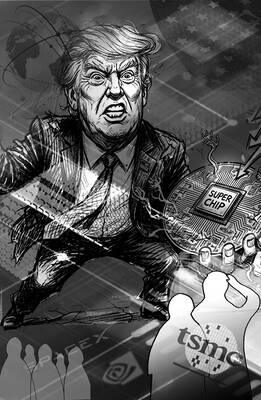
The White House’s decision to take a 9.9 percent stake in Intel Corp is looking like very shrewd business indeed. Since the government bought in at US$20.47 a share last August, the US chipmaker’s surging stock price has delivered the US a US$43 billion return. One of the reasons the investment has so far proved so sound is that the White House has made sure of it. According to The Wall Street Journal, Howard personally pushed deals on Intel’s behalf with some of the most lucrative clients imaginable. They include Nvidia Corp, the company at the heart of the AI
A single photograph can cut through a lot of noise, but it can also be used to misrepresent the truth. At the very least, it can concentrate the mind on something that requires further investigation. On Monday last week, Ma Ying-jeou Foundation CEO Tai Hsia-ling (戴遐齡) and former National Security Council secretary-general King Pu-tsung (金溥聰) held a news conference in which they showed a photograph of former foundation CEO Hsiao Hsu-tsen (蕭旭岑), now Chinese Nationalist Party (KMT) deputy chairman. In the image Hsiao is seated next to Xiamen Taiwan Businessmen Association chairman Han Ying-huan (韓螢煥). The two men were holding
I first met Professor Ray Jiing (井迎瑞) as a film and documentary student at Shih Hsin University’s (SHU) Department of Radio Television and Film in 1988. The following year, he went on to become the director of the Chinese Taipei Film Archive — forerunner of the Taiwan Film and Audiovisual Institute (TFAI). Over his eight-year tenure, Jiing rescued and restored over 200 classic Taiwanese films. In 1997, he established the Graduate Institute of Studies in Documentary and Film Archiving at Tainan National University of the Arts (TNNUA), and I joined the program in his third cohort of students. Beyond a
President William Lai Ching-te’s (賴清德) May 20 second-anniversary address was not just a routine policy review; it was damage control. US President Donald Trump’s remarks — that he did not want to see anyone move toward independence and that the delivery of a major Taiwan arms package could depend on the progress of US-China relations — unsettled Taiwan’s public and created an opening for opposition parties to question whether Taiwan was being treated as a bargaining chip in Washington’s dealings with Beijing. Lai’s speech was designed to close that opening. The address covered the expected ground: sovereignty, cross-strait relations, defense spending,


 RSS
RSS