


Although China’s economic growth rate has slipped for five quarters in a row, in the third quarter of this year its rate was still one of the highest in the world at 9 percent. While national economies around the world are slowing down or going into recession, China’s economic performance can only be called exceptional.
Some people even look to China as the savior that could bring the global economy back to life. Last month, the Chinese government announced a 4 trillion yuan (US$586 billion) economic stimulus package. During October and last month, China cut interest rates by 1.35 percent — the biggest cut in 11 years.
This is not China’s prescription for saving the global economy. Rather, it is designed to keep the economy alive through the coming economic winter.
After three decades of economic opening and liberalization, China’s economy is tightly bound up with the wider world. The country’s economy is now 65 percent dependent on foreign trade. China holds more than US$1.9 trillion in foreign reserves and has US$420 billion in foreign debt. Foreign capital utilization exceeds US$1 trillion, and foreign-owned businesses account for more than 55 percent of foreign trade.
Given this level of global integration, China can hardly avoid being affected by the financial storm that has been spreading around the world since last year.
Nevertheless, China’s economy still grew 9 percent year-on-year in the third quarter. In October, investment was up 24.4 percent, consumption 18 percent and net imports 29.8 percent. With figures like these, one might think that China’s economy has not been affected by the global financial crisis at all.
However, many leading indicators suggest that an economic winter may be approaching. Since the start of this year, China’s real estate market has slid downward for 11 months in a row, taking it back to the low point it reached during the Asian financial crisis of 1997 to 1998. Real estate prices have dropped for three consecutive months — the biggest fall ever. The Shanghai stock exchange has dived from a high point of 5,955 points in October last year to 1,871 points at the end of last month — a loss of 15 trillion yuan. China’s plunging property market and the international financial crisis have brought consumer confidence down to 92 points, 5 points down compared with one year ago, and a three-year low.
There is more. Last month, China’s manufacturing purchasing managers’ index (PMI) was just 38.8 points, 27 points down from the same month last year, 5.8 points down from October and the lowest level on record. The new orders index, which includes both export and domestic orders, dropped 9.6 percent in October and a further 9.4 percent last month, down to 32.3 points, which is 42.7 percentage points down from last November and a historic low.
Notably, new export orders last month fell 12.4 points compared with October, down to 29 points, which is 45.9 percentage points down from last November and, again, a historic low.
In fact, economic data for October already showed signs that China’s economy was heading for a frosty period.
For example, the country’s industrial output growth rate fell four months in a row, halved from 16 percent in June to 8 percent in October — the lowest in seven years. The Nomura Research Institute estimates that it may be halved again for last month to 4 percent, which would be the lowest since 1990. At the same time, power generation has seen 4 percent negative growth from October last year, the first negative figure since May 1998. Fiscal revenue also saw negative growth for the first time since 1996.
These figures show that China’s economy has already been hit hard by the international financial crisis and that the government is now making strenuous efforts to turn the tide. On Nov. 5, Chinese Premier Wen Jiabao (溫家寶) announced that the government would adopt expansionary fiscal policy and appropriately loosened monetary policy. This is the first time since the 1997 to 1998 Asian financial crisis that China has adopted such policies, and it signals a clear turn away from the tighter controls of the intervening period.
Four days later, on Nov. 9, China announced that it would pour in 4 trillion yuan over the next two years to boost economic activity. Meanwhile, from the end of September until now, the People’s Bank of China has lowered the statutory deposit-reserve ratio by 2 percentage points, freeing up about 1 trillion yuan, and it has cut annual interest rates on deposits and loans by 1.62 percent and 1.89 percent respectively — the biggest rate cut in 11 years.
China’s economy cannot escape the threatening shadow of the international financial crisis, and the government dares not lower its guard. Chinese officials have already revealed that the country’s economic growth rate fell sharply to 7 percent in October.
The World Bank predicts that China’s growth rate next year will be around 7.5 percent. It looks as though China is going to have to fight to keep growth up to the desired 8 percent.
The current financial crisis is of a far bigger scale and is much more deadly than the one that hit Asia in 1997 and 1998. It remains to be seen whether China can safely get through the coming economic winter. It is going to be a severe test of the Chinese government’s political dexterity and of “capitalism with Chinese characteristics.”
Tung Chen-yuan is an associate professor, and Wang Guo-chen is a doctoral candidate in the Graduate Institute of Development Studies at National Chengchi University.
TRANSLATED BY JULIAN CLEGG
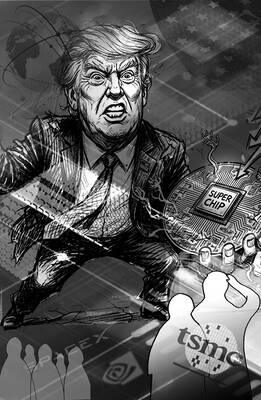
The White House’s decision to take a 9.9 percent stake in Intel Corp is looking like very shrewd business indeed. Since the government bought in at US$20.47 a share last August, the US chipmaker’s surging stock price has delivered the US a US$43 billion return. One of the reasons the investment has so far proved so sound is that the White House has made sure of it. According to The Wall Street Journal, Howard personally pushed deals on Intel’s behalf with some of the most lucrative clients imaginable. They include Nvidia Corp, the company at the heart of the AI
A single photograph can cut through a lot of noise, but it can also be used to misrepresent the truth. At the very least, it can concentrate the mind on something that requires further investigation. On Monday last week, Ma Ying-jeou Foundation CEO Tai Hsia-ling (戴遐齡) and former National Security Council secretary-general King Pu-tsung (金溥聰) held a news conference in which they showed a photograph of former foundation CEO Hsiao Hsu-tsen (蕭旭岑), now Chinese Nationalist Party (KMT) deputy chairman. In the image Hsiao is seated next to Xiamen Taiwan Businessmen Association chairman Han Ying-huan (韓螢煥). The two men were holding
I first met Professor Ray Jiing (井迎瑞) as a film and documentary student at Shih Hsin University’s (SHU) Department of Radio Television and Film in 1988. The following year, he went on to become the director of the Chinese Taipei Film Archive — forerunner of the Taiwan Film and Audiovisual Institute (TFAI). Over his eight-year tenure, Jiing rescued and restored over 200 classic Taiwanese films. In 1997, he established the Graduate Institute of Studies in Documentary and Film Archiving at Tainan National University of the Arts (TNNUA), and I joined the program in his third cohort of students. Beyond a
A recent report concerning a student who is suing his teacher posed the question in its headline: Does failing a student in two subjects constitute bullying? The college student in Chiayi County apparently sought NT$2 million (US$63,603) in state compensation, but a court dismissed the case. The first reaction of many might have been to ask: What has happened to students nowadays? Some say that teachers have lost their authority, while others say students are overindulged. Some even start reminiscing over the days when “whatever the teacher says goes.” However, the real issue might be overlooked if emotional reactions like that are the


 RSS
RSS