


They were walking to school in the southern city of Kandahar, a group of teenage girls discussing a test they had coming up, when two men on a motorcycle sprayed them with a strange liquid. Within seconds a painful tingling began, and there was an unusual smell as the skin of 16-year-old Atifa Biba began to burn.
Her friend rushed over to help her, struggling to wipe the liquid away, when she too was showered with acid. She covered her face, crying out for help as they sprayed her again, trying to aim the acid into her face. The weapon was a water bottle containing battery acid; the result was at least one girl blinded and two others permanently disfigured. Their only crime was attending school.
It was not an isolated incident. For women and girls across Afghanistan, conditions are worsening — and those women who dare to publicly oppose the traditional order now live in fear for their lives.
Member of Parliament (MP) Shukria Barakzai receives regular death threats for speaking out on women’s issues. Talking at her home in central Kabul, she closed the living room door as her three young daughters played in the hall.
“You can’t imagine what it feels like as a mother to leave the house each day and not know if you will come back again,” she said, her eyes welling up as she spoke.
“But there is no choice. I would rather die for the dignity of women than die for nothing. Should I stop my work because there is a chance I might be killed? I must go on, and if it happens it happens,” she said.
Barakzai receives frequent but cryptic warnings about planned suicide attacks on her car, but no help from the government. Officials advise her to stay at home and not go to work, but offer nothing in the way of security assistance, despite her requests. She said warlords in parliament who received similar threats were immediately provided with armored vehicles, armed guards and a safe house by the government.
Afghan women are feeling increasingly vulnerable as the security situation worsens and a growing number of Western and Afghan officials call for the Taliban to join the government.
“We are very worried that, now the government is talking with the Taliban, our rights will be compromised,” said Shinkai Karokhail, an outspoken MP for Kabul. “We must not be the sacrifice by which peace with the Taliban is made.”
Under Taliban rule, up until 2001, women were not allowed to work and were forbidden from venturing outside the home without a male escort.
Afghan women who defy traditional gender roles and speak out against the oppression of women are routinely subject to threats, intimidation and assassination. An increasingly powerful Taliban regularly attacks projects, schools and businesses run by women.
Six weeks ago, Lieutenant-Colonel Malalai Kakar was assassinated in her car on her way to work in Kandahar. She was Afghanistan’s highest-ranking female police officer and a fierce defender of women’s rights. Only 1.5m tall, she was known to have beaten men she found to be abusing their wives. Another senior female police officer was killed in the province of Herat in June.
Talking at a safe house on the outskirts of Kabul, Mullah Zubiallah Akhond, a Taliban commander from the southern province of Uruzgan, said the group’s attacks on women were always political and not based on any desire to target or punish women specifically.
He condemned the acid attack on the group of schoolgirls in Kandahar, and insisted the Taliban were not involved.
“We support the education of girls, but separate from boys. We would not attack schoolgirls. We only target those working with the government,” he said.
The Taliban’s regional commands have varying attitudes toward women, but all those fighting under the Taliban banner are committed to enforcing their interpretation of Shariah law, which forbids women from working or leaving the house without a male escort.
The Islamist group is just one of the many threats facing Afghanistan’s few outspoken female MPs.
“Our parliament is a collection of lords,” Barakzai said. “Warlords, drug lords, crime lords.”
In parliament, she says, she is often greeted with screams of “kill her” when she stands up to speak, and she has had no shortage of personal threats from fellow MPs.
They visit her privately to tell her she will be killed if she continues to speak out on such issues as the right of a woman to have a personal passport (separate from the standard “family passport”) or against compulsory virginity tests for young women, and the right of a man to have custody of a child at two-years old. It is not only men who oppose women in parliament — both Barakzai and Karokhail have faced obstruction from other female MPs on key women’s issues.
Karokhail said that, of the 68 women in the 249-strong parliament, only five were vocal on women’s issues. The majority of women in parliament vote in favor of more traditional legislation that often rules against women’s rights.
Some women now fear the parliament is becoming more conservative towards women.
“Talibani ideas are natural among our people, particularly their vision about women,” Barakzai said.
Afghan commentators say President Hamid Karzai, desperate to win next year’s elections, has been bringing former mujahidin commanders into parliament in the hope they will support him at election time.
Most of these former jihadi commanders share the Taliban’s ideas about women and are expected to support legislation that will once again limit women’s freedom. In addition, according to the Taliban commander, the group has a growing number of MPs in parliament lobbying for their policies.
In much of the country, especially rural areas, women remain subservient to the men in their family and rarely venture out of their homes. Even in the relatively liberal capital, Kabul, it is common to see women robed in blue burkas trailing five paces behind their husbands.
It is difficult to gauge how the worsening situation in the country is affecting women, but a recent study by the UN said some 87 percent of them suffer abuse in the home. Afghan human rights groups are documenting cases of “honor” killings, forced abortions and rape, and a database is now being constructed by the UN.
Najla Zewari, who works for the UN’s gender and justice unit, believes violence against women is increasing, fuelled by growing frustrations caused by the economic crisis and lack of security.
She said there had also been a sharp increase in rapes by men who claimed they could not afford the pay the dowry needed to marry. After the public shame of an attack, the victim is usually outcast and the rapist is then the only man who will have the woman as his wife.
It is crimes like this that make many Afghans nostalgic for the harsh justice of Taliban rule. Barakzai countered: “Women were safe, in one sense, under the Taliban — but they were kept as slaves, they were not allowed to do what they wanted even in their own home.”
As the Taliban strengthen, the future for women in Afghanistan looks bleaker. Barakzai said women’s rights, once heralded as the great success of post-invasion Afghanistan, had been sidelined and might suffer more in the struggle to find a solution to the fighting.
Last week, a council of 400 women politicians met in Kabul to discuss this possibility and prepare ways to counter it.
“Our biggest fear at the moment is that the return of Talibani ideas to government will wind back the gains we have made in these last years,” Karokhail said.
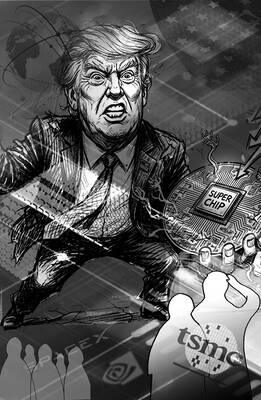
The White House’s decision to take a 9.9 percent stake in Intel Corp is looking like very shrewd business indeed. Since the government bought in at US$20.47 a share last August, the US chipmaker’s surging stock price has delivered the US a US$43 billion return. One of the reasons the investment has so far proved so sound is that the White House has made sure of it. According to The Wall Street Journal, Howard personally pushed deals on Intel’s behalf with some of the most lucrative clients imaginable. They include Nvidia Corp, the company at the heart of the AI
A single photograph can cut through a lot of noise, but it can also be used to misrepresent the truth. At the very least, it can concentrate the mind on something that requires further investigation. On Monday last week, Ma Ying-jeou Foundation CEO Tai Hsia-ling (戴遐齡) and former National Security Council secretary-general King Pu-tsung (金溥聰) held a news conference in which they showed a photograph of former foundation CEO Hsiao Hsu-tsen (蕭旭岑), now Chinese Nationalist Party (KMT) deputy chairman. In the image Hsiao is seated next to Xiamen Taiwan Businessmen Association chairman Han Ying-huan (韓螢煥). The two men were holding
I first met Professor Ray Jiing (井迎瑞) as a film and documentary student at Shih Hsin University’s (SHU) Department of Radio Television and Film in 1988. The following year, he went on to become the director of the Chinese Taipei Film Archive — forerunner of the Taiwan Film and Audiovisual Institute (TFAI). Over his eight-year tenure, Jiing rescued and restored over 200 classic Taiwanese films. In 1997, he established the Graduate Institute of Studies in Documentary and Film Archiving at Tainan National University of the Arts (TNNUA), and I joined the program in his third cohort of students. Beyond a
A recent report concerning a student who is suing his teacher posed the question in its headline: Does failing a student in two subjects constitute bullying? The college student in Chiayi County apparently sought NT$2 million (US$63,603) in state compensation, but a court dismissed the case. The first reaction of many might have been to ask: What has happened to students nowadays? Some say that teachers have lost their authority, while others say students are overindulged. Some even start reminiscing over the days when “whatever the teacher says goes.” However, the real issue might be overlooked if emotional reactions like that are the


 RSS
RSS