


A day of joy but also another day of horror. Even as US voters were giving the world the man whom opinion polls showed to be the overwhelming favorite in almost every country, his predecessor’s terrible legacy was already crowding in on the president-elect.
Twenty-three children and 10 women died in the latest US air strike in Afghanistan, a failed war on terror that has only brought worse terror in its wake. In Iraq, explosions killed 13 people. President-elect Barack Obama’s stand against an unpopular war was the bedrock of his success on Tuesday, even though the financial meltdown sealed his victory. Now he must make good on his promises of withdrawal.
On Iran, the last of the toughest three issues in his foreign in-tray, his line differed sharply from Republican presidential candidate Senator John McCain’s. In contrast to McCain’s call to “bomb, bomb, bomb Iran,” Obama offered dialogue. Though he qualified his initial talk of having the president sit down with his Iranian counterpart, he remains wedded to engagement rather than boycott.
In this arc of conflict — Iran, Iraq and Afghanistan — Obama’s approach is preferable to US President George W. Bush’s or McCain’s. The century-old paradigm of Republicans as the party of realism and the Democrats as the party of ideologues was turned upside down by the neocons. Bush led an administration of crusaders and took the country to disaster. Obama offers a return to traditional diplomacy.
Nevertheless, his position contains massive inconsistencies. While his instincts are cautious and pragmatic, he has not repudiated the war on terror. Rather, he insists that by focusing excessively on Iraq, the Bush administration “took its eye off the ball.” The real target must be Afghanistan and if Osama bin Laden is spotted in Pakistan, bombing must be used there too.
This is a cul-de-sac. If the most important thing that Obama should do quickly is announce the immediate closure of Guantanamo Bay, the corollary is a declaration that the war on terror is over. Accept that terrorism is a technique. It is not an ideology. The West faces no global enemy, no worldwide Islamofascist conspiracy.
Foreign crises should be treated on a case-by-case basis. Their roots lie in the complex interplay of local tensions, social grievances, economic inequalities, unemployment, food and water shortages and cultural prejudice that plagues so many countries.
If fundamentalists of this ideology or that religion try to exploit that, they only scratch the surface. Don’t hand them the gift of overreaction.
In Afghanistan that means separating the issue of the Taliban from that of al-Qaeda. NATO’s tentative new policy of talking to the Taliban should be expanded, so that foreign troops can be withdrawn from the south. The trend should be to bring troops out, not send more in. Erratic air strikes only enrage the population and foster the Pashtun resistance that is the foundation of the Taliban’s support. Similarly in Pakistan Obama should forge stronger ties to the new government and give it funds to bring development to the North-West Frontier Province. Let Pakistani politicians take the lead in working with tribal authorities.
In Iraq the contradictions in Obama’s policy center on his plans to keep a “residual force.” His promise to withdraw all combat troops by June 2010 will be welcomed by a majority in Iraq’s parliament. But what does Obama mean by a residual force? Officials on his team say it could number as many as 50,000 troops. Even if much of this force remains on bases and is barely visible to Iraqi civilians, it cannot avoid symbolizing the fact that the occupation continues. Only a total pullout can remove the anger over the US occupation felt by most Arabs throughout the Middle East.
Egypt, Jordan and Saudi Arabia will resist this. They will tell Obama that a US retreat hands victory to a resurgent Iran and Shiites everywhere. But it is not a US withdrawal that will help Iran. Bush’s war has already done that, since it was bound to empower Iraq’s majority community. The best way to prevent Iran’s strong relationship with the government in Baghdad from becoming a regional threat is for the US to engage with Iran and forge a new relationship.
Of course, that is easier said than done. By coincidence, Americans elected Obama on the anniversary of the seizure of the US embassy in Tehran. American attitudes are still distorted by feelings of anger, humiliation and revenge going back 29 years. Iranian leaders are also wary, assuming that Bush was bent on “regime change” and Obama’s softer policy may contain the same sting.
In his anniversary speech, Iran’s supreme leader, Ayatollah Ali Khamenei, praised the hostage seizure, as usual, as a blow against “global arrogance” — the shorthand now used for the US instead of the “Great Satan.” But Khamenei raised the stakes by insisting the US must apologize for Bush’s efforts to undermine Iran. He attacked what he called “the various plots the US government has hatched against Iran for the past five years.”
“Americans have not only refused to apologize for their acts but have also continued with their hegemony,” he said. “We are for safeguarding our identity, independence and dignity.”
Nevertheless, most analysts in Tehran believe Iranian politicians want a new start.
“The only opponents of dialogue with the US are hardliners in the conservative camp,” Hossein Adeli, a former ambassador in London who heads the Ravand thinktank, said last week. “They’re scattered among various factions. The mainstream of the conservatives favor dialogue with the US, as long as they conduct it themselves.”
In spite of his preference for dialogue, Obama refers to Iran’s government as a “regime” and calls it “a threat to all of us.”
He also favors sanctions as long as Iran fails to suspend its uranium enrichment programme. Nor has he ruled out military action. But Iranians say the basis for compromise exists. The challenge for Obama is to show the world whether he is ready to offer Tehran a grand bargain rather than a big bang.
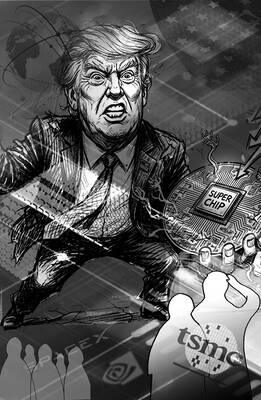
The White House’s decision to take a 9.9 percent stake in Intel Corp is looking like very shrewd business indeed. Since the government bought in at US$20.47 a share last August, the US chipmaker’s surging stock price has delivered the US a US$43 billion return. One of the reasons the investment has so far proved so sound is that the White House has made sure of it. According to The Wall Street Journal, Howard personally pushed deals on Intel’s behalf with some of the most lucrative clients imaginable. They include Nvidia Corp, the company at the heart of the AI
The Ministry of the Interior, working with the navy and coast guard, is organizing Taiwan’s first joint exercise simulating escort tankers carrying liquefied natural gas (LNG) and oil through a Chinese blockade. The drills simulate fuel transport along three maritime corridors leading toward Japan, the Philippines and the US. Deputy Minister of the Interior Sawyer Mars (馬士元) said that a blockade of the Taiwan Strait would amount to “almost a 100 percent blockade of the regional energy supply.” Minister of National Defense Wellington Koo said planning to counter a blockade is standard practice in Taipei. While the exercise is limited in
A single photograph can cut through a lot of noise, but it can also be used to misrepresent the truth. At the very least, it can concentrate the mind on something that requires further investigation. On Monday last week, Ma Ying-jeou Foundation CEO Tai Hsia-ling (戴遐齡) and former National Security Council secretary-general King Pu-tsung (金溥聰) held a news conference in which they showed a photograph of former foundation CEO Hsiao Hsu-tsen (蕭旭岑), now Chinese Nationalist Party (KMT) deputy chairman. In the image Hsiao is seated next to Xiamen Taiwan Businessmen Association chairman Han Ying-huan (韓螢煥). The two men were holding
I first met Professor Ray Jiing (井迎瑞) as a film and documentary student at Shih Hsin University’s (SHU) Department of Radio Television and Film in 1988. The following year, he went on to become the director of the Chinese Taipei Film Archive — forerunner of the Taiwan Film and Audiovisual Institute (TFAI). Over his eight-year tenure, Jiing rescued and restored over 200 classic Taiwanese films. In 1997, he established the Graduate Institute of Studies in Documentary and Film Archiving at Tainan National University of the Arts (TNNUA), and I joined the program in his third cohort of students. Beyond a


 RSS
RSS