


The Chinese National Federation of Industries (CNFI) recently ran three controversial TV commercials urging tax cuts to stimulate the economy and arguing for the existence of an inverse relationship between tax rates and economic development.
The commercials have resulted in protests from the “fair tax alliance,” which on Aug. 27 asked the National Communications Commission (NCC) to ban such “false” commercials. But the NCC, citing freedom of speech, said the advertisements were legal.
So far, the debate has for the most part limited itself to the rationale of the proposed tax cuts and whether the NCC should restrict commercials for such “non-commodities.”
Supporters of the tax cuts have argued that they are an emerging trend globally, citing the policy of former US president Ronald Reagan’s administration in the 1980s to back their claims. But they have purposely ignored the reviews of Reagan’s tax-cut policy that were later issued. Economist John Kenneth Galbraith severely attacked the policy in his book, The Culture of Contentment, arguing that tax cuts had led to excessive accumulation of private assets, while public interests were sacrificed and environmental protection and social welfare were overlooked.
Another economist, Lester Thurow, also commented on the policy in his book The Future of Capitalism, saying that tax cuts have not only widened the income gap, but also exacerbated social tensions. Thurow said that if the problem were allowed to continue, capitalism and democracy could be headed for a confrontation, which could eventually threaten the spirit of democratic politics. Indeed, looking back at the political and economic developments of the past decade or so, money politics has already risen as communist regimes collapsed one after the other. However, largely unnoticed was the fact that the very capitalistic democracy that was used to confront communism had also waned.
The most important confrontation between capitalism and democracy lies in tax policies. A government always has to balance economic development and social justice in its tax system, a thorny issue that has haunted every country.
Let us examine this from the perspective of broadcasting policy.
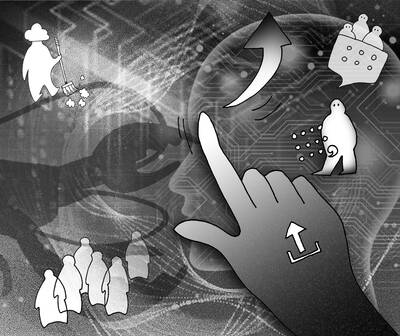
It is a well-known fact that media can affect government policies. Broadcasting policy is therefore another field on which the confrontation between capitalism and democracy will play out. Without a democratic media, there would be no democratic countries.
The CNFI is spending lots of money running the commercials, which quote British prime minister Winston Churchill and the late Nobel Prize-winning economist Milton Friedman to highlight the necessity of tax cuts. The way the commercials have been packaged gives them a veneer of objectivity and professionalism, but they have simplified the complex issue of tax policy. And more importantly, anonymous commercials may distort the issues, because their producers cannot be held to account. However, the authorities are unable to interfere with the commercials, as they are legal.
In future, an increased number of advertisements seeking to monopolize the “market of ideas” will appear. This will highlight the contradictions that exist between capitalism and democracy in the media and it will be up to the media to resolve these contradictions.
The media should play its role as a public tool with dexterity. When controversy arises, the media should bring its function as a public forum into full play, so that those without great amounts of capital can also make their voices heard. They should also promote communication and rational dialogue between people who hold different views. This is how we can resolve the contradictions that exist between capitalism and democracy.
The commercials touch on fundamental issues. Unfortunately, they have yet to receive attention from political talk shows, as the media have ignored this topic in the pursuit of higher ratings. The lack of discussion on political talk shows is aimed at balancing the effects of this commercial and therefore makes these shows accomplices of the federation. The value political talk shows attach to ratings is not a surprise and the reason behind this is perhaps the result of commercial TV stations’ capitalistic inclinations.
Thanks to the alliance’s recent protests to the NCC, the matter has now entered the public sphere, which has led to discussion in the print media. A call-in show on Public Television Service (PTS) also invited people with different views to discuss tax reform. Given its non-commercial status, PTS was in a position to freely promote diversity of opinion.
Let us hope that political talk shows on commercial TV will learn from PTS and not become mere mouthpieces for capitalist and oftentimes non-democratic interests.
Lo Huei-wen is an assistant communications management professor at Shih Hsin University.
TRANSLATED BY EDDY CHANG

Weeks into the craze, nobody quite knows what to make of the OpenClaw mania sweeping China, marked by viral photos of retirees lining up for installation events and users gathering in red claw hats. The queues and cosplay inspired by the “raising a lobster” trend make for irresistible China clickbait. However, the West is fixating on the least important part of the story. As a consumer craze, OpenClaw — the AI agent designed to do tasks on a user’s behalf — would likely burn out. Without some developer background, it is too glitchy and technically awkward for true mainstream adoption,
On Monday, a group of bipartisan US senators arrived in Taiwan to support the nation’s special defense bill to counter Chinese threats. At the same time, Beijing announced that Chinese President Xi Jinping (習近平) had invited Chinese Nationalist Party (KMT) Chairwoman Cheng Li-wun (鄭麗文) to visit China, a move to make the KMT a pawn in its proxy warfare against Taiwan and the US. Since her inauguration as KMT chair last year, Cheng, widely seen as a pro-China figure, has made no secret of her desire to interact with the Chinese Communist Party (CCP) and meet with Xi, naming it a
Taiwan People’s Party (TPP) Chairman Huang Kuo-chang (黃國昌) took the stage at a protest rally on Sunday in front of the Presidential Office Building in Taipei in support of former TPP chairman Ko Wen-je (柯文哲), who has been sentenced to 17 years in jail for corruption and embezzlement. Huang told the crowd that Chinese Nationalist Party (KMT) Chairwoman Cheng Li-wun (鄭麗文) had sent a message of support the previous day, saying she would be traveling from the south to Taipei: If the protest continued into the evening, she had said, she would show up. The rally was due to end
A delegation of Chinese Nationalist Party (KMT) officials led by Chairwoman Cheng Li-wun (鄭麗文) is to travel to China tomorrow for a six-day visit to Jiangsu, Shanghai and Beijing, which might end with a meeting between Cheng and Chinese President Xi Jinping (習近平). The trip was announced by Xinhua news agency on Monday last week, which cited China’s Taiwan Affairs Office (TAO) Director Song Tao (宋濤) as saying that Cheng has repeatedly expressed willingness to visit China, and that the Chinese Communist Party (CCP) Central Committee and Xi have extended an invitation. Although some people have been speculating about a potential Xi-Cheng


 RSS
RSS