


Costa Rican President Oscar Arias said on Wednesday that foreign governments should keep on applying sanctions against Honduras’ interim government even as its leaders expressed interest in further negotiations on ending the standoff.
Arias, who sought unsuccessfully to mediate a compromise between ousted Honruran president Manuel Zelaya and his foes, said the interim administration “isn’t convinced” and “hasn’t yet recognized that President Zelaya should be reinstated.”
Arias told reporters at a regional summit in Costa Rica that “sanctions should continue to be applied.”
Some governments have frozen aid programs for Honduras or canceled visas for officials connected to the interim government.
The Costa Rican leader said acting Honduran President Roberto Micheletti had called him to ask that Arias send an envoy to Honduras to speak with all three branches of the interim government.
He said Micheletti had suggested Enrique Iglesias, the former longtime head of the Inter-American Development Bank. Arias did not say whether Iglesias would go.
Micheletti issued a statement on Wednesday calling Arias’ mediation “the best path to achieving a consensus in Honduras,” and he asked Arias to include all parts of society in the dialogue, including church groups, students, business groups, unions, political parties and news media.
“Our citizens need to support and broaden the San Jose dialogue in Honduras, that is, have a dialogue among our own people,” Micheletti wrote.
Last week, Micheletti’s government rejected a proposal by Arias that Zelaya resume the presidency in a coalition government of all parties and that amnesty be given to both sides.
Honduran officials said Zelaya would be arrested if he returned to his homeland.
In Tegucigalpa, the Honduran capital, pro-Zelaya protesters returned to the streets and blocked traffic in another of their daily demonstrations demanding his restoration to the presidency.
Backers of the government that was installed after the army flew Zelaya out of Honduras on June 28 have also held demonstrations.
Meanwhile, two Venezuelan diplomats remained holed up at their country’s embassy a week after the interim government ordered them to leave.
The interim government accuses Venezuela — whose President Hugo Chavez is a vocal ally of Zelaya’s — of threatening Honduras and interfering in its internal affairs. It gave the diplomats a 72-hour deadline to leave on July 21, but they refused, saying they didn’t recognize the government.
The embassy’s charge d’affaires, Ariel Vargas, vowed to hold out in the embassy as about 20 Zelaya supporters gathered outside seeking to block any forcible takeover.
“We can’t go out on the street for fear they will arrest us,” Vargas told reporters.
The interim government has said it will simply wait for the Venezuelans to leave.
Zelaya and a group of about 500 supporters remained at a Nicaraguan town on the border with Honduras.
On Wednesday, UN officials toured the camp “to see what these people’s health condition is,” said Nicaraguan Health Minister Guillermo Gonzalez, who accompanied the group.
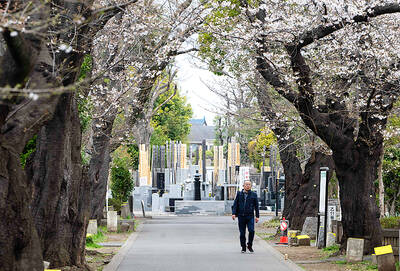
ROCKY RELATIONS: The figures on residents come as Chinese tourist numbers drop following Beijing’s warnings to avoid traveling to Japan The number of Chinese residents in Japan has continued to rise, even as ties between the two countries have become increasingly fractious, data released on Friday showed. As of the end of December last year, the number of Chinese residents had increased by 6.5 percent from the previous year to 930,428. Chinese people accounted for 22.6 percent of all foreign residents in Japan, making them by far the largest group, Japanese Ministry of Justice data showed. Beijing has criticized Tokyo in increasingly strident terms since Japanese Prime Minister Sanae Takaichi last year suggested that a military conflict around Taiwan could

A retired US colonel behind a privately financed rocket launch site in the Dominican Republic sees the project as a response to China’s dominance of the space race in Latin America. Florida-based Launch on Demand is slated to begin building a US$600 million facility in a remote region near the border with Haiti late this year. The project is designed to meet surging demand for the heavy-lift rockets needed to put clusters of satellites into orbit. It is also an answer to China’s growing presence in the region, said CEO Burton Catledge, a former commander of the US Air Force’s 45th Operations

Germany is considering Australia’s Ghost Bat robot fighter as it looks to select a combat drone to modernize its air force, German Minister of Defense Boris Pistorius said yesterday. Germany has said it wants to field hundreds of uncrewed fighter jets by 2029, and would make a decision soon as it considers a range of German, European and US projects developing so-called “collaborative combat aircraft.” Australia has said it will integrate the Ghost Bat, jointly developed by Boeing Australia and the Royal Australian Air Force, into its military after a successful weapons test last year. After inspecting the Ghost Bat in Queensland yesterday,
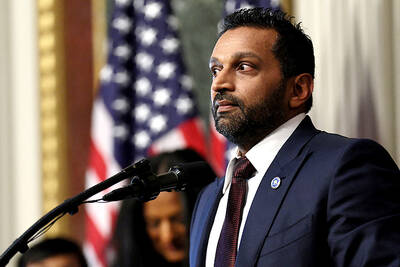
A pro-Iran hacking group claimed to breach FBI Director Kash Patel’s personal e-mail inbox and posted some of the contents online. The e-mails provided by the hacking group include travel details, correspondence with leasing agents in Washington and global entry, and loyalty account numbers. The e-mail address the hackers claim to have compromised has been previously tied to Patel’s personal details, and the leaked e-mails contain photos of Patel and others, in addition to correspondence with family members and colleagues. “The FBI is aware of malicious actors targeting Director Patel’s personal email information,” the agency said in a statement on


 RSS
RSS