


To judge how far aid has helped Africa along the road to prosperity, just look down at the pavement -- or the lack of it.
The most important highway in East Africa starts at the Indian Ocean port of Mombasa. Tens of thousands of trucks every year carry food, fuel and other goods to 100 million people in east and central Africa up a bone-jarring two-lane road.
Despite millions of aid dollars spent on roads, the wear and tear is so bad that journeys take weeks. And the cost makes it cheaper to have a container of corn shipped from Iowa than to truck it 800km to western Kenya.
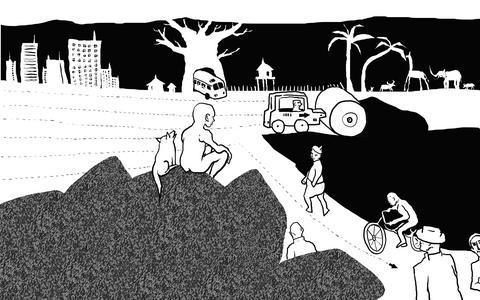
ILLUSTRATION: MOUNTAIN PEOPLE
In the 50 years since the first African countries won independence, the world has spent US$568 billion on Africa. Yet Africans are poorer now than a quarter century ago, and much of the money has ended up on the road to nowhere. This dismal record is sparking a vigorous debate on how best to help the world's poorest continent, and to what degree aid is the answer.
A growing chorus of Africans is saying what they need is not handouts, but investment so they can rebuild on their own.
"Africans ... are tired. They are tired of being the subject of everybody's charity and care. And what is happening in many African countries now is the realization that nobody can do it but us," said Ngozi Okonjo-Iweala, a World Bank managing director and former finance minister of Nigeria, at a talk on a changing Africa. "We can invite partners who support us, but we have to start."
LIFEBLOOD
Roads are the lifeblood of an economy, the delivery system for agriculture, mining, tourism and other mainstays of African industry. But roads in Africa are few and bad. When foreign companies calculate the price of doing business on the continent, they look at figures like the cost of transportation and decide to go somewhere else.
"No one would ever have 100 million people in the rich world along a broken-down, two-lane, undivided road as we do here," said leading economist Jeffrey Sachs about Nairobi. "If the donors were thinking about what would really provide development, it's a proper, divided highway on which truck traffic could go."
Truth is, they did think of it -- and almost built it -- 40 years ago. But today, the east-west Trans-African Highway exists only on maps. On the ground, it turns into a muddy footpath in the jungles of eastern Congo.
The story of the highway shows why aid to Africa has largely failed in the past, and what can be learned for the future.
Back in 1969, the Japanese government proposed extending the Mombasa Highway to Lagos, Nigeria on the Atlantic Ocean. The four-lane, 7,080km paved highway would be slightly longer than Interstate 90 running from Boston to Seattle across the US. It was to bring modern trade to six African countries.
By 1971, the deal had the support of the six countries, nine other rich countries and six international aid agencies. They hoped to have at least two lanes of all-weather road open by 1978.
It did not take long for problems to emerge. Dictator Idi Amin took control of Uganda and threatened neighboring Kenya, which then closed the highway.
MOBUTU
The fight reflected a constant plague for foreign aid to Africa -- corrupt dictators, and donors who gave them money to protect political and economic interests. Nowhere was this exchange clearer than in Zaire, now known as Congo.
Zaire needed to build roads from scratch. But the Central African country was ruled by Mobutu Sese Seko, one of the most brutal dictators in African history.
Mobutu took power during the Cold War, at a time when the US and the Soviet Union were scrambling for influence in Africa. In the mid-1970s, he was a funnel for arms flowing to anti-communist rebels.
And so billions of dollars poured into Zaire to keep him happy, and to maintain the flow of Zairean gold, diamonds and copper to the West. Western nations largely looked the other way as the aid money disappeared into his offshore bank accounts and into the pockets of dozens of corrupt leaders.
Mobutu stopped plans for the highway in 1974, after stealing the money Belgium gave him for initial surveys. In a well-known African joke that reflects the thinking of the time, a young African dictator calls Mobutu for advice after coming under rebel attack.
"Did they come by sea?" Mobutu asks.
"No," the younger ruler would reply.
"Did they come by air?" Mobutu asks.
"No, they came by road," the protege answers.
"Tsk tsk, my son, I always told you," Mobutu says. "Never build roads."
REPAIRS, REBUILDING
Despite Mobutu in Zaire, the highway was in good condition in Kenya. In the 1970s, the East African country's economy was booming, with trucks filled with valuable coffee and tea running downhill from 1.6km-high Nairobi and across breathtaking African savanna to the port of Mombasa.
But roads do not last forever.
The average African highway is designed to last 15 to 20 years, if properly maintained, says Andrew Gitonga, the Kenya roads project officer for the EU. Since 1983, the EU has spent US$200 million to repair Kenya's section of the highway and has about US$120 million more of road projects planned this year.
Gitonga said the road needs to be completely rebuilt.
"There has been no standard maintenance program for 15 years, so the roads are falling into disrepair until they collapse," he said. "Some government contracts in the past were given in an untransparent manner to unqualified contractors without clear standards."
The transition between good road work and bad is painfully obvious when you hit a pothole at 80.5kph. A close examination of the hole will show that whoever built it skimped on the thickness of the rock bed and the asphalt surfacing, pocketing a little extra profit.
Almost every day road workers can be seen patching the holes. One man sprays in some tar, a second shovels in a little asphalt and a third goes over it twice with a compactor. Within five minutes the lane is open, with hundreds of cars every hour driving over a repair that will probably last less than six months, or until the seasonal rains wash it away.
MISGUIDED DONORS
The same neglect for maintenance has led to the slow deterioration of thousands of donor-funded projects over the years.
Just off the Mombasa highway in Nairobi, the International Committee of the Red Cross maintains its distribution hub for eastern Africa. Trucks loaded with food and supplies set off to deliver aid to some of the world's most desperate people.
The biggest obstacle: The roads.
"The roads are in a desolate state and they are not getting any better," says Bent Korsgaard, logistics director for the Kenya office.
A University of Minnesota study determined that big trucks cost about US$0.434 per 1.6km to operate on normal roads. In Africa, the cost for Red Cross trucks is US$2.88 per 1.6km.
A truck that follows the Trans-African Highway for the 2,400km, 21-day roundtrip to Butembo, Congo requires five days in the workshop when it gets back. It's cheaper to hire a Russian cargo plane than to drive a truck to some cities within 1,000km.
That doesn't even count the bribes truckers have to pay on African roads. A recent survey in West Africa found they range from about US$3.33 per 97km in Togo to US$25 in Mali.
Roads are hardly the only aid fiascos. Kenya alone is littered with dozens of half-baked, half-built projects funded by wealthy countries, monuments to good intentions gone awry.
GOOD INTENTIONS
Often donors did not understand Africa or talk to Africans. The Norwegian government built a fish processing plant on Lake Turkana in the 1970s to provide jobs for nomadic cattle herders -- soon doomed in part because the local community had no fishing culture.
In a self-assessment in 1987, the World Bank found 106 out of 189 African development projects audited -- almost 60 percent -- had serious shortcomings or were complete failures. African agriculture projects failed 75 percent of the time.
The World Bank did better when it worked more closely with communities and better monitored projects. But a recent report on aid from the World Bank's private arm, the International Finance Corp, found only half of its Africa projects succeed.
Aid is also hampered because it is often determined not just by what poor countries need but by what rich countries want to give to boost their own economies.
Much so-called foreign aid never leaves the country that promised it, because donor governments spend it to buy domestically-produced products or hire its own citizens as consultants. The World Bank estimates that throughout the 1980s, more than half of all aid was tied to what donor countries wanted to export, often at higher prices than could be found on the market. This practice reduced the value of aid by anywhere from 11 to 30 percent.
Under the Buy American Act, the US Agency for International Development must spend aid money to buy products and services from US suppliers whenever possible, and then deliver them aboard expensive US-flagged ships or planes.
"Foreign assistance is far from charity," J. Brian Atwood, the USAID director under former President Bill Clinton, told Congress in 1995. "It is an investment in American jobs, American business."
Other rich nations do the same. Japan, one of the largest donors to Africa, provides a lot of aid in the form of four-wheel-drive vehicles -- despite the roads.
MILLENNIUM PROJECT
Sachs argues past aid failed because not enough was invested at every level, in every sector. In 2004, Sachs and the UN started the Millennium Project experiment to supply 12 African villages with all they need, all at once, and see if they can be self-sufficient in five years.
"The speed of results is astounding and the point is that if the resources are there, the rate of improvement is wonderful," Sachs says. "I believe that we're at the cusp of that now."
Sachs' nemesis, economist William Easterly of New York University, retorts that Sachs' results are on a very small scale. He says only a free market can lift a nation out of poverty, and wants to see far more limited aid for specific programs with good track records, such as health care.
Easterly argues that aid bureaucracies are now rewarded for giving money that never reaches those who need it.
"It's just not possible for outsiders with their experts to create economic development and prosperity in another country," he said. "We should say: `There are a lot of problems and as rich outsiders we can't fix everything, but where can we do the most good for the most people?"'
The stakes are high. The outcome will decide if -- and how -- the world spends another US$568 billion on Africa.
DREAM STILL ALIVE
The dream of a world-class road network for Africa is still alive -- at least on paper. The African Union has a plan to build it, but it would take tens of billions of dollars that could come only from rich countries.
The east-west Trans-African Highway is still missing about 2,939km. But West African states are building a regional network that will run from landlocked Chad to the Western port of Dakar in Senegal, and from Mauritania to Nigeria. Kenya is also building a road to neighboring Ethiopia.
Aid to Africa is going up again to about US$37per capita, from a low of US$24 in 1999. But this time the world has learned something. Aid to countries with more democratic systems has tripled at the expense of those whose leaders have unchecked power, according to the World Bank.
These days, when a new road is under construction in Kenya, white cars with EU flags on the doors visit every day to make sure every inch of the highway is built to specification.
And a maintenance contract comes with it.

In the past month, two important developments are poised to equip Taiwan with expanded capabilities to play foreign policy offense in an age where Taiwan’s diplomatic space is seriously constricted by a hegemonic Beijing. Taiwan Foreign Minister Lin Chia-lung (林佳龍) led a delegation of Taiwan and US companies to the Philippines to promote trilateral economic cooperation between the three countries. Additionally, in the past two weeks, Taiwan has placed chip export controls on South Africa in an escalating standoff over the placing of its diplomatic mission in Pretoria, causing the South Africans to pause and ask for consultations to resolve
An altercation involving a 73-year-old woman and a younger person broke out on a Taipei MRT train last week, with videos of the incident going viral online, sparking wide discussions about the controversial priority seats and social norms. In the video, the elderly woman, surnamed Tseng (曾), approached a passenger in a priority seat and demanded that she get up, and after she refused, she swung her bag, hitting her on the knees and calves several times. In return, the commuter asked a nearby passenger to hold her bag, stood up and kicked Tseng, causing her to fall backward and
In December 1937, Japanese troops captured Nanjing and unleashed one of the darkest chapters of the 20th century. Over six weeks, hundreds of thousands were slaughtered and women were raped on a scale that still defies comprehension. Across Asia, the Japanese occupation left deep scars. Singapore, Malaya, the Philippines and much of China endured terror, forced labor and massacres. My own grandfather was tortured by the Japanese in Singapore. His wife, traumatized beyond recovery, lived the rest of her life in silence and breakdown. These stories are real, not abstract history. Here is the irony: Mao Zedong (毛澤東) himself once told visiting
When I reminded my 83-year-old mother on Wednesday that it was the 76th anniversary of the founding of the People’s Republic of China, she replied: “Yes, it was the day when my family was broken.” That answer captures the paradox of modern China. To most Chinese in mainland China, Oct. 1 is a day of pride — a celebration of national strength, prosperity and global stature. However, on a deeper level, it is also a reminder to many of the families shattered, the freedoms extinguished and the lives sacrificed on the road here. Seventy-six years ago, Chinese Communist leader Mao Zedong (毛澤東)


 RSS
RSS