


China should view Hong Kong as a testing ground for democracy and stop slamming the brakes on reform, according to the city's former No. 2 who straddled the handover from British rule.
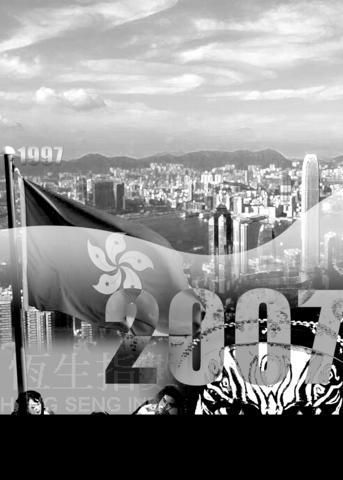
As Hong Kong looks to the 10th anniversary this weekend of the transfer of sovereignty to China, Anson Chan (
In an interview, the former head of the civil service in Hong Kong said that while people enjoyed a high degree of autonomy, a vibrant economy and an independent judiciary, it is political life that Beijing has restricted.
This prompted her to re-enter politics last year, forming a lobby group to press for constitutional reform and outline steps toward full democracy.
"The reason I'm involved is because I have already lamented the lack of progress in the 10 years since the handover," she said. "Of course, you would have expected there would be progress, but why isn't it there?"
Chan was the first woman and first Chinese to be chief secretary of Hong Kong, the second-highest official position, which made her deputy both to the city's last British governor Chris Patten and its first post-colonial leader Tung Chee-hwa (董建華).
Now 67, she retired in 2001 only to return to the political scene in 2005, joining tens of thousands of people in protests demanding greater democracy, and her voice commands great respect.
The first major rally was in 2003 when more than half a million people marched against a proposed anti-subversion law which China wanted to impose. The bill was withdrawn, and Chan said the protest changed the political landscape for good.
"The sheer size of the demonstration really caught some local people and certainly Beijing by surprise. Beijing ever since then has taken a more direct interest in what happens in Hong Kong politically. We definitely have seen Beijing is getting more involved," she said.
Currently Hong Kong's political leaders are selected by a committee of 800 mainly Beijing loyalists, while only half of the 60 legislators are chosen by direct election.
Democratic reforms are enshrined in the Basic Law used to govern the city since the handover, but it does not clearly state how and when.
The text says that can be considered after this year, although the timing is not specified. Democracy advocates have pushed for reforms.
China is reluctant to allow change for fear it will destabilize the city and spread democratic pressure to the mainland.
In 2004, its top legislature interpreted the Basic Law and ruled out direct elections by this year. The result was another half a million people taking to the streets in protest.
Chan warned that such interference undermined confidence in the territory, both among its own people and internationally.
"You must not use power like this because every time you use it, there's a consequence," she said.
Chan said Hong Kong people were ready for full democracy and China should use the territory as a testing ground.
"If you look at our general education level, the behavior of the average man on the street and our economic development, I don't see any reason or why anybody can really say in their heart that Hong Kong people are not ready for universal suffrage," she said.
But Britain is not helping much either.
Chan criticized London for not speaking up.
"I think the British government should remember that unlike other countries, it has more of a constitutional responsibility," she said.
Still, Chan said she was hopeful about Hong Kong Chief Executive Donald Tsang's (曾蔭權) pledge to resolve the thorny democracy issue by the end of his new five-year term in 2012.
Tsang, who begins his second term on July 1, has vowed to release concrete proposals this summer which will go to public consultation before being given to China.
Meanwhile Chan hopes to stimulate more public discussion on the issue, and describe herself as "cautiously optimistic."
"If I'm not optimistic, I wouldn't have come out and taken up the task of trying to do something on constitutional reform. So I believe something good will come out of it," she said.
"But it cannot be just one person's effort, so it has to be very much the community's efforts. I hope more people should be willing to speak up about it," Chan said.
Recently, China launched another diplomatic offensive against Taiwan, improperly linking its “one China principle” with UN General Assembly Resolution 2758 to constrain Taiwan’s diplomatic space. After Taiwan’s presidential election on Jan. 13, China persuaded Nauru to sever diplomatic ties with Taiwan. Nauru cited Resolution 2758 in its declaration of the diplomatic break. Subsequently, during the WHO Executive Board meeting that month, Beijing rallied countries including Venezuela, Zimbabwe, Belarus, Egypt, Nicaragua, Sri Lanka, Laos, Russia, Syria and Pakistan to reiterate the “one China principle” in their statements, and assert that “Resolution 2758 has settled the status of Taiwan” to hinder Taiwan’s
Can US dialogue and cooperation with the communist dictatorship in Beijing help avert a Taiwan Strait crisis? Or is US President Joe Biden playing into Chinese President Xi Jinping’s (習近平) hands? With America preoccupied with the wars in Europe and the Middle East, Biden is seeking better relations with Xi’s regime. The goal is to responsibly manage US-China competition and prevent unintended conflict, thereby hoping to create greater space for the two countries to work together in areas where their interests align. The existing wars have already stretched US military resources thin, and the last thing Biden wants is yet another war.
As Maldivian President Mohamed Muizzu’s party won by a landslide in Sunday’s parliamentary election, it is a good time to take another look at recent developments in the Maldivian foreign policy. While Muizzu has been promoting his “Maldives First” policy, the agenda seems to have lost sight of a number of factors. Contemporary Maldivian policy serves as a stark illustration of how a blend of missteps in public posturing, populist agendas and inattentive leadership can lead to diplomatic setbacks and damage a country’s long-term foreign policy priorities. Over the past few months, Maldivian foreign policy has entangled itself in playing
A group of Chinese Nationalist Party (KMT) lawmakers led by the party’s legislative caucus whip Fu Kun-chi (?) are to visit Beijing for four days this week, but some have questioned the timing and purpose of the visit, which demonstrates the KMT caucus’ increasing arrogance. Fu on Wednesday last week confirmed that following an invitation by Beijing, he would lead a group of lawmakers to China from Thursday to Sunday to discuss tourism and agricultural exports, but he refused to say whether they would meet with Chinese officials. That the visit is taking place during the legislative session and in the aftermath


 RSS
RSS