


Missile defense has suddenly emerged as a divisive issue in Europe. Rather than enhancing European security, the Bush administration's plan to deploy elements of a missile defense system in Poland and the Czech Republic threatens to increase strains with Russia and deepen divisions with the US' European allies, particularly those in Eastern Europe, where support for US polices has historically been strongest.
The growing opposition to the US missile defense deployment is rooted in the way in which it has managed -- or rather mismanaged -- the presentation of its deployment plans.
First, US officials did not lay the political and psychological groundwork for deployment. They assumed that Czech and Polish leaders -- who were strongly pro-US -- would willingly agree to deployment, and that public opinion in both countries would go along with whatever the governments decided.
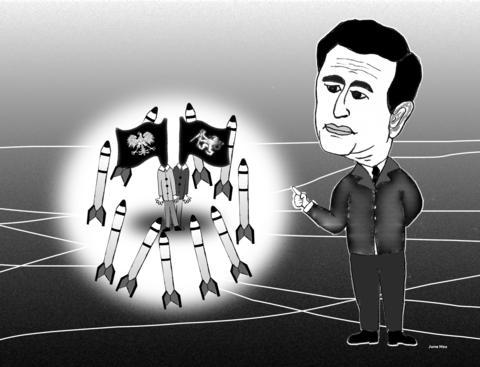
But the US failed to develop a coherent public rationale for its planned deployment of a system designed to destroy a missile fired by a rogue regime. As a result, the Czech and Polish governments were unable to answer fundamental questions about the costs and benefits of the deployment for Polish and Czech national security. This allowed skeptics and opponents of missile defense to gain the upper hand in the internal debates in both countries.
Second, US officials initially tended to view missile defense largely as a technological issue divorced from its political context. For most Europeans, however, the military-technical issues are less important than the broader political implications of deployment for European stability and security. The initial US briefings to European allies ignored this fact.
Third, the US underestimated the role of public opinion in Poland and the Czech Republic. US officials assumed that it was sufficient to have the consent of the governments and failed to recognize the degree to which these countries have become increasingly "Europeanized" in the last decade. Membership of the EU has resulted in the proliferation of ties to Europe at many levels, as well as a major influx of EU money. This has had an enormous impact on public attitudes in Eastern Europe.
In Poland, a big gap exists between the government's attitude and that of the population regarding the EU. The Polish government is dominated by Euro-skeptics and has pursued a highly nationalistic policy that has often antagonized EU officials. Ordinary Poles, by contrast, are strongly pro-European. According to recent polls, 80 percent of the population supports Poland's membership of the EU -- the highest in Europe.
Fourth, US officials have tended to assume that the countries of Eastern Europe will remain staunchly pro-American and automatically support US policy. That was true five years ago, but it is much less true today. As Eastern European countries become more closely integrated into the EU, they increasingly have to calculate the impact of their policies on relations with Europe.
At the same time, the war in Iraq and abuses associated with it have tarnished the US' image in Eastern Europe. This is true even in Poland, which is the most pro-American country in the region. The Polish government strongly supported the US in Iraq, sending the third largest contingent of forces, after the US and Great Britain. However, Polish public opinion, like public opinion in Western Europe, was overwhelmingly opposed to the Iraq invasion.
Moreover, many Poles feel they have little to show for the government's support. As former Polish defense minister Radek Sikorski noted recently, there is a sense among many Poles that the US takes Poland for granted. Sikorski's argument shocked many US officials, because he is considered one of the most pro-American politicians in Poland. But it reflects a widespread sentiment among many Poles, including those who are staunch supporters of close ties with the US.
Unlike the Iraq operation, the missile defense deployment will almost certainly require approval by the Polish parliament. This approval cannot be taken for granted. The government will need to explain to a skeptical Polish population and parliament why the deployment is in Poland's national interest -- not just the US' interest -- and how it enhances Polish security. Simply saying, "because the US wants it" will not be enough.
The US can still win the missile debate in Europe, but only if it stops treating missile defense primarily as a technological issue and addresses the broader political concerns that are driving the debate among European publics, including those in Eastern Europe.
F. Stephen Larrabee holds the corporate chair in European security at the RAND Corp. Andrzej Karkoszka was state secretary for defense in Poland from l995 to 1998 and director of the strategic defense review in the Polish Ministry of Defense from 2003 to last year. Copyright: Project Syndicate
Recently, China launched another diplomatic offensive against Taiwan, improperly linking its “one China principle” with UN General Assembly Resolution 2758 to constrain Taiwan’s diplomatic space. After Taiwan’s presidential election on Jan. 13, China persuaded Nauru to sever diplomatic ties with Taiwan. Nauru cited Resolution 2758 in its declaration of the diplomatic break. Subsequently, during the WHO Executive Board meeting that month, Beijing rallied countries including Venezuela, Zimbabwe, Belarus, Egypt, Nicaragua, Sri Lanka, Laos, Russia, Syria and Pakistan to reiterate the “one China principle” in their statements, and assert that “Resolution 2758 has settled the status of Taiwan” to hinder Taiwan’s
Singaporean Prime Minister Lee Hsien Loong’s (李顯龍) decision to step down after 19 years and hand power to his deputy, Lawrence Wong (黃循財), on May 15 was expected — though, perhaps, not so soon. Most political analysts had been eyeing an end-of-year handover, to ensure more time for Wong to study and shadow the role, ahead of general elections that must be called by November next year. Wong — who is currently both deputy prime minister and minister of finance — would need a combination of fresh ideas, wisdom and experience as he writes the nation’s next chapter. The world that

Can US dialogue and cooperation with the communist dictatorship in Beijing help avert a Taiwan Strait crisis? Or is US President Joe Biden playing into Chinese President Xi Jinping’s (習近平) hands? With America preoccupied with the wars in Europe and the Middle East, Biden is seeking better relations with Xi’s regime. The goal is to responsibly manage US-China competition and prevent unintended conflict, thereby hoping to create greater space for the two countries to work together in areas where their interests align. The existing wars have already stretched US military resources thin, and the last thing Biden wants is yet another war.
As Maldivian President Mohamed Muizzu’s party won by a landslide in Sunday’s parliamentary election, it is a good time to take another look at recent developments in the Maldivian foreign policy. While Muizzu has been promoting his “Maldives First” policy, the agenda seems to have lost sight of a number of factors. Contemporary Maldivian policy serves as a stark illustration of how a blend of missteps in public posturing, populist agendas and inattentive leadership can lead to diplomatic setbacks and damage a country’s long-term foreign policy priorities. Over the past few months, Maldivian foreign policy has entangled itself in playing


 RSS
RSS