


In the most polluted city on earth, the smog is so thick that it seems to consume its source. Iron foundries, smelting plants and cement factories loom out of the haze then disappear once more as you drive along Linfen's roads.
The outlines of smoke stacks blur in the filthy mist. No sooner are the plumes of carbon and sulphur belched out than the chimneys are swallowed up again.
"We only see the sun for a few days each year," said Zhou Huocun, a doctor in the outlying village of Liucunzhen.
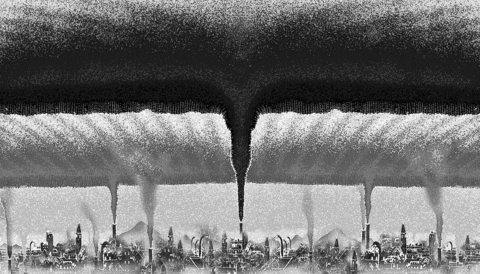
"The color of our village is black. It is so dirty that nobody airs their quilts outside any more so we are getting more parasites. I have seen a steady increase in respiratory diseases as the air quality gets worse and worse," he said.
Outside Zhou's hospital, shoes leave marks in the black dust. But it is a different type of carbon footprint that is drawing international attention to this part of the world.
Linfen is the frontline of the battle against global warming. For the past five years, the city of 3.5 million people has been the most polluted place on the planet, bottom of the World Bank's air quality rankings, and a symbol of the worst side-effects of China's breakneck economic growth.
Enveloped by a spectral haze, the city lies at the heart of a 19km industrial belt, fed by the 50 million tonnes of coal mined each year in the nearby hills of Shanxi Province. The New York-based Blacksmith Institute puts it alongside Chernobyl on a list of the planet's 10 most contaminated places.
What Linfen symbolizes is the cost of development in China and the other most populous country: India. Both economies are growing explosively, leading to a rapid expansion of their middle classes. This in turn has seen a growing appetite for power -- one sated by the building of dirty, inefficient coal-fired plants that are slowly cooking the world's atmosphere.
The effects have been dramatic. By 2009 China is predicted to overtake the US as the world's biggest emitter of greenhouse gases. India has recently become the fourth biggest polluter, but its steeply rising emissions will see it in third place within a few years.
China's three decades of industrial blitzkrieg has extracted a heavy price. Seventy percent of its rivers are contaminated. In the southern Himalayas, ancient glaciers are melting. Further north, encroaching deserts threaten the livelihoods of 400 million people.
India, which is only half as rich as China, has also suffered. The frequency of catastrophic weather events such as flash flooding, say Indian meteorologists, is increasing. Clouds of brown soot cover the skies above the Indian Ocean for months each year. Agricultural scientists in the subcontinent note rising temperatures caused wheat yields to drop by a 10th last year.
The new consumption culture has brought Western-style affluence that largely rural India can barely cope with. Car sales are growing at 20 percent a year, but there are not enough roads for anyone to drive on. India -- unlike China, Europe and America -- does not set any fuel economy standards.
The result is that in the backstreets of a city such as Kanpur on the banks of the Ganges sit lines of cars, their engines idling in the sun. Kanpur, with 3 million people, is the world's seventh most polluted place, according to the World Bank study. A thick brown haze of exhaust fumes is visible at street level.
Last year hundreds of people were lining up outside the government hospital, their mouths covered with dirty rags.
"About 40 percent of the patients coming with respiratory diseases are affected by the atmospheric pollution," said RP Singh, who describes the air as a "killer."
The environmental problems in India and China, which between them have 2.4 billion people, have become an excuse for inaction elsewhere. Many Britons argue that whatever positive steps they take will be insignificant compared with the negative impact of economic growth in Asia.
As British Prime Minister Tony Blair puts it: "Close down all of Britain's emissions and in less than two years just the growth in China's emissions would wipe out the difference."
British officials on a visit to New Delhi this year said that they were sceptical that India and China would sacrifice growth for green measures.
"They are talking about climate change but doing very little in reality," a source said.
But for those seeking good news, it can be found even in China. Linfen is trying to clean up. By the end of this year, the city aims to close 160 of 196 iron foundries, and 57 of 153 coking plants. By replacing small, dirty and dangerous plants with large, cleaner and more carefully regulated facilities, the local government in Linfen plans to drastically reduce emissions. Central heating will be provided by gas instead of coal.
The changes are being driven by business (nobody wants to invest in such a polluted place), bureaucratic self-interest (local officials find it difficult to be promoted) and shifting political priorities.
"We have more power than before," said Yang Zhaofeng (楊兆豐), a top official in Linfen's environmental bureau. "The mayor says we can sacrifice economic growth in order to improve air quality. That used to be unthinkable."
There are already small signs of change. Last year, Linfen's residents breathed 163 days of unhealthy air, 15 days fewer than in 2005. Many factories have already been closed -- not a wisp of smoke emerges from their chimneys. Thanks partly to such measures, Linfen lost its bottom spot in China's latest pollution rankings to the far-flung western city of Urumqi.
Both Beijing and New Delhi argue that they must use more energy to lift their populations from poverty, and that emissions per person are a fraction of those in rich states.
Indian Prime Minister Manmohan Singh told a conference this month: "The principal polluters are the United States and countries of Western Europe. Per capita emissions are far ahead [of India and China]. You cannot preserve energy by perpetuating poverty in the poor nations."
The figures bear out his words. India emits 1.1 tonnes of carbon dioxide per person. China puts out 3.5 tonnes. Both are less than the global average of 4.2 tonnes. The comparable figures for the UK and America are 9.6 and 20.2 tonnes respectively.
Last year Indian President Abdul Kalam, a former scientist, called for 25 percent of power generation to come from renewable sources by 2030. The figure is now just 6 percent.
The country, which started its renewables ministry a decade ago, is building the world's biggest wind farm site, with 500 turbines outside Mumbai. The farm will have a capacity of 1,000MW.
"We are helping to make India one of only four countries in the world that can manufacture and export such technologies," said Tulsi Tanti, founder and managing director of Suzlon, which is building the wind farm. "Global warming created a great awareness for us. We have the support of the government and with the economy growing by eight-10 percent there will be a power deficit which we can fill with clean wind power."
In China there's also a growing appreciation of the unsustainable nature of red-hot economic growth, which has led to new green policies. In an address to the National People's Congress this month, Chinese Premier Wen Jiabao (溫家寶) promised that "backward" factories would be shut down and energy efficiency improved to "bring pollution under control and protect the environment".
Previous leaders have failed to keep similar pledges. Wen acknowledged that China had fallen short of its environmental targets last year. According to the latest five-year plan, China should use 20percent less energy per unit of economic output by 2010. Last year, however, it managed to improve energy efficiency by only 1 percent.
Yang Ailun (
"They are worried about the immediate causes of pollution -- like river contamination -- rather than global warming. Climate change seems far away," she said. "If the government is really serious about environmental protection, then we need to change our economic structure and reduce our dependency on coal."
The timing is critical. The Kyoto Protocol, which required developed countries to reduce their emissions by 5 percent from 1990 levels, expires in 2012. China and India were not given targets under the Kyoto protocol while the US refused to ratify it.
The upshot is that none of these three giants have any binding commitment to cut emissions.
But for an effective replacement for the protocol, these three will have to take part in negotiations by 2010. Much depends on the US, which is responsible for about a quarter of all emissions. Without willing US engagement, the chances of a new agreement are small.
Rajendra Pachauri, chairman of the UN Intergovernmental Panel on Climate Change, which last month reported that global warming was "unequivocal" and caused by human activity, said the only reasonable solution was to cut emissions of greenhouse gases gradually, while attempting to find new, low-carbon, energy sources, such as wind, solar, water and nuclear power.
"But we cannot ask developing countries like India and China to bear all of this burden. Both have a point when they say that all the carbon dioxide was emitted in the process of the West becoming industrialized especially by the United States," Pachauri said. "India and China will argue that this is not a problem created by themselves."
"Instead we will find that people in the West will have to change their behavior and conserve energy, use less power, perhaps wear warmer clothes in cold winters rather than turning up the central heating. It also means countries like India will need help building railways so that their public transport systems can cope with the growth," he said.
When negotiations start this December for a deal to replace the Kyoto Protocol, China and India will resist binding targets to reduce emissions. New Delhi will probably seek technology to reduce carbon emissions from its power plants. At most, Beijing might agree to goals on energy efficiency and greater use of alternatives to coal and oil.
Shame could prove the great motivator.
"The whole world will soon say to China, `You are the number one emitter. You have got to do something,'" said Jeffrey Sachs, head of the Earth Institute at Columbia University.
Speaking at a recent lecture in Beijing, Sachs said China needed to move quickly towards clean coal and carbon capture technology.
"The safe use of fossil fuels is the single most important source of hope in China and India," he said.
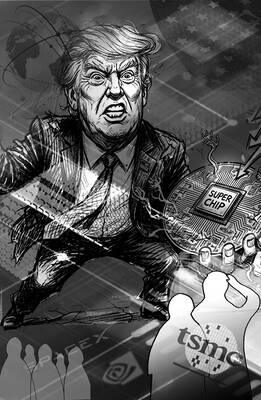
The White House’s decision to take a 9.9 percent stake in Intel Corp is looking like very shrewd business indeed. Since the government bought in at US$20.47 a share last August, the US chipmaker’s surging stock price has delivered the US a US$43 billion return. One of the reasons the investment has so far proved so sound is that the White House has made sure of it. According to The Wall Street Journal, Howard personally pushed deals on Intel’s behalf with some of the most lucrative clients imaginable. They include Nvidia Corp, the company at the heart of the AI
A single photograph can cut through a lot of noise, but it can also be used to misrepresent the truth. At the very least, it can concentrate the mind on something that requires further investigation. On Monday last week, Ma Ying-jeou Foundation CEO Tai Hsia-ling (戴遐齡) and former National Security Council secretary-general King Pu-tsung (金溥聰) held a news conference in which they showed a photograph of former foundation CEO Hsiao Hsu-tsen (蕭旭岑), now Chinese Nationalist Party (KMT) deputy chairman. In the image Hsiao is seated next to Xiamen Taiwan Businessmen Association chairman Han Ying-huan (韓螢煥). The two men were holding
I first met Professor Ray Jiing (井迎瑞) as a film and documentary student at Shih Hsin University’s (SHU) Department of Radio Television and Film in 1988. The following year, he went on to become the director of the Chinese Taipei Film Archive — forerunner of the Taiwan Film and Audiovisual Institute (TFAI). Over his eight-year tenure, Jiing rescued and restored over 200 classic Taiwanese films. In 1997, he established the Graduate Institute of Studies in Documentary and Film Archiving at Tainan National University of the Arts (TNNUA), and I joined the program in his third cohort of students. Beyond a
A recent report concerning a student who is suing his teacher posed the question in its headline: Does failing a student in two subjects constitute bullying? The college student in Chiayi County apparently sought NT$2 million (US$63,603) in state compensation, but a court dismissed the case. The first reaction of many might have been to ask: What has happened to students nowadays? Some say that teachers have lost their authority, while others say students are overindulged. Some even start reminiscing over the days when “whatever the teacher says goes.” However, the real issue might be overlooked if emotional reactions like that are the


 RSS
RSS