


Something is amiss in the world of finance.
The problem is not another financial meltdown in an emerging market, with the predictable contagion that engulfs neighboring countries. Even the most exposed countries handled the last round of financial shocks in May and June of last year relatively comfortably.
Instead, the problem this time around is one that relatively calm times have helped reveal: The predicted benefits of financial globalization are nowhere to be seen.
Financial globalization is a recent phenomenon. One could trace its beginnings to the 1970s, when recycled petrodollars fueled large capital inflows to developing nations. But it was only around 1990 that most emerging markets threw caution to the wind and removed controls on private portfolio and bank flows. Private capital flows have exploded since, dwarfing trade in goods and services. So the world has experienced true financial globalization only for 15 years or so.
Freeing up capital flows had an inexorable logic -- or so it seemed. Developing nations, the argument went, have plenty of investment opportunities, but are short on savings. Foreign capital inflows would allow them to draw on the savings of rich countries, increase their investment rates and stimulate growth. In addition, financial globalization would allow poor nations to smooth out the boom-and-bust cycles associated with temporary terms-of-trade shocks and other bouts of bad luck. Finally, exposure to the discipline of financial markets would make it harder for profligate governments to misbehave.
But things have not worked out according to plan. Research at the IMF, of all places, as well as by independent researchers documents a number of puzzles and paradoxes. For example, it is difficult to find evidence that countries that freed up capital flows have experienced sustained economic growth as a result. In fact, many emerging markets experienced declines in investment rates. Nor, on balance, has liberalization of capital flows stabilized consumption.
Most intriguingly, the countries that have done the best in recent years are those that relied the least on foreign financing. China, the world's growth superstar, has a huge current-account surplus, which means that it is a net lender to the rest of the world. Among other high-growth countries, Vietnam's current account is essentially balanced, and India has only a small deficit. Latin America, Argentina and Brazil have been running comfortable external surpluses recently. In fact, their new-found resilience to capital-market shocks is due in no small part to their becoming net lenders to the rest of the world after years as net borrowers.
To understand what is going on, we need a different explanation of what keeps investment and growth low in most poor nations. Whereas the standard story -- the one that motivated the drive to liberalize capital flows -- is that developing countries are saving-constrained, the fact that capital is moving outward rather than inward in the most successful developing countries suggests that the constraint lies elsewhere. Most likely, the real constraint lies on the investment side.
The main problem seems to be the paucity of entrepreneurship and low propensity to invest in plant and equipment -- what Keynes called "low animal spirits" -- especially to raise output of products that can be traded on world markets. Behind this shortcoming lay various institutional and market distortions associated with industrial and other modern-sector activities in low-income environments.
When countries suffer from low investment demand, freeing up capital inflows does not do much good. What businesses in these countries need is not necessarily more finance, but the expectation of larger profits for their owners. In fact, capital inflows can make things worse, because they tend to appreciate the domestic currency and make production in export activities less profitable, further weakening the incentive to invest.
Thus, the pattern in emerging market economies that liberalized capital inflows has been lower investment in the modern sectors of the economy, and eventually slower economic growth, once the consumption boom associated with the capital inflows plays out. By contrast, countries like China and India, which avoided a surge of capital inflows, managed to maintain highly competitive domestic currencies and thereby kept profitability and investment high.
The lesson for countries that have not yet made the leap to financial globalization is clear: beware. Nothing can kill growth more effectively than an uncompetitive currency, and there is no faster route to currency appreciation than a surge in capital inflows.
For those countries that have already made the leap, the choices are more difficult. Managing the exchange rate becomes much more difficult when capital is free to come and go as it pleases. But it is not impossible -- as long as policymakers understand the role played by the exchange rate and the need to subordinate capital flows to the requirements of competitiveness.
Given all the effort that the world's "emerging markets" have devoted to shielding themselves from financial volatility, they have reason to ask: Where in the world is the upside of financial liberalization? That is a question all of us should consider.
Dani Rodrik is a professor of political economy at Harvard University's John F. Kennedy School of Government. Copyright: Project Syndicate
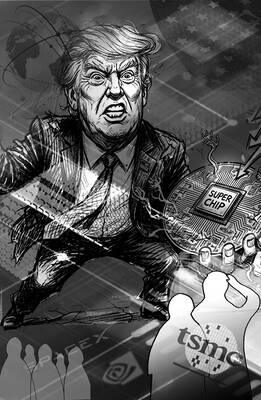
The White House’s decision to take a 9.9 percent stake in Intel Corp is looking like very shrewd business indeed. Since the government bought in at US$20.47 a share last August, the US chipmaker’s surging stock price has delivered the US a US$43 billion return. One of the reasons the investment has so far proved so sound is that the White House has made sure of it. According to The Wall Street Journal, Howard personally pushed deals on Intel’s behalf with some of the most lucrative clients imaginable. They include Nvidia Corp, the company at the heart of the AI
A single photograph can cut through a lot of noise, but it can also be used to misrepresent the truth. At the very least, it can concentrate the mind on something that requires further investigation. On Monday last week, Ma Ying-jeou Foundation CEO Tai Hsia-ling (戴遐齡) and former National Security Council secretary-general King Pu-tsung (金溥聰) held a news conference in which they showed a photograph of former foundation CEO Hsiao Hsu-tsen (蕭旭岑), now Chinese Nationalist Party (KMT) deputy chairman. In the image Hsiao is seated next to Xiamen Taiwan Businessmen Association chairman Han Ying-huan (韓螢煥). The two men were holding
I first met Professor Ray Jiing (井迎瑞) as a film and documentary student at Shih Hsin University’s (SHU) Department of Radio Television and Film in 1988. The following year, he went on to become the director of the Chinese Taipei Film Archive — forerunner of the Taiwan Film and Audiovisual Institute (TFAI). Over his eight-year tenure, Jiing rescued and restored over 200 classic Taiwanese films. In 1997, he established the Graduate Institute of Studies in Documentary and Film Archiving at Tainan National University of the Arts (TNNUA), and I joined the program in his third cohort of students. Beyond a
A recent report concerning a student who is suing his teacher posed the question in its headline: Does failing a student in two subjects constitute bullying? The college student in Chiayi County apparently sought NT$2 million (US$63,603) in state compensation, but a court dismissed the case. The first reaction of many might have been to ask: What has happened to students nowadays? Some say that teachers have lost their authority, while others say students are overindulged. Some even start reminiscing over the days when “whatever the teacher says goes.” However, the real issue might be overlooked if emotional reactions like that are the


 RSS
RSS