


Let's say that one day Beijing elects to attack Taiwan with all its military might, but Taiwan refuses to surrender despite mounting civilian casualties and considerable damage to roads, bridges, ports, airports and other key infrastructure.
Caught unawares, or at least unable to respond in time, Washington dispatches warships to the area and ratchets up the rhetoric. By the time these arrive, however, People's Liberation Army (PLA) ground and air forces have overcome the Taiwanese military in most locations and secured the Presidential Office, key military installations, the legislature and other important government buildings. The Americans, recognizing when a thing cannot be undone by military means, withdraw a certain distance and watch.
What then?
Before the end of World War II, a preparatory body headed by Chen Yi (
Amid all the bluster about how many hundred missiles China has pointed at Taiwan, the fundamental issue of how China would administer postwar Taiwan is obscured, if not ignored.
China has plans of some nature drawn up for an invasion. But it is not clear that Beijing has the remotest idea how to govern an occupied territory that was once a wealthy democracy -- and this does not factor in the logistics of feeding and sheltering an occupying army and bureaucracy.
The idea that Taiwanese civilians would be unwilling to confront PLA forces and a military government -- especially after atrocities occur -- is not convincing; what would be needed to mitigate such problems is a collaborationist administration.
An interesting question that follows is: Who would they choose? And from this: Are such people identifiable now?
The likelihood of a collaborationist government being able to competently deal with the international economic response to an invasion is low -- indeed, Beijing would probably be struggling hard to defend "mainland" China's economic integrity.
Other changes that might shock Taiwan's middle class from its stupor would be the expulsion of selected foreigners and organizations, the purging of universities and possible revoking of citizenship for people of "non-Chinese" descent and their title to property, and restrictions on movement.
The best-case scenario for China would see a pragmatic public accept their lot -- much as Taiwanese did following the flight of KMT troops to Taiwan in the late 1940s and early 1950s. But after that time the KMT was boosted by US support and sensible economic reforms that spread wealth across most sectors of society. It is not clear how China would act in an occupied Taiwan, and whether "sensible" policy would have much role to play.
The more one fleshes out a postwar scenario, the more insane an invasion appears. With Beijing, however, this does not lessen the likelihood of one. Of prime concern is the certainty that a postwar administration would quickly earn the contempt -- then hatred -- of most Taiwanese, a situation mirroring that of 60 years ago. If China wishes to proceed with this scenario, it had better be prepared to crush dissent ruthlessly and so destroy its uncertain international reputation -- and kiss its fantasy of a spiritually united China goodbye.
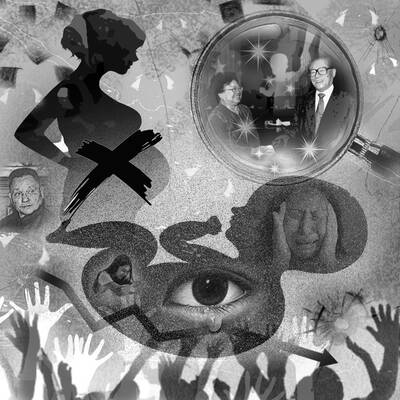
Jan. 1 marks a decade since China repealed its one-child policy. Just 10 days before, Peng Peiyun (彭珮雲), who long oversaw the often-brutal enforcement of China’s family-planning rules, died at the age of 96, having never been held accountable for her actions. Obituaries praised Peng for being “reform-minded,” even though, in practice, she only perpetuated an utterly inhumane policy, whose consequences have barely begun to materialize. It was Vice Premier Chen Muhua (陳慕華) who first proposed the one-child policy in 1979, with the endorsement of China’s then-top leaders, Chen Yun (陳雲) and Deng Xiaoping (鄧小平), as a means of avoiding the
In the US’ National Security Strategy (NSS) report released last month, US President Donald Trump offered his interpretation of the Monroe Doctrine. The “Trump Corollary,” presented on page 15, is a distinctly aggressive rebranding of the more than 200-year-old foreign policy position. Beyond reasserting the sovereignty of the western hemisphere against foreign intervention, the document centers on energy and strategic assets, and attempts to redraw the map of the geopolitical landscape more broadly. It is clear that Trump no longer sees the western hemisphere as a peaceful backyard, but rather as the frontier of a new Cold War. In particular,
As the Chinese People’s Liberation Army (PLA) races toward its 2027 modernization goals, most analysts fixate on ship counts, missile ranges and artificial intelligence. Those metrics matter — but they obscure a deeper vulnerability. The true future of the PLA, and by extension Taiwan’s security, might hinge less on hardware than on whether the Chinese Communist Party (CCP) can preserve ideological loyalty inside its own armed forces. Iran’s 1979 revolution demonstrated how even a technologically advanced military can collapse when the social environment surrounding it shifts. That lesson has renewed relevance as fresh unrest shakes Iran today — and it should

The last foreign delegation Nicolas Maduro met before he went to bed Friday night (January 2) was led by China’s top Latin America diplomat. “I had a pleasant meeting with Qiu Xiaoqi (邱小琪), Special Envoy of President Xi Jinping (習近平),” Venezuela’s soon-to-be ex-president tweeted on Telegram, “and we reaffirmed our commitment to the strategic relationship that is progressing and strengthening in various areas for building a multipolar world of development and peace.” Judging by how minutely the Central Intelligence Agency was monitoring Maduro’s every move on Friday, President Trump himself was certainly aware of Maduro’s felicitations to his Chinese guest. Just


 RSS
RSS