


Milton Friedman, who died on Thursday in San Francisco of heart failure at age 94, was considered one of the 20th century's most influential economists. Although advocates of his policies seem to have diminished, Friedman's free-market and anti-government philosophies will always retain their appeal.
Friedman, a 1976 Nobel laureate for economics, visited Taiwan three times and was well known here -- as elsewhere -- for his famous quote: "There is no such thing as a free lunch."
During his visits, Friedman had tried to inspire the government to move toward a more liberalized, free market system, despite the era's prevailing economic philosophy -- inspired by John Maynard Keynes -- that called for greater government involvement in addressing the economy.
Friedman advised establishing a floating foreign exchange rate system, improving control of the money supply, privatizing state-owned enterprises and getting rid of government red tape.
Although his advice was not widely accepted by the nation's conservative leaders at the time, his principles have come to be widely accepted now.
Friedman was an approachable man who loved to argue. One legacy Friedman left for Taiwan was the debate he engaged in with Chao Yao-tung (
In that debate, Friedman said that government should take a hands-off approach to private businesses and that regulations were unnecessary or even harmful to market efficiency.
But Chao, who later served as economics minister, argued that the government played a pivotal role in protecting consumers and workers from the excesses of the capitalist marketplace.
Lauded as a great economist who invented modern monetarism, Friedman's idea of maintaining a steady growth in money supply to keep inflation at bay has influenced the formulation of monetary policies in many countries around the world, including Taiwan.
But there is another Friedman tenet that has come under attack these days: he believed that man's essentially humane nature would find its full expression under free-market capitalism.
In his 1962 book Capitalism and Freedom, Friedman wrote: "Few trends could so thoroughly undermine the very foundations of our free society as the acceptance by corporate officials of a social responsibility other than to make as much money for their stockholders as possible."
The main social responsibility of a company, as Friedman saw it, is to maximize profit. By doing so, a company allows its employees to keep their jobs, benefits its suppliers, gives customers the products they need and reimburses its investors.
But Friedman's beliefs -- that success in business is a virtue and that by serving their own interests, companies also fulfill their social responsibilities -- apparently carry little weight in today's society.
Following a series of greed-driven corporate scandals, societies are demanding a new type of corporation that not only makes profits for investors, but also conducts itself in a morally acceptable way to benefit stakeholders and the communities in which they are embedded.
Some may find Friedman's views too narrow for today's business environment. But the debate about corporate social responsibility also raged in his day, and the late economist remained firm in his beliefs and didn't really care whether others liked them.
To many in Taiwan, Friedman's legacy not only stems from that landmark debate in 1981, but also from the straightforward way he expressed his economic views.
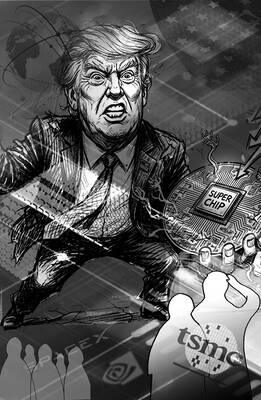
The White House’s decision to take a 9.9 percent stake in Intel Corp is looking like very shrewd business indeed. Since the government bought in at US$20.47 a share last August, the US chipmaker’s surging stock price has delivered the US a US$43 billion return. One of the reasons the investment has so far proved so sound is that the White House has made sure of it. According to The Wall Street Journal, Howard personally pushed deals on Intel’s behalf with some of the most lucrative clients imaginable. They include Nvidia Corp, the company at the heart of the AI
A single photograph can cut through a lot of noise, but it can also be used to misrepresent the truth. At the very least, it can concentrate the mind on something that requires further investigation. On Monday last week, Ma Ying-jeou Foundation CEO Tai Hsia-ling (戴遐齡) and former National Security Council secretary-general King Pu-tsung (金溥聰) held a news conference in which they showed a photograph of former foundation CEO Hsiao Hsu-tsen (蕭旭岑), now Chinese Nationalist Party (KMT) deputy chairman. In the image Hsiao is seated next to Xiamen Taiwan Businessmen Association chairman Han Ying-huan (韓螢煥). The two men were holding
I first met Professor Ray Jiing (井迎瑞) as a film and documentary student at Shih Hsin University’s (SHU) Department of Radio Television and Film in 1988. The following year, he went on to become the director of the Chinese Taipei Film Archive — forerunner of the Taiwan Film and Audiovisual Institute (TFAI). Over his eight-year tenure, Jiing rescued and restored over 200 classic Taiwanese films. In 1997, he established the Graduate Institute of Studies in Documentary and Film Archiving at Tainan National University of the Arts (TNNUA), and I joined the program in his third cohort of students. Beyond a
A recent report concerning a student who is suing his teacher posed the question in its headline: Does failing a student in two subjects constitute bullying? The college student in Chiayi County apparently sought NT$2 million (US$63,603) in state compensation, but a court dismissed the case. The first reaction of many might have been to ask: What has happened to students nowadays? Some say that teachers have lost their authority, while others say students are overindulged. Some even start reminiscing over the days when “whatever the teacher says goes.” However, the real issue might be overlooked if emotional reactions like that are the


 RSS
RSS