


Egypt's Kifaya Movement has upped the ante in its opposition to President Hosni Mubarak's regime by issuing a massive report that dares to name names and detail corruption among the country's leaders. Nothing in Egypt's long history has ever equaled this airing of the country's dirtiest laundry.
Kifaya's action is especially bold in the midst of a government crackdown to prepare the way for the succession of Mubarak's son, Gamal. For example, a recent law mandates punishment for anyone who spreads rumors that Gamal is to be the next president.
Corruption in Egypt, as in other Arab states, is extensive enough to undermine the possibility of economic advancement, higher living standards, a free media, independent courts and democracy. Egypt's political elite -- fearful of critical media coverage, defeat in fair elections and even imprisonment -- prefer the existing regime and oppose any significant reform.
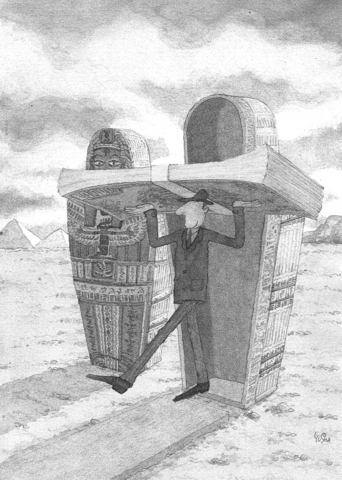
This is a key theme of the report, entitled Corruption in Egypt: A Black Cloud That Never Passes. As long as the system is corrupted from above, and as long as the only way common people can deal with the government is through bribery, says the report, inefficiency will reign and people will cheat each other. The only way to break this vicious circle is to replace the regime.
At the same time, as was seen in the late Yasser Arafat's Palestine Authority, a corrupt regime encourages people to turn to radical Islamists, who work hard to present themselves as honest. If the Muslim Brotherhood comes to power in Egypt one day, Kifaya's report will explain a lot about how it happened.
The report begins by joking that Egypt's name should be changed to "Fasadistan," which means the land of corruption. It documents cases relating to housing, business, health, transportation, trade, banks, drugs, agriculture, politics, culture and the media. One chapter covers how the security forces control appointments to all key jobs, including positions in schools and universities.
But the most dramatic part of the book concerns Mubarak himself. An anecdote in the report, which rings true, related Mubarak's meeting with officers of the Third Army two years ago. Some of the younger officers complained about corruption. Mubarak apparently surprised them by saying that he knew that many leading people in the country were thieves, but that he believed they had stolen enough to keep them happy.
He was afraid, he explained, that if he appointed new people, they would start over in their depredations, placing a much heavier burden upon Egypt.
According to the report, however, Mubarak, his wife, Susan, and his two sons, Gamal and Alaa, are far from being mere bystanders. When Mubarak became president in 1981, parliament granted him the right to control all military contracts without legislative oversight. In effect, the report states, he has a monopoly on military spending and imports, apparently a rich source of kickbacks each time he approves a deal.
Similarly, Susan Mubarak is the head of as many as 100 charities that often exist only on paper. The report charges that as much as US$5 million might go to one of these institutions in a year, but that a large portion is then siphoned off to her secret foreign bank accounts.
Ironically, Susan Mubarak, says the report, urged the passage of a 1992 law that permitted Egyptian non-governmental organizations (NGOs) to receive foreign funds -- a provision used by some opposition groups -- in order to provide channels for the NGOs she runs.
Gamal also has his own charities that provide him with money, claims Kifaya, including the famous al-Mustaqbal organization.
Mubarak's two sons are said by the report to have received profit-making partnerships -- without making any investment -- in a large number of companies, including Phillip Morris, Skoda Auto, Movenpick, Vodafone, McDonalds, and many others. They can also, it adds, obtain unsecured bank loans for themselves and their friends.
The report maintains that these funds are often used to participate in illegal financial transactions, arms dealing, and money laundering. The sons' interests allegedly also include forays into drug smuggling and illegal exports of archaeological treasures -- Egypt's cultural heritage -- in partnership with Culture Minister Faruq Husni, who is supposed to safeguard them. Anyone who stands in their way, according to the report, can be thrown into prison on false charges of drug dealing.
Other Cabinet ministers are no better, Kifaya claims. Youssef Boutros-Ghali, nephew of the former UN secretary-general, Interior Minister Habib Aladli and such powerful figures as Ibrahim Suleiman and Safwat Sharif are engaged in similar deals, sometimes in partnership with Mubarak's sons.
In short, the report says, officials can do what they like, unbound by law or transparency. By using the "emergency law," which has restricted freedom since 1981, together with censorship and rigged elections, Egypt's government treats its citizens like serfs.
Meanwhile, massive corruption is devastating Egypt's economy, with growth falling by half in the last two years, accompanied by rising unemployment, higher inflation and currency depreciation. Foreign investment is also declining, and local production is paralyzed, necessitating expensive imports. The discontent fueled by these failures is a major potential cause of unrest.
By issuing such a detailed report and daring to name Mubarak and his family as the prime culprits, Kifaya is challenging the regime head-on. The need for reform, it argues, is not based merely on a desire for better government or abstract rights, but is necessary to save a country that is being strangled. The regime may respond by trying to tighten the noose.
Barry Rubin is director of the GLORIA Center at Israel's Interdisciplinary University and editor of the Middle East Review of International Affairs.
Copyright: Project Syndicat
When I visited Taiwan last summer, I called on the nation to use its status as a technology superpower to build superweapons. It is obvious to me as I return a year later that Taiwan is now answering that call. By 2030, Taiwan envisions a domestic drone hub, capable of producing large quantities of drones per year. The nation continues to tighten cooperation across the private sector, scientific researchers and the elected government, on creating new and innovative production avenues for defense, while efforts to become central to the “democratic supply chain” are only increasing. Anduril is seeing all of these positive
Singaporean former Prime Minister and current senior minister Lee Hsien- Loong(李顯龍) last month stood on Chinese soil and told Beijing that Singapore cooperates because of “shared interests”, not because of common “ethnic descent,” a significant statement that has upended China’s cognitive warfare tactics of “ethnic nationalism.” Along with using its military buildup and economic growth to expand its international dominance, China has long deployed ethnic politics to promote the idea that all ethnic Chinese around the world, regardless of citizenship, share a tight bond with the Chinese motherland, by which it means the regime of the People’s Republic of China (PRC)
Chinese Nationalist Party (KMT) Chairwoman Cheng Li-wun (鄭麗文) in San Francisco on Tuesday last week said if she had not met with Chinese President Xi Jinping (習近平), she would have been “just a plain” and “even negligible” KMT chairperson, bluntly signaling the role she is playing in her visit to the US — Beijing’s messenger from Taiwan. Cheng and her delegation arrived in the US on Monday last week for a two-week visit across five major cities. Her party said the group is scheduled to meet with US lawmakers, officials, policy experts and businesspeople. Before departing, Cheng said her trip
In 1935, the German Reich led by the National Socialist Party officially created the Nuremberg Race Laws, a “legal cage”, for German Jews, stripping them of citizenship, criminalizing their personal relationships, barring them from public life, and transforming them into stateless subjects and isolating them from the rest of society. Similarly, in March 2026, the People’s Republic of China (PRC) National People’s Congress adopted the “Promoting Ethnic Unity and Progress” law, which represents the most significant shift in Chinese domestic governance since the era of Mao Zedong (毛澤東). Ostensibly designed as domestic legislation to manage China’s 56 officially recognized ethnic groups,


 RSS
RSS