


Long story short, an influential member of Congress played the China card, and the State Department folded.
It was a drama that reached its conclusion late last week, when the State Department, responding to fears that its security might be breached by a secretly placed device or hidden software, agreed to keep personal computers made by Lenovo of China off its networks that handle classified government messages and documents.
The damage to Lenovo is more to its reputation than to its pocketbook. The State Department will use the 16,000 desktop computers it purchased from Lenovo, just not on the computer networks that carry sensitive government intelligence.
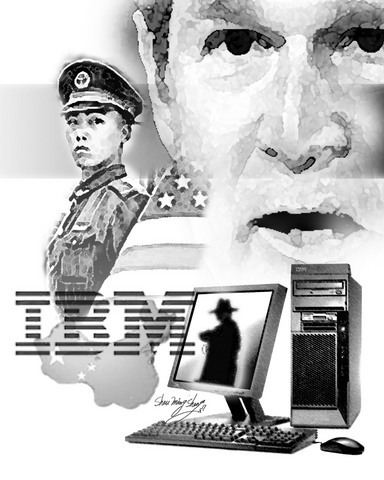
Yet the episode does point to how much relations between the US and China have become a tangled web of political, trade and security issues. Mutual economic dependence and mutual distrust, it seems, go hand in hand.
To the Lenovo side, the outcome was a matter of anti-China politics overriding economic logic.
Last year, the Chinese company completed the purchase of the personal computer business of IBM, after the administration of President George W. Bush concluded a national security review. Given the nod, Lenovo figured it was free to do business in the US just like any other personal computer company.
But the State Department decision suggests that it is not that simple. "Unfortunately, we're in a situation where certain people in Congress and elsewhere want to make a political issue of this," said Jeffrey Carlisle, vice president of government relations for Lenovo. "They are trying to create as uncomfortable an atmosphere as possible for us in doing business with the federal government."
Carlisle characterizes the worry that the Chinese government might secretly slip spying hardware or software on Lenovo computers shipped to the State Department as "a fantasy." The desktop machines, he said, will be made in Monterrey, Mexico, and Raleigh, N.C., at plants purchased from IBM.
"It's the same places, using the same processes as IBM had," Carlisle said. "Nothing's changed."
Representative Frank R. Wolf, however, said that the change of ownership changes a lot. In a letter to Secretary of State Condoleezza Rice earlier this month, he wrote that because of the Chinese government's "coordinated espionage program" intended to steal US secrets, the Lenovo computers "should not be used in the classified network."
Wolf is the chairman of the House subcommittee that oversees the budget appropriations for the State Department, Commerce Department and Justice Department.
bipartisan decision
In an interview on Monday, Wolf said the security concerns about the State Department's use of Lenovo computers had been brought to his attention by two members of the US-China Economic and Security Review Commission, a bipartisan group appointed by Congress.
"They deserve the credit for this," Wolf said.
Larry Wortzel, a member of the review commission and former military attache to the US embassy in Beijing, said he and another commission member, Michael Wessel, began looking into the sale in March. What most concerned them, he said, was that 900 of the Lenovo computers were intended for use on the State Department's classified networks.
Lenovo is partly owned by the Chinese government, which holds 27 percent. "This is a company owned and beholden to agencies of the People's Republic of China," Wortzel said. "Our assumption is that if the Chinese intelligence agencies could take action, they would take action."
After meetings with US government securities agencies, including classified briefings, Wortzel and Wessel concluded that it would be possible for the Chinese government to put clandestine hardware or software on personal computers that might be able to tap into US intelligence.
"This is not off the wall as to whether there are potential security concerns here," Wessel said.
Both Wortzel and Wessel insisted that theirs is not an anti-China stance or even anti-Lenovo.
"I'm sure they are very good computers," Wortzel said. "I would use them in my home. But I would not use one on a classified network at the State Department."
The State Department said last week that it would not use the Lenovo computers on its classified networks. In a letter to Wolf, Richard Griffin, assistant secretary of state for diplomatic security, said that the department had "consulted with US government security experts and is recommending that the computers purchased last fall be utilized on unclassified systems only."
routine testing
The letter added that the State Department was "initiating changes in its procurement processes in light of the changing ownership" of computer equipment suppliers.
A spokesman said that "to allay any possible fears and any possible concerns, this is where we came out."
Certainly, there are fears aplenty these days in any matter related to China. Carlisle of Lenovo insists any security fears about its computers are unfounded. The company's computers and the software loaded on them are routinely tested inside the company and, on the State Department sale, by third-party US contractors.
"If anything were detected, it would be a death warrant for the company," Carlisle said. "No one would ever buy another Lenovo PC. It would make no sense to do it."
Lenovo, industry analysts say, may well have the stronger argument, but it may still suffer.
"Basically, this is much ado about nothing," said Roger Kay, president of Endpoint Technologies Associates. "Unfortunately, perceptions count. And the damage has already been done."

A recent report concerning a student who is suing his teacher posed the question in its headline: Does failing a student in two subjects constitute bullying? The college student in Chiayi County apparently sought NT$2 million (US$63,603) in state compensation, but a court dismissed the case. The first reaction of many might have been to ask: What has happened to students nowadays? Some say that teachers have lost their authority, while others say students are overindulged. Some even start reminiscing over the days when “whatever the teacher says goes.” However, the real issue might be overlooked if emotional reactions like that are the
When I visited Taiwan last summer, I called on the nation to use its status as a technology superpower to build superweapons. It is obvious to me as I return a year later that Taiwan is now answering that call. By 2030, Taiwan envisions a domestic drone hub, capable of producing large quantities of drones per year. The nation continues to tighten cooperation across the private sector, scientific researchers and the elected government, on creating new and innovative production avenues for defense, while efforts to become central to the “democratic supply chain” are only increasing. Anduril is seeing all of these positive
Singaporean former Prime Minister and current senior minister Lee Hsien- Loong(李顯龍) last month stood on Chinese soil and told Beijing that Singapore cooperates because of “shared interests”, not because of common “ethnic descent,” a significant statement that has upended China’s cognitive warfare tactics of “ethnic nationalism.” Along with using its military buildup and economic growth to expand its international dominance, China has long deployed ethnic politics to promote the idea that all ethnic Chinese around the world, regardless of citizenship, share a tight bond with the Chinese motherland, by which it means the regime of the People’s Republic of China (PRC)
Taiwan’s economic momentum, driven by demand for artificial intelligence (AI) products, remains strong, with booming demand for advanced semiconductors, servers and key components. In the first quarter, GDP expanded 14.55 percent year-on-year, the second consecutive quarter of double-digit percentage growth and accelerating from the 12.95 percent expansion in the previous quarter, the Directorate-General of Budget, Accounting and Statistics (DGBAS) reported on Friday. Net exports remained the dominant driver of growth, contributing 10.33 percentage points to Taiwan’s GDP growth in the first quarter. That came as exports rose 35.76 percent year-on-year in the first quarter, outpacing 26.34 percent growth in imports, the


 RSS
RSS