


It is an anniversary that China wants to forget. May 16 marks 40 years since the start of the Cultural Revolution, one of the most insane episodes of the 20th century when children turned on parents, pupils tyrannized teachers and hundreds of thousands died in the name of class war.
The government will hold no commemoration. But for one survivor, at least, the lessons of those "10 years of chaos" must be heeded if China is to develop a modern law-governed society to match its economic progress.
Zhang Sizhi (
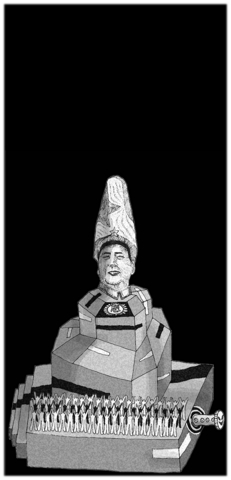
In only his second interview in the three decades since, Zhang told the Guardian newspaper that these experiences convinced him of the need for an independent legal system. Although President Hu Jintao (
"It is ridiculous that party cadres who have no legal qualification are taking the place of the courts in administering justice," said Zhang. "But in the current environment, it has become almost a rule of the game."
The official history of that period records the May 16 circular in which Mao called for a life-or-death struggle against bourgeois ideology, saying: "All erroneous ideas, all poisonous weeds, all ghosts and monsters, must be subjected to criticism."
Textbooks recognize this was a mistake that led to political chaos, economic instability and social unrest as Red Guards publicly humiliated, and sometimes killed, professors, doctors and other "counter-revolutionaries."
But questions about responsibility and compensation remain largely unanswered. Although Mao drafted the circular, most of the blame for what followed is usually heaped upon the "Gang of Four" led by Mao's wife, Jiang Qing (
At their televised trial, the Gang of Four were accused of persecuting 700,000 people and held directly responsible for 35,000 deaths. Most foreign scholarship puts the killings at between 300,000 and 800,000. In their biography of Mao, Jung Chang and Jon Halliday estimate the toll at 3 million.
The trial was billed as a resurrection of the rule of law, but it was anything but fair. Like the judge, Zhang was under orders about how to handle the case.
"The key point was not to mention Mao in the courtroom," he recalled. "It is still very sensitive to talk about Mao's mistakes."
His client had no such qualms. Jiang testified that she was "Mao's dog" who only bit on his orders. Such comments were censored from the televised highlights. The judge acknowledged Mao was partially responsible, but his comments were removed from the trial summary in the Chinese media. The four were convicted. Jiang killed herself in jail in 1991.
Zhang says political interference is still the legal system's biggest problem. In Beijing, the mayor or the secretary general of the Communist Party often give detailed orders to judges. In big trials it comes in the form of written guidance. But instructions are also made by phone or face-to-face, which means no one can be held accountable.
International human rights groups say China executes 4,000 to 10,000 people every year.
"Sometimes people are given the death penalty without serious consideration of their crimes," says Zhang, who favors reducing the number of crimes punishable by death.
Asked whether he had ever won a politically sensitive case in his 50 years as a defense lawyer, Zhang paused, then replied. "No, not one." But he had not given up. "The court's verdict is not the final result. History will be the judge."
Zhang keeps pushing for legal reform.
"Lawyers should be practical as well as idealistic, but everyone should do their best to increase the independence of the legal system. No one can stop the big international trend and that trend is democracy," he said.
This year he was among a group of retired senior cadres who wrote an open letter attacking the propaganda department and calling for an end to censorship. Part of their motivation is to avoid a repeat of the past.
"Relationships changed as a result of the Cultural Revolution. The moral level of our country declined. If you want to talk about mistakes made by Mao, this was one of them," said Zhang, before pausing again. "I am too frank. That is why I usually deny interviews."
Is it not better that such things are in the open?
"Yes, this should be talked about. But nowadays, it is not easy to tell the truth," he said.
That is not the only reason why he thinks there is never likely to be justice for victims of the Cultural Revolution.
"There are so many perpetrators it will never be possible to track them down. How can compensation be paid? So many bad things happened," he said.
The Cultural Revolution at a glance
● Mao Zedong launched the Cultural Revolution in 1966 by calling for a life-or-death struggle against bourgeois ideology. It allowed him to reassert authority over rivals who criticized his handling of the economy.
● Student Red Guards, who worshipped Mao, led the persecution of "class enemies." They were urged on by the ultra-leftist "Gang of Four."
● Thousands died in battles between political factions or killed themselves after public humiliations. The best known victim was Lin Biao (林彪), the head of the army, who died in a plane crash after an attempted coup in 1971.
● Ancient treasures and temples were destroyed after Mao called for the eradication of feudal values. The turmoil ended with his death in 1976.
Recently, China launched another diplomatic offensive against Taiwan, improperly linking its “one China principle” with UN General Assembly Resolution 2758 to constrain Taiwan’s diplomatic space. After Taiwan’s presidential election on Jan. 13, China persuaded Nauru to sever diplomatic ties with Taiwan. Nauru cited Resolution 2758 in its declaration of the diplomatic break. Subsequently, during the WHO Executive Board meeting that month, Beijing rallied countries including Venezuela, Zimbabwe, Belarus, Egypt, Nicaragua, Sri Lanka, Laos, Russia, Syria and Pakistan to reiterate the “one China principle” in their statements, and assert that “Resolution 2758 has settled the status of Taiwan” to hinder Taiwan’s
Singaporean Prime Minister Lee Hsien Loong’s (李顯龍) decision to step down after 19 years and hand power to his deputy, Lawrence Wong (黃循財), on May 15 was expected — though, perhaps, not so soon. Most political analysts had been eyeing an end-of-year handover, to ensure more time for Wong to study and shadow the role, ahead of general elections that must be called by November next year. Wong — who is currently both deputy prime minister and minister of finance — would need a combination of fresh ideas, wisdom and experience as he writes the nation’s next chapter. The world that
Can US dialogue and cooperation with the communist dictatorship in Beijing help avert a Taiwan Strait crisis? Or is US President Joe Biden playing into Chinese President Xi Jinping’s (習近平) hands? With America preoccupied with the wars in Europe and the Middle East, Biden is seeking better relations with Xi’s regime. The goal is to responsibly manage US-China competition and prevent unintended conflict, thereby hoping to create greater space for the two countries to work together in areas where their interests align. The existing wars have already stretched US military resources thin, and the last thing Biden wants is yet another war.
As Maldivian President Mohamed Muizzu’s party won by a landslide in Sunday’s parliamentary election, it is a good time to take another look at recent developments in the Maldivian foreign policy. While Muizzu has been promoting his “Maldives First” policy, the agenda seems to have lost sight of a number of factors. Contemporary Maldivian policy serves as a stark illustration of how a blend of missteps in public posturing, populist agendas and inattentive leadership can lead to diplomatic setbacks and damage a country’s long-term foreign policy priorities. Over the past few months, Maldivian foreign policy has entangled itself in playing


 RSS
RSS