


US President George W. Bush's controversial appointment of John Bolton, a reputedly abrasive Republican hawk, as US ambassador to the UN sits uneasily alongside the mission statement proclaimed only last week by Karen Hughes, America's new image maker-in-chief.
"There is no more important challenge for our future than the urgent need to foster greater understanding, more respect, and a sense of common interests and ideals among Americans and people of different countries, cultures and faiths," Hughes told the Senate.
She admitted her job as under-secretary of state for public diplomacy would be difficult. But she said the US' aim was to reach out to other countries rather than confront them.
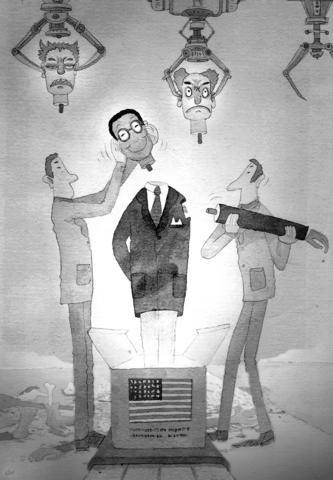
ILLUSTRATION: YU SHA
"The mission of public diplomacy is to engage, inform and help others understand our policies. I am mindful that before we seek to be understood, we must first work to understand ... But I am confident our ideals will prevail," she said.
Unlike Bolton, Hughes' nomination was unanimously approved. But it likewise surprised some in Washington. She is a White House insider with scant foreign experience. At a time of unprecedented anti-American feeling, her task would daunt the most seasoned diplomat. But she has two advantages over her predecessors.
Improving overseas perceptions of the US and its policies has become a top second-term priority for the administration. And Hughes has a degree of influence and access to Bush to make even her boss, Secretary of State Condoleezza Rice, envious.
Hughes worked as Bush's press secretary when he ran for the Texas governorship in 1994. By all accounts, the two developed a fierce mutual loyalty.
As a White House counsellor from 2001, she was variously described as Bush's consigliere, minder and "human firewall". Her forthright manner also earned her the nickname of Nurse Ratched after the bossy supervisor of a mental ward in the 1975 film, One Flew Over the Cuckoo's Nest.
The Washington Post columnist Anne Applebaum noted caustically that the US' biggest public relations challenge was not especially amenable to alliterative soundbites about "engagement, education and empowerment."
"What we call the `war on terror' is in fact a small part of a larger intellectual and religious struggle within Islam," she said.
"Friendly state visits by Laura Bush will not suffice ... Neither will more Britney Spears songs for Muslim teenagers on US-funded Farsi and Arabic radio," she said.
Hughes certainly needs some new post-Iraq tunes, as this year's Pew Global attitudes survey of 16 countries suggested.
"The United States remains broadly disliked in most countries surveyed, and the opinion of the American people is not as positive as it once was," Pew found. "The magnitude of America's image problem is such that even popular US policies [such as tsunami relief] have done little to repair it. Attitudes toward the US remain quite negative in the Muslim world, though hostility towards America has eased."
Yet, contrary to what the Bolton affair suggests, there is more to Hughes' appointment than touching up the paintwork on the Bush bandwagon. The US knows it has a problem -- and is moving tentatively to tackle it.
The administration's decision to drop the phrase "global war on terror" in favor of "global struggle against violent extremism" appears part of a wider effort to de-emphasize military solutions and to recruit European allies to help attract moderate Muslim opinion.
Rice's "practical idealism" in foreign policy is said to be gaining ground over the neo-conservative ideologues of Secretary of Defense Donald Rumsfeld's Pentagon. The refashioned White House emphasis is on promoting democracy, about which most can agree, rather than unilaterally bashing "rogue regimes."
The bottom line is whether Bush accepts that policies as well as presentation will have to change if the US' image is to be rehabilitated.
A gap appears to be emerging between Washington’s foreign policy elites and the broader American public on how the United States should respond to China’s rise. From my vantage working at a think tank in Washington, DC, and through regular travel around the United States, I increasingly experience two distinct discussions. This divergence — between America’s elite hawkishness and public caution — may become one of the least appreciated and most consequential external factors influencing Taiwan’s security environment in the years ahead. Within the American policy community, the dominant view of China has grown unmistakably tough. Many members of Congress, as
The Hong Kong government on Monday gazetted sweeping amendments to the implementation rules of Article 43 of its National Security Law. There was no legislative debate, no public consultation and no transition period. By the time the ink dried on the gazette, the new powers were already in force. This move effectively bypassed Hong Kong’s Legislative Council. The rules were enacted by the Hong Kong chief executive, in conjunction with the Committee for Safeguarding National Security — a body shielded from judicial review and accountable only to Beijing. What is presented as “procedural refinement” is, in substance, a shift away from
The shifting geopolitical tectonic plates of this year have placed Beijing in a profound strategic dilemma. As Chinese President Xi Jinping (習近平) prepares for a high-stakes summit with US President Donald Trump, the traditional power dynamics of the China-Japan-US triangle have been destabilized by the diplomatic success of Japanese Prime Minister Sanae Takaichi in Washington. For the Chinese leadership, the anxiety is two-fold: There is a visceral fear of being encircled by a hardened security alliance, and a secondary risk of being left in a vulnerable position by a transactional deal between Washington and Tokyo that might inadvertently empower Japan
After declaring Iran’s military “gone,” US President Donald Trump appealed to the UK, France, Japan and South Korea — as well as China, Iran’s strategic partner — to send minesweepers and naval forces to reopen the Strait of Hormuz. When allies balked, the request turned into a warning: NATO would face “a very bad” future if it refused. The prevailing wisdom is that Trump faces a credibility problem: having spent years insulting allies, he finds they would not rally when he needs them. That is true, but superficial, as though a structural collapse could be caused by wounded feelings. Something


 RSS
RSS