


Drug companies want us to believe that soaring prices for prescription drugs are necessary to cover their research and development (R&D) costs -- a claim that implies that they spend most of their money on R&D, and that after they pay for it, they have only modest profits left over.
Curtailing prices, they say, would choke off R&D and stifle innovation. But the real story is very different.
Big drug companies actually spend relatively little on R&D -- far less than they spend on marketing and administration, and even less than what they have left over in profits. In 2002, for example, the top 10 US drug companies had sales of US$217 billion.
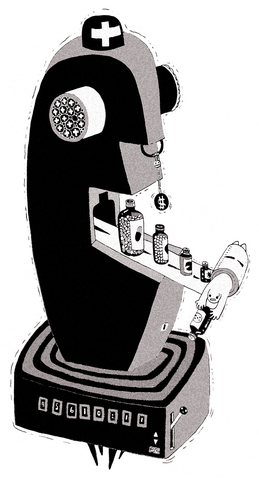
ILLUSTRATION: MOUNTAIN PEOPLE
According to their own figures, they spent 14 percent of sales revenues on R&D. But they spent over twice as much, a whopping 31 percent, on marketing and administration. And they had 17 percent left over as profits.
Most drug companies lump marketing and administration together in their annual reports, but one reported that 85 percent of the total went to marketing. Assuming that the figure is roughly the same for the other big companies -- and there's reason to think that it is -- then they spent nearly twice as much on marketing alone as they did on R&D.
In its public pronouncements, the industry denies this by counting just four specific activities as marketing -- sales visits to doctors, the value of free samples, direct-to-consumer advertisements and advertisements in medical journals. But, in fact, marketing budgets cover a lot more than this, most importantly the "education" of doctors -- ?which teaches them to prescribe more drugs.
And what about profits? For many years, drug companies in the US have had higher profits than any other industry -- after they've paid for R&D and all their other expenses. Compare the 17 percent profit margin for the top 10 US drug companies in 2002 with the median of only 3.1 percent for all of America's "Fortune 500" industries that year. In 2003, for the first time, the industry fell slightly from first place to third in terms of profitability, but its profits were still well above the median.
The recent claim that drug companies spend on average US$802 million to bring each new drug to market is based on secret, proprietary data and is wildly inflated.
But, whatever they spend on R&D, if drug companies spend more on marketing and have more left over as profits, they can hardly claim that high prices are necessary to cover their R&D. Instead, high prices are necessary to cover their stupendous marketing expenditures and maintain their enormous profits. There is now some pushback on prices, but drug companies are compensating by convincing more people to take more drugs for dubious or exaggerated ailments, thereby increasing volume.
The important issue is not how much drug companies spend on R&D, but whether we consumers get our money's worth. Remarkable as it seems, only a small fraction of drugs are innovative in any meaningful sense of the word.
In the six years from 1998 to 2003, of the 487 drugs that entered the market, fully 78 percent were classified by the US Food and Drug Administration as likely to be no better than drugs already on the market. Moreover, 68 percent were not even new chemical compounds, but just old drugs in new forms or combinations.
In other words, the major output of the industry is not important new drugs, but minor variations of drugs that are already on the market -- called copycat or "me-too" drugs. For example, the top-selling drug in the world, Pfizer's Lipitor, is the fourth of six cholesterol-lowering drugs of the same type. There are now whole families of me-too drugs, and little reason to think one is better than another at comparable doses.
Far from being a model of free enterprise, the pharmaceutical industry is utterly dependent on government-funded research and government-granted monopolies in the form of patents and exclusive marketing rights. The few innovative drugs usually stem from publicly funded research done at government or university labs. Even among related me-too drugs, the original is usually based on government-sponsored work.
For example, the first of the Lipitor-type drugs, Mevacor, came on the market in 1987 and was based largely on university research. Most of today's top-selling drugs have progenitors that date back to the 1980s or even earlier.
The bottom line is that, despite industry rhetoric, drug companies are growing less and less innovative. They're just re-jiggering the same old drugs, getting new patents and exclusivity, and relying on their marketing muscle to convince doctors and patients that they're producing medical miracles.
Every advanced country regulates prescription drug prices in some way. Even in the US, Medicare regulates doctors' fees and hospital payments. So we need not worry about stifling innovative R&D. Drug companies do much less of it than they claim, and what they do they can easily afford.
Marcia Angell, is senior lecturer in social medicine at Harvard Medical School and author of The Truth About the Drug Companies: How They Deceive Us and What to Do About It.
Copyright: Project Syndicate
Recently, China launched another diplomatic offensive against Taiwan, improperly linking its “one China principle” with UN General Assembly Resolution 2758 to constrain Taiwan’s diplomatic space. After Taiwan’s presidential election on Jan. 13, China persuaded Nauru to sever diplomatic ties with Taiwan. Nauru cited Resolution 2758 in its declaration of the diplomatic break. Subsequently, during the WHO Executive Board meeting that month, Beijing rallied countries including Venezuela, Zimbabwe, Belarus, Egypt, Nicaragua, Sri Lanka, Laos, Russia, Syria and Pakistan to reiterate the “one China principle” in their statements, and assert that “Resolution 2758 has settled the status of Taiwan” to hinder Taiwan’s
Can US dialogue and cooperation with the communist dictatorship in Beijing help avert a Taiwan Strait crisis? Or is US President Joe Biden playing into Chinese President Xi Jinping’s (習近平) hands? With America preoccupied with the wars in Europe and the Middle East, Biden is seeking better relations with Xi’s regime. The goal is to responsibly manage US-China competition and prevent unintended conflict, thereby hoping to create greater space for the two countries to work together in areas where their interests align. The existing wars have already stretched US military resources thin, and the last thing Biden wants is yet another war.
As Maldivian President Mohamed Muizzu’s party won by a landslide in Sunday’s parliamentary election, it is a good time to take another look at recent developments in the Maldivian foreign policy. While Muizzu has been promoting his “Maldives First” policy, the agenda seems to have lost sight of a number of factors. Contemporary Maldivian policy serves as a stark illustration of how a blend of missteps in public posturing, populist agendas and inattentive leadership can lead to diplomatic setbacks and damage a country’s long-term foreign policy priorities. Over the past few months, Maldivian foreign policy has entangled itself in playing
A group of Chinese Nationalist Party (KMT) lawmakers led by the party’s legislative caucus whip Fu Kun-chi (?) are to visit Beijing for four days this week, but some have questioned the timing and purpose of the visit, which demonstrates the KMT caucus’ increasing arrogance. Fu on Wednesday last week confirmed that following an invitation by Beijing, he would lead a group of lawmakers to China from Thursday to Sunday to discuss tourism and agricultural exports, but he refused to say whether they would meet with Chinese officials. That the visit is taking place during the legislative session and in the aftermath


 RSS
RSS